Neal Ascherson

Neal Ascherson was for many years a foreign correspondent for the Observer, based in Bonn, and has written several books on Central and Eastern Europe, including Black Sea and The Struggles for Poland. He is also the author of Stone Voices: The Search for Scotland and a novel, The Death of the Fronsac. He has written more than a hundred pieces for the LRB, starting early in 1980 with an account of being in a taxi queue with the spy Anthony Blunt, ‘fervently cheerful’ now his secret had been revealed.

Volker Ullrich shows that Hitler did in fact have a private life, although a pretty boring one, and did have friends, most of them married couples where the wife would mother Adolf, feed him cream cakes and be rewarded with displays of ‘Austrian charm’.
At the British Museum: Celts

Neal Ascherson, 22 October 2015

‘Splendid​ specimens of the untrousered, strong-legged Celt’. That was what John Stuart Blackie, the founder of Scotland’s first chair of Celtic studies in 1882, liked to see about him in the Highlands. In Celts: Art and Identity (at the British Museum until 31 January, then at the National Museum of Scotland from 30 March until 25 September) he would have met several...

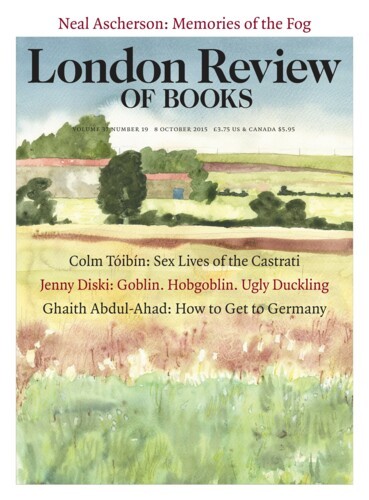
Brown Goo like Marmite: Memories of the Fog

Neal Ascherson, 8 October 2015

The little pub​ is still there, the Myddleton Arms, and in front of it the zebra crossing on the Canonbury Road. I came out of the pub that evening in early December 1962, and stopped as the door closed behind me. There was no crossing, no beacon pole. I could make out the paving slabs gleaming wetly under my feet, but not the kerb. With a painful jolt, I stumbled into the roadway. Shuffling...

Remarque apparently knew that The Promised Land would be his last novel, and meant it to be one of his finest, perhaps his masterwork – even in comparison to All Quiet on the Western Front. But he died in 1970, leaving it unfinished: a massive stub. Michael Hofmann, his translator, recalls some other unfinished fictions. But this is not The Mystery of Edwin Drood or The Man without Qualities. Those two books lack their ends, but what remains doesn’t feel raw or rough; they simply break off. The Promised Land in contrast feels unpruned.

Karl Miller Remembered

Neal Ascherson, John Lanchester and Andrew O’Hagan, 23 October 2014

People​ said things about Karl, but not often to his face. He might like the things or he might not, and that did not always depend on whether they were intended as compliments or the opposite. Personal remarks could be returned with interest, hot or cold. Whichever way, he remembered them with accuracy.

I can think of two personal remarks about Karl, in his early years, which reached him and...

‘The subtlest​ of insults to Scotland is, it seems, to return to it,’ Neal Ascherson wrote in the Scottish political review Q in 1975. The historian Christopher Harvie described the...

Read more reviews

Coleridge’s​ favourite novelist, John Galt, had a gift for encapsulating disgrace under pressure, and his novels of small-town Scottish life are among the early masterpieces of British...

Read more reviews

Beast of a Nation: Scotland’s Self-Pity

Andrew O’Hagan, 31 October 2002

In Westminster Abbey a couple of years ago, I stood for over an hour talking to Neal Ascherson. It was one of those freezing January evenings – cold stone, long shadows – and we...

Read more reviews

Littoral

Misha Glenny, 9 May 1996

In the late Twenties, the paternal grandfather of Dimitri, a close friend of mine from Thessaloniki, decided to leave Novorossisk, the Russian Black Sea port. The Soviet Government had ended the...

Read more reviews

Intelligencer

Sylvia Lawson, 24 November 1988

The book’s title mocks the author’s own position. It comes from a newspaper column of 1985 in which he attacked what he saw as ‘the retreat from politics’ into nihilistic...

Read more reviews

The Rat Line

Christopher Driver, 6 December 1984

By chance, the evening I took this book to bed for the painful reading expected, I jabbed the tooth of a comb down a fingernail and cried out. As a reminder of what Klaus Barbie was about, not...

Read more reviews

Liking Walesa

Tim Sebastian, 15 July 1982

For nearly eighteen months Lech Walesa walked on quicksand, buoyant and for all the world supremely confident. In the summer of 1981 I asked him whether he was worried about the Soviet tanks...

Read more reviews

Poland’s Special Way

Keith Middlemas, 4 February 1982

In the six months since Neal Ascherson’s intricate but lucid account of the rise of Solidarity was finished, Poland’s affairs have become the latest world-heroic saga. While the...

Read more reviews

Read anywhere with the London Review of Books app, available now from the App Store for Apple devices, Google Play for Android devices and Amazon for your Kindle Fire.

Sign up to our newsletter

For highlights from the latest issue, our archive and the blog, as well as news, events and exclusive promotions.

Newsletter Preferences