Neal Ascherson

Neal Ascherson was for many years a foreign correspondent for the Observer, based in Bonn, and has written several books on Central and Eastern Europe, including Black Sea and The Struggles for Poland. He is also the author of Stone Voices: The Search for Scotland and a novel, The Death of the Fronsac. He has written more than a hundred pieces for the LRB, starting early in 1980 with an account of being in a taxi queue with the spy Anthony Blunt, ‘fervently cheerful’ now his secret had been revealed.

Rumba, Conga, Communism

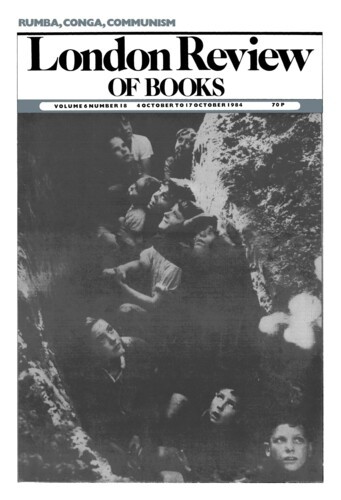
Neal Ascherson, 4 October 1984

‘Culture brings Freedom,’ José Marti once vaguely proclaimed. The attempt to make sense of this slogan during the Cuban revolution cost both these outstanding men – Franqui and Infante – their country. One of Fidel Castro’s closest comrades in the war against Batista, Carlos Franqui, came down with him from the Sierra as the bearded men took power; for the first five years after 1959 he was, more than any other single person, associated with the explosion of ‘revolutionary culture’ which amazed and moved Europe and the rebellious young of the Americas. He was the editor of the independent daily paper Revolucion, while Cabrera Infante, already famous as a journalist and novelist, ran the paper’s Monday cultural supplement, Lunes.’
Last Leader

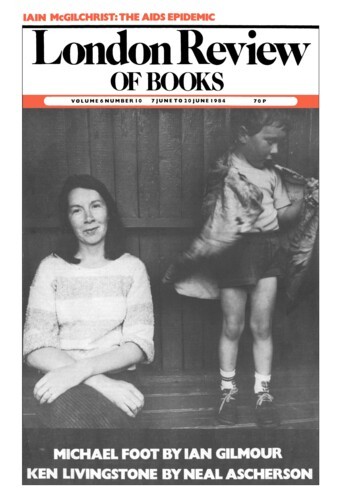
Neal Ascherson, 7 June 1984

After crossing the river, the little band of Palaeolithic hunters huddled together shivering on the far bank. They were cold and wet, but they still had their flint-tipped spears. Men and women together, side by side collected dry brushwood at the top of the sandy shore and tried to start a fire. Here at least the ground was firm, unlike the flat swamps of the south bank, and in the distance ahead they could see a line of northern heights, shaggy with forest. There should be deer there, perhaps a mammoth. The fire took hold and warmed them. Soon the group was spreading out and – without regard to colour, sexual preference, age, size or creed – beginning to gather the nuts, berries and tubers and to share them democratically, once more in balance with the environment and with one another. And as the evening shadows lengthened, the first members of the species Homo Erectus to arrive in London fell to their normal diversions, or ‘what we would consider a life of idle luxury – music, dancing, relating to each other, the constant flow of conversation’.–

Dance of the Vampires

Neal Ascherson, 19 January 1984

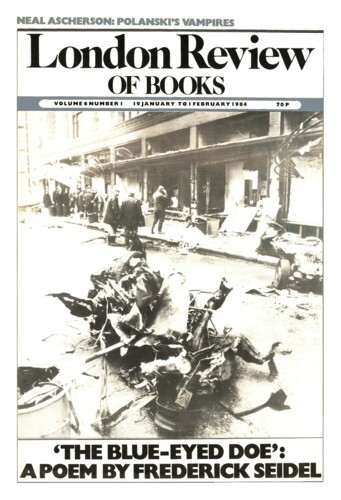
‘I am widely regarded, I know, as an evil, profligate dwarf.’ So declares Roman Polanski, moodily kicking his souvenirs about on the last page of this autobiography. Of all the films he never made, the most revealing might have been the project he cooked up years ago in Paris for a sexually-explicit Snow White, with a mongoloid news vendor from St Germain-des-Prés as Prince Charming, a homosexual yodelling choir as musical accompaniment and a troupe of midget wrestlers to play the Seven Dwarves. The treatment was put together by him and his friend Gérard Brach, equally underset and insatiable. The financier Pierre Braunberger, who failed to see that he was billed as the real Prince Charming in this revolting allegory, was happy with everything except the midgets, who proved too expensive. On their account, he withdrew his money and the film collapsed before a frame had been shot. He may have saved his family from the poorhouse by doing so, for Polanski, like the seven hammerlocking dwarfs, was a spectacular overspender.

Cross Words

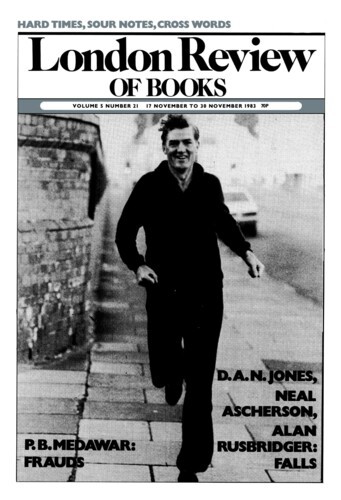
Neal Ascherson, 17 November 1983

Rupert Murdoch’s decision to take on the Times was

Cushy Numbers

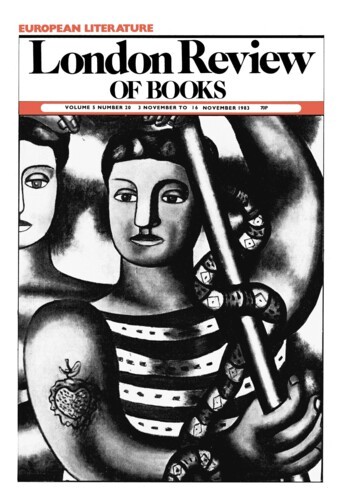
Neal Ascherson, 3 November 1983

‘The fascination exercised by the study of collaborationism on the historian (especially the Anglo-Saxon one) can be attributed partly to unfamiliarity with something outside the national experience, but, perhaps even more, to the sheer range of mutual personal situations involved.’ Even now, that Anglo-Saxon unfamiliarity remains immense. It seems, at least to me, that all the books and – especially – films of recent years about the German occupation of France, and about French behaviour during that period, have still taught the British little. All that has taken place is a retreat from our naive belief in an almost universal support for the Resistance, associated with righteous horror at the ‘handful’ of Collaborators (even though shaving girls’ heads was ‘going a bit far’), to the idea that the Resistance was a Communist fraud backed from London by leftist elements in SOE, operating in a France where Pétain was thoroughly popular even for assisting the Germans in the extermination of the French Jews.–

‘T he subtlest​ of insults to Scotland is, it seems, to return to it,’ Neal Ascherson wrote in the Scottish political review Q in 1975. The historian Christopher Harvie described...

Read more reviews

C oleridge’s​ favourite novelist, John Galt, had a gift for encapsulating disgrace under pressure, and his novels of small-town Scottish life are among the early masterpieces of British...

Read more reviews

Beast of a Nation: Scotland’s Self-Pity

Andrew O’Hagan, 31 October 2002

In Westminster Abbey a couple of years ago, I stood for over an hour talking to Neal Ascherson. It was one of those freezing January evenings – cold stone, long shadows – and we...

Read more reviews

Littoral

Misha Glenny, 9 May 1996

In the late Twenties, the paternal grandfather of Dimitri, a close friend of mine from Thessaloniki, decided to leave Novorossisk, the Russian Black Sea port. The Soviet Government had ended the...

Read more reviews

Intelligencer

Sylvia Lawson, 24 November 1988

The book’s title mocks the author’s own position. It comes from a newspaper column of 1985 in which he attacked what he saw as ‘the retreat from politics’ into nihilistic...

Read more reviews

The Rat Line

Christopher Driver, 6 December 1984

By chance, the evening I took this book to bed for the painful reading expected, I jabbed the tooth of a comb down a fingernail and cried out. As a reminder of what Klaus Barbie was about, not...

Read more reviews

Liking Walesa

Tim Sebastian, 15 July 1982

For nearly eighteen months Lech Walesa walked on quicksand, buoyant and for all the world supremely confident. In the summer of 1981 I asked him whether he was worried about the Soviet tanks...

Read more reviews

Poland’s Special Way

Keith Middlemas, 4 February 1982

In the six months since Neal Ascherson’s intricate but lucid account of the rise of Solidarity was finished, Poland’s affairs have become the latest world-heroic saga. While the...

Read more reviews

Read anywhere with the London Review of Books app, available now from the App Store for Apple devices, Google Play for Android devices and Amazon for your Kindle Fire.

Sign up to our newsletters

For highlights from the latest issue, our archive and the blog, as well as news, events and exclusive promotions.

Newsletter Preferences