Neal Ascherson

Neal Ascherson was for many years a foreign correspondent for the Observer, based in Bonn, and has written several books on Central and Eastern Europe, including Black Sea and The Struggles for Poland. He is also the author of Stone Voices: The Search for Scotland and a novel, The Death of the Fronsac. He has written more than a hundred pieces for the LRB, starting early in 1980 with an account of being in a taxi queue with the spy Anthony Blunt, ‘fervently cheerful’ now his secret had been revealed.

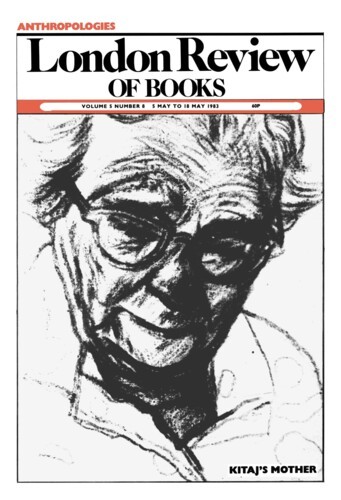
Diary: On A.J.P. Taylor

Neal Ascherson, 2 June 1983

Men everywhere supposed (as A.J.P. Taylor tends to begin sentences) that he would join in the general execration of Lord Dacre over the Hitler diaries. A lot of men, indeed, were looking forward to this: historians wrestling in mud is a common spectacle that never loses its power to give pleasure – like dissent between taxi-drivers. They were disappointed. Taylor stayed out of the mud. More accurately, he wrote in these pages that he found the whole affair boring – ‘cold mutton’, as he said about the Anthony Blunt affair. Perhaps he did. Historians are queer. Still, boredom is ruder than execration. I have nearly finished imitating A.J.P. Taylor’s rhythms now. Let me add this. I once wrote a whole book in what I conceived to be his style – short, choppy sentences bouncing the reader rapidly up and down so that he does not fall asleep. The book received a kind notice from Taylor, and sold almost no copies at all. Men thought it too expensive. I only paid the indexing bill years later. This was not because I was cross or indigent, but because I was mean.–
Believing in gringos

Neal Ascherson, 19 May 1983

‘The fire that is burning in our own front yard’. Three days after President Reagan used those words to describe events in Central America, as he addressed the joint Houses of Congress, the Polish police were out again on the streets of Warsaw and Gdansk and the crowds were fleeing from the teargas and the batons. Back yards have become front yards these days. The change in wording isn’t insignificant. In a back yard, something can be expected to be smouldering at most times. It smells nasty, but poses no threat: this is where the householder is allowed to do his own destroying. But in a front yard (not an altogether easy feature to imagine, unless you think of living in a stable), any fire can only have been lit by somebody else with hostile intent. In fact, any yard in which a dangerous fire is burning, capable of setting light to the house, automatically becomes a front yard. This both Russians and Americans seem to agree upon. They also concur that the fireman’s job is a dirty one, best left to friends and allies, although their own tanks or marines may have to be used in the last resort. But the techniques approved for firefighting differ a little. The Russians, in their thrifty way, appreciate friends who know how to use the truncheon, the censor’s scissors and the psychiatric ward. The Americans believe in denying flames oxygen by piling money on them, and they hand their friends sacks of currency with appropriate instructions.

Hard Men

Neal Ascherson, 5 May 1983

‘This book is written in anger,’ the author begins. ‘Anger at previous attempts to portray the British soldier. Anger at the violence and the hatred that became part of a way of life. Anger at the misrepresentation of the facts …’

Going Straight

Neal Ascherson, 17 March 1983

It is certainly time for a long silence. The long clamour about those who have come so strangely to be called ‘the Cambridge spies’, revelations malevolent, piteous or merely inaccurate, ought to be wound up after the publication of Michael Straight’s contribution. Very possibly, Anthony Blunt will one day write such a book himself. But the names have almost all been named, the questions of motive worn smooth, the titles and pensions (some of them) stripped like epaulettes, the spell in the pillory served. Let’s get the blanket over this parrot and enjoy a spell of peace.

By San Carlos Water

Neal Ascherson, 18 November 1982

When they heard that Britain was sending troops to recover the Falklands, many in this country were inclined to laugh. Some farcical anti-climax was expected – Anguilla on a wider stage, with penguins. Events which soon followed, ending with Mrs Thatcher taking the salute at a victory parade, have made it hard to remember why it all at first seemed so comic. But the early incredulity...

‘T he subtlest​ of insults to Scotland is, it seems, to return to it,’ Neal Ascherson wrote in the Scottish political review Q in 1975. The historian Christopher Harvie described...

Read more reviews

C oleridge’s​ favourite novelist, John Galt, had a gift for encapsulating disgrace under pressure, and his novels of small-town Scottish life are among the early masterpieces of British...

Read more reviews

Beast of a Nation: Scotland’s Self-Pity

Andrew O’Hagan, 31 October 2002

In Westminster Abbey a couple of years ago, I stood for over an hour talking to Neal Ascherson. It was one of those freezing January evenings – cold stone, long shadows – and we...

Read more reviews

Littoral

Misha Glenny, 9 May 1996

In the late Twenties, the paternal grandfather of Dimitri, a close friend of mine from Thessaloniki, decided to leave Novorossisk, the Russian Black Sea port. The Soviet Government had ended the...

Read more reviews

Intelligencer

Sylvia Lawson, 24 November 1988

The book’s title mocks the author’s own position. It comes from a newspaper column of 1985 in which he attacked what he saw as ‘the retreat from politics’ into nihilistic...

Read more reviews

The Rat Line

Christopher Driver, 6 December 1984

By chance, the evening I took this book to bed for the painful reading expected, I jabbed the tooth of a comb down a fingernail and cried out. As a reminder of what Klaus Barbie was about, not...

Read more reviews

Liking Walesa

Tim Sebastian, 15 July 1982

For nearly eighteen months Lech Walesa walked on quicksand, buoyant and for all the world supremely confident. In the summer of 1981 I asked him whether he was worried about the Soviet tanks...

Read more reviews

Poland’s Special Way

Keith Middlemas, 4 February 1982

In the six months since Neal Ascherson’s intricate but lucid account of the rise of Solidarity was finished, Poland’s affairs have become the latest world-heroic saga. While the...

Read more reviews

Read anywhere with the London Review of Books app, available now from the App Store for Apple devices, Google Play for Android devices and Amazon for your Kindle Fire.

Sign up to our newsletters

For highlights from the latest issue, our archive and the blog, as well as news, events and exclusive promotions.

Newsletter Preferences