Neal Ascherson

Neal Ascherson was for many years a foreign correspondent for the Observer, based in Bonn, and has written several books on Central and Eastern Europe, including Black Sea and The Struggles for Poland. He is also the author of Stone Voices: The Search for Scotland and a novel, The Death of the Fronsac. He has written more than a hundred pieces for the LRB, starting early in 1980 with an account of being in a taxi queue with the spy Anthony Blunt, ‘fervently cheerful’ now his secret had been revealed.

Who would have thought it?

Neal Ascherson, 8 March 1990

This book went to press in the previous decade, in a different geological period of European history, in the almost forgotten circumstances of the late spring of 1989. When it was first sent to me, I read several sections but then put it on one side. Some obscure motive, which might have been prudence, warned me that the autumn of 1989 might not be the right moment to review a book about Eastern Europe. Now, not yet twelve months since the last of these essays was written, it becomes fascinating to read through The Uses of Adversity from cover to cover, and to measure it against the new Europe which is becoming visible beneath the torrents of change.
Nairn is best

Neal Ascherson, 21 May 1987

Some sixty years ago, when David Thomson was a boy, he suffered from a condition that badly affected his eyesight. He could see, but poorly. He read Braille and, though this was forbidden, the printed page. On two occasions, when the condition grew worse, he was condemned to spend six weeks at a time lying on his back in a darkened room. In general, all heavy physical exertion was banned. His mother sent him away from London to live with her family at Nairn, in north-eastern Scotland, on the shore of the Moray Firth. The years that he passed there built the emotional and imaginative foundations of his life.

Citizen Grass and the World’s End

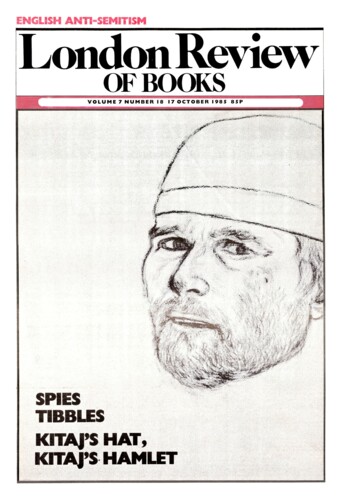
Neal Ascherson, 17 October 1985

‘In the early Sixties,’ said Grass – he was talking to an audience of Greek intellectuals in Athens, during the dictatorship of the Colonels – ‘I started doing day-to-day political work. The presumptuous élitist notion that writers are the conscience of the nation and should rise above the practical realities of politics has always gone against my grain.’’

Newspapers of the Consensus

Neal Ascherson, 21 February 1985

Readers who had encountered its first volume would have known that Stephen Koss’s work on the British political press was monumental. Now it has become his monument in another, brutally unexpected sense, for Stephen Koss died suddenly soon after the completion of the second volume. The outrage felt by everyone who had known or read him had something to do with his youth, but more to do with the cutting-off of his gifts. These included an almost superhuman capacity for tracking, retrieving, devouring and assimilating information in less time and from more sources than was previously thought possible. Koss was the archive-cruncher of his age. But he had another gift, which was to make the imparting of densely-packed information stylish, readable, often mockingly witty. Because of this, Koss is always present in his own work, an energetic, high-spirited, sceptical presence who gives off pulses of his own enjoyment. The old cliché about authors living on in their books is freshened up here: Koss bounces about this second volume like a cowboy, suddenly coming into view to crack a whip or wave a hat or whoop whenever the slow-moving herd of facts threatens to come to a halt.

Boswell’s Bowels

Neal Ascherson, 20 December 1984

James Boswell created the ‘Age of Johnson’, rescuing the late 18th century, above all, for the Victorians. The Boswell industry at Yale University has given an ‘Age of Boswell’ to the 20th century. This second volume of the grand Frederick Pottle-Frank Brady biography marks the climax of that long achievement. Climax, but not end: in some country-house loft or uncleared bank vault, I would bet, lies the huge bundle which is the missing Johnson-Boswell correspondence. But that discovery, if and when it comes, can only ornament what has already been done. We know more about James Boswell than about any other human being who inhabited the earth two hundred years ago.

‘T he subtlest​ of insults to Scotland is, it seems, to return to it,’ Neal Ascherson wrote in the Scottish political review Q in 1975. The historian Christopher Harvie described...

Read more reviews

C oleridge’s​ favourite novelist, John Galt, had a gift for encapsulating disgrace under pressure, and his novels of small-town Scottish life are among the early masterpieces of British...

Read more reviews

Beast of a Nation: Scotland’s Self-Pity

Andrew O’Hagan, 31 October 2002

In Westminster Abbey a couple of years ago, I stood for over an hour talking to Neal Ascherson. It was one of those freezing January evenings – cold stone, long shadows – and we...

Read more reviews

Littoral

Misha Glenny, 9 May 1996

In the late Twenties, the paternal grandfather of Dimitri, a close friend of mine from Thessaloniki, decided to leave Novorossisk, the Russian Black Sea port. The Soviet Government had ended the...

Read more reviews

Intelligencer

Sylvia Lawson, 24 November 1988

The book’s title mocks the author’s own position. It comes from a newspaper column of 1985 in which he attacked what he saw as ‘the retreat from politics’ into nihilistic...

Read more reviews

The Rat Line

Christopher Driver, 6 December 1984

By chance, the evening I took this book to bed for the painful reading expected, I jabbed the tooth of a comb down a fingernail and cried out. As a reminder of what Klaus Barbie was about, not...

Read more reviews

Liking Walesa

Tim Sebastian, 15 July 1982

For nearly eighteen months Lech Walesa walked on quicksand, buoyant and for all the world supremely confident. In the summer of 1981 I asked him whether he was worried about the Soviet tanks...

Read more reviews

Poland’s Special Way

Keith Middlemas, 4 February 1982

In the six months since Neal Ascherson’s intricate but lucid account of the rise of Solidarity was finished, Poland’s affairs have become the latest world-heroic saga. While the...

Read more reviews

Read anywhere with the London Review of Books app, available now from the App Store for Apple devices, Google Play for Android devices and Amazon for your Kindle Fire.

Sign up to our newsletters

For highlights from the latest issue, our archive and the blog, as well as news, events and exclusive promotions.

Newsletter Preferences