Three of Rachel Ruysch’s paintings feature pineapples. In Still Life of Exotic Flowers on a Marble Ledge (c.1735), the fruit is hidden in a chaotic mass of stems and blooms, easy to miss behind an immense white flower head. In A Still Life with Devil’s Trumpet Flowers, Peonies, Hibiscus, Passion Flowers and Other Plants in a Brown Stoneware Vase (1700), you can see it clearly in the centre of the bouquet, its dark green leaves lit up and framed like a halo by the addition of a curved stalk at either side. You have to look twice to realise it’s floating in mid-air, supported by nothing sturdier than the stems and heads of the flowers beneath. Ruysch’s pyramidal bouquets often require some suspension of disbelief. The vases never seem large enough for the splendid, voluminous arrangements that loom over them. But a balancing act composed of flowers – lightweight, long-stemmed, delicate – is one thing; putting a pineapple in there is another. How would the fruit not topple the whole thing over? What would happen to the fragile-looking butterfly circling the base?
Ruysch was a meticulous observer of nature, an artist whose insects seem real enough to buzz out of their frames. But her most innovative compositions have an unlikely aspect, a touch of the improbability that comes from throwing lilies and cabbage roses together with fruit from halfway around the world. The retrospective organised by the Alte Pinakothek in Munich, and currently at the Museum of Fine Arts in Boston (until 7 December), locates her work in a specific intellectual milieu. Her father, the anatomist and botanist Frederik Ruysch, taught at the Hortus Medicus in Amsterdam, one of the largest collections of rare and exotic plants in Europe. The garden boasted specimens shipped from the Dutch colonies: pineapples from Brazil, prickly pear cacti from Curaçao, banana trees and jasmine from Suriname. A network of enthusiastic horticulturalists grew up around it, competing with one another to cultivate the most difficult species on their estates. As a young woman in the 1680s and 1690s, Ruysch was exposed to their collections, as well as those of local entomologists and herpetologists. One of her early influences, the painter Otto Marseus van Schrieck, known for his moody pictures of plants, worms and reptiles writhing on the forest floor, was nicknamed Snuffelaer, ‘the sniffer’, because of his fascination with what went on in the undergrowth.
Ruysch’s work was distinctive in the world of flower painting because it absorbed and projected this knowledge. According to the art historian Marianne Berardi, she wanted to impart ‘something about the nature of the nature she was painting’. Her only picture that doesn’t primarily feature flowers or fruit is of a fat Surinam toad, a creature much studied by contemporary scientific societies for its curious reproductive process. Ruysch painted a female of the species with three little toadlets popping out of its back. In her still lifes of the 1690s, she incorporated many rare, non-native plant species, deviations from the roll-call of roses, poppies, peonies and lilies. Her Still Life with Cactus in a Blue Vase (1690-95) is cool-toned, with petals in shades of white, blue, mint green and greyish purple (no conventional pinks in sight). Its focal point is a white devil’s trumpet, native to Mexico, which Ruysch crowns with a corkscrewing, blue-tinged snail vine from Brazil. Beneath the devil’s trumpet is an African pumpkin from Sri Lanka, slit open to reveal large glossy red seeds; above, extending diagonally into the top-left corner, is a three-armed Mexican cactus, its fine, tapering prickles just visible against the dark ground.
In the 17th century, flower painting could serve a variety of ends. The still lifes of Ruysch’s teacher, Willem van Aelst, in which expensive-looking vases are arrayed next to gold pocket watches on silk ribbons, were designed to flatter the social aspirations of their buyers. Maria van Oosterwijck, before Ruysch the most celebrated female practitioner of the genre, painted a Vanitas Still Life (1668) in which the flowers, some withering and collapsing, are flanked by a skull, an hourglass and a manuscript with the title REKENINGH (‘Reckoning’). It’s like being smacked over the head with your own mortality. There was an uneasy need to make flowers stand for something or risk being frivolously decorative: lilies for chastity, sunflowers for devotion to God, and so on.
You can find symbols in Ruysch if you look for them. In her Still Life with Flowers (1709), the stem of the orange carnation at the front has splintered under the weight of the flower’s head, leaving it dangling like a broken limb. (‘Ruysch’s nosegays can be regarded as one of the least heavy-handed examples of memento mori in Dutch art,’ Berardi writes.) But her allusions were more often to newer, secular systems of thought. The associations that her plants and animals bear, and which bind them together in her compositions, have to do with their properties as living things. There is a connection between species that bloom downwards in her Flower Still Life with Crown Imperial (1690s) – between the snake’s head fritillary, drooping on the left of the painting, and the orange crown imperial at the top-right. The big blowsy striped tulip below, inverted so that its head hangs down, echoes their form. In another work from the 1690s, Flower Bouquet with Butterflies (1692-96), plants are arranged by odour: the grim-smelling carrion flower sits just above the stinking passion flower, as if striving to outdo it. (Ruysch was experimenting: no drawing room would have featured an arrangement this pungent.) Among the animals, prey and predator are often depicted in deathly interactions. The lizard in the mossy foreground of Still Life with Fruit (1711) is shown whipping around, preparing to launch itself at a butterfly.
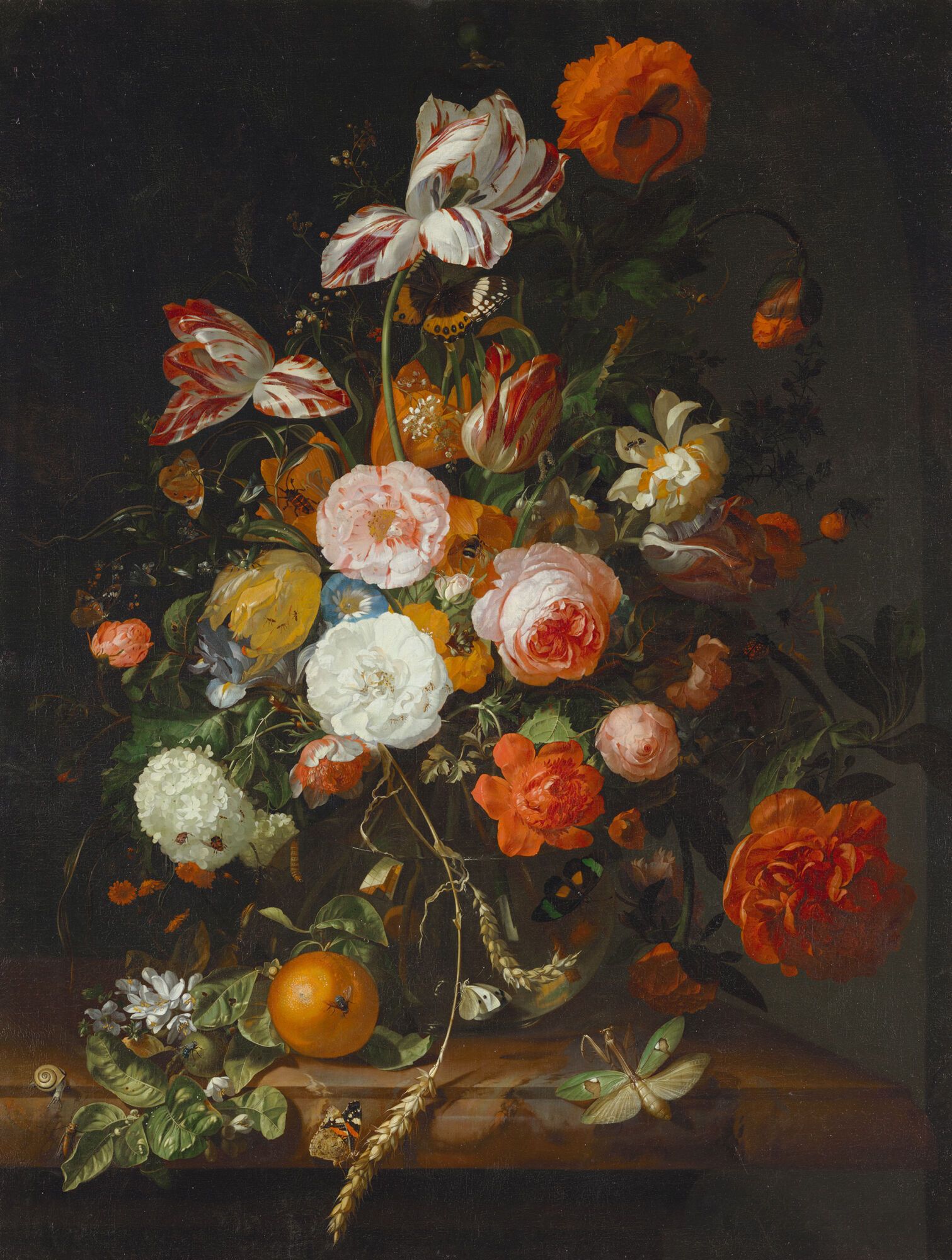
Ruysch’s compositions grew in complexity over the years. The nosegays, garlands and bouquets that she painted after her training with Van Aelst imitate his restrained, fluid style. In Flower Piece (c.1682), half the picture is pure black ground: on the right, a single rose branch with an acrobatic butterfly on its topmost bud extends into the corner, giving the composition a stylish diagonal slant. (Even the loop of string that secures the branches in an early hanging arrangement is elegant: not many artists can make string look this good.) By the 1710s, at the peak of her career, Ruysch was painting flower and fruit pieces so monumental, abundant and complicated that you can barely see the background peeking through. In Still Life with Fruit and Flowers (1714), made to hang in the bedchamber of her patron, Elector Palatine Johann Wilhelm, a basket of flowers in the top half of the composition spills over into a greedy jumble of fruit in the lower foreground: plums, peaches, nectarines, a pumpkin, enough grapes to feed the elector’s standing army. Everything is positioned on top of or behind something else, creating a layered density that seems to curve out towards the viewer like a convex mirror. There is so much to see that one of the highlights of the picture is buried away in a corner. In the shadowy top-left, a squat little bird sits in its nest in the branches, locking eyes with the viewer as it waits for an unwary snail.
In contemporary Dutch art theory, the manner in which painters established three-dimensional objects in space, individuating them and making legible the relations between them, was known as houding. It was the skill of ‘placing each thing, without confusion, separate and well apart from the objects which are next to and around it,’ the artist Willem Goeree wrote. In its absence, elements were liable to appear ‘entangled in one another, packed together, or falling towards us in a tumble’. In this context, Ruysch’s crowded, complicated arrangements can seem rebellious, or muddled. Her Posy of Roses, Marigolds and Larkspur, with Insects and Bumblebee (1695) is an impossible thicket, a spiky mass of stems and thorns. But light is directed strategically to guide us through it, exaggerating the distinctions between the flowers at the front and those at the back and between the top sides and undersides of leaves. Flecks of light make even the antennae of the cabbage white in the corner three-dimensional.
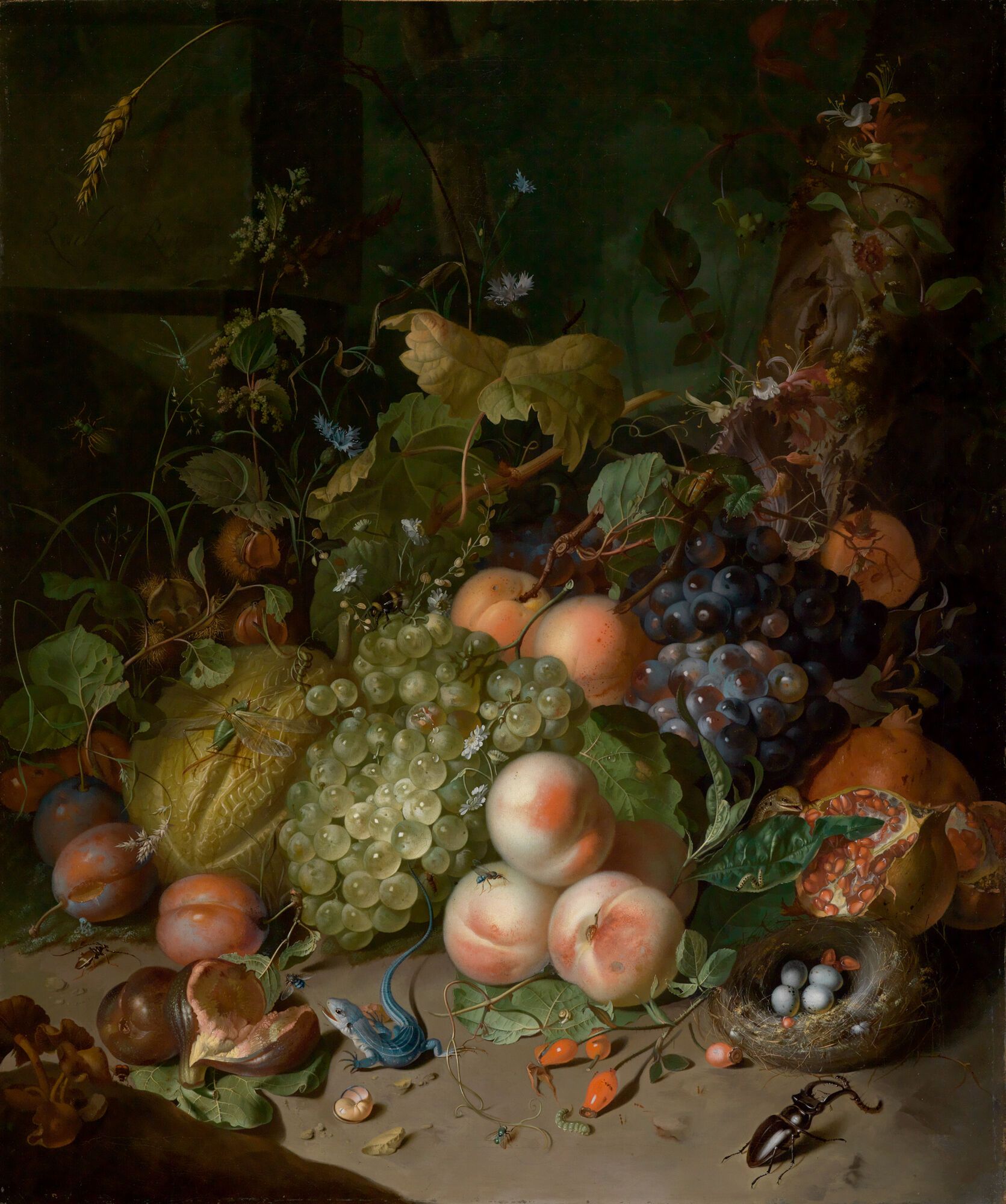
In the Still Life of 1714, stems of wheat no thicker than a hair – just traces of yellow paint – are so brightly lit that they leap out of the foreground. By contrast, the vague, blurry edges of the outer blossoms in a 1710 Still Life seem to retreat into the darkness. Textural contrasts do a similar job. Leaves that seem to clump together from a distance turn out to have different kinds of tactility: there are dry, crunchy-looking leaves, already munched by insects, and Valencia orange leaves in the same colours that are so shiny and wet-looking they resemble latex. Similarities between elements, repetitions of shape or colour, act like signposts through the chaos. Fruit Piece (1709) can be read chromatically, by the thread of orange that runs through it from left to right: orange on the tops of the fungi; pinkish-orange shading on the peaches; orange in the open centre of the melon; orange in the wing-tips of the butterfly that perches on it; orange in the yolks of the bird’s eggs; tiny interior whorls of orange in the shell in the foreground.
Ruysch was interested in the difference between interiors and exteriors. She painted cut stems in which you can see the pith running up the centre in cross-section, as well as broken eggs, burst grapes, halved pomegranates, bitten plums, melons and pumpkins slit open to their seeds. She showed lizards rearing up so that their plain underbellies are visible. The fruit compositions that she painted increasingly from the 1690s – some dedicated fruit pieces, pendants to flower pieces; others in which fruits and flowers appear together – celebrate abundance and variety, but usually feature signs of disturbance, rupture or decay. In Still Life with Fruit (1698), some of the grapes have gone brown and oozed open, and bubbles of liquid are forming on the surface of a bruised peach. (There’s a real filthiness to Ruysch’s peaches, even when they aren’t beginning to putrefy: they are always huge, positively hefty, with suggestive indentations.) Still Life with Fruits and Insects (1710) has chestnuts bursting out of their shells and a grub lodged obscenely in the chewed depression of a pomegranate segment. Flies and wasps are circling. Ruysch seems to have worked her way up to this style. In the early Swag of Flowers and Fruit Suspended in Front of a Niche (1681), the grapes are pale, perfect orbs, flat and almost transparent, with none of the knowing lusciousness of the later specimens.
Classically minded theorists, who believed that the point of art was to idealise, to depict the most perfect flowers and fruits or invent them where they didn’t exist, didn’t admire Ruysch’s attention to deficiency. ‘Who would hang a Piece of ordinary, unripe or rotten Fruit in his best Room, and among a Cabinet-collection, seeing the Life itself is so disagreeable?’ the Dutch painter and critic Gerard de Lairesse demanded in 1707. ‘Such Rubbish I did formerly admire; but as they only shew the Deformities of Nature, I have no Appetite to view them any more.’ Ruysch would have been able to look to other still life painters who depicted ‘deformities’: one of her early influences, the Dutch artist Jan Davidsz. de Heem, painted split pomegranates and figs, unripe blackberries, peaches crawling with insects. Her ‘appetite’ for imperfect shapes, though, was likely rooted in her scientific knowledge and the real specimens, plants and animals, that she worked from. (The iguanas, snakes and toads that her father kept preserved in alcohol were very much ‘as they came’.) It doesn’t seem a stretch to guess that there might also have been a personal aspect to it. Ruysch gave birth to ten children – nine between 1695 and 1706 alone – and carried on painting into her eighties, when she took to including her age in her signatures. She might be expected to have known a thing or two about ‘life itself’.
Send Letters To:
The Editor
London Review of Books,
28 Little Russell Street
London, WC1A 2HN
letters@lrb.co.uk
Please include name, address, and a telephone number.
