Rosemary Hill

Rosemary Hill’s most recent book is Time’s Witness: History in the Age of Romanticism. Her four-part series, The Lives of Stonehenge, can be found on the LRB Podcast. She is a contributing editor at the LRB, and presents ‘London Revisited’ on the LRB’s Close Readings subscription podcast.

At the V&A 2: Wedding Dresses, 1775-2014

Rosemary Hill, 9 October 2014

Of all​ the 19th-century innovations disparaged by Eric Hobsbawm as ‘invented traditions’, the white wedding must rank alongside clan tartans as the most enduring, a convention now so firmly rooted that many people think it’s medieval. To the Georgians a white wedding was a foreign novelty. In 1818 a British traveller in Normandy, Dawson Turner, remarked on a bride...
‘It will not​ have escaped such an audience as this that Sex played a large part in my uncle’s life.’ E.M. Forster was addressing an early meeting of the Bloomsbury Group’s Memoir Club, and was reading a paper about his closest male relation, the disliked, unmissed and now dead Uncle Willie. The evidence for Sex lay somewhere in William Forster’s unhappy,...

At Tate Britain (2): Kenneth Clark

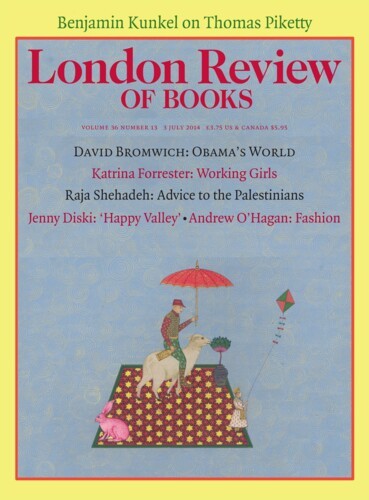
Rosemary Hill, 3 July 2014

In part ten​ of Civilisation, Kenneth Clark turned his attention to the Enlightenment, the age of the great amateurs. These were men ‘rich and independent enough to do what they liked’, who nevertheless did things which required considerable ability, men like Lord Burlington, the architect earl. A connoisseur, an ‘arbiter of taste’, Clark explained, ‘the sort...

At Tate Britain: ‘Ruin Lust’

Rosemary Hill, 3 April 2014

R uins are unstable things, sometimes physically, culturally almost always. Their appeal as occasions for art is only partly aesthetic; they are the remains of something else, of which they must necessarily be a shadow, an echo or a critique. Tate Britain’s exhibition (until 18 May), drawn mostly from its own collection and gathered under the capacious heading of Ruin Lust, takes too...

Only More So: 1950s Women

Rosemary Hill, 19 December 2013

War was looming when Alexander Korda’s film Fire over England was released in 1937. It stars Flora Robson as Elizabeth I, and as the opening titles roll the voiceover sets the scene: ‘the free people of a small island’ defy the tyranny of a Continental power and ‘a woman guides and inspires them.’ Robson, firm of jaw and bristling with double-decker ruffs and...

Leave me my illusions: Antiquarianism

Nicholas Penny, 29 July 2021

Moonlight on broken stone tracery is a common motif; dark interiors provide a foil for stained glass and for white satin and deep blue velvet. The men must be away on the crusades. Young women are sobbing...

Read more reviews

Very Pointed: Pugin

Dinah Birch, 20 September 2007

Modern lives look prim beside the turbulent existence of Augustus Welby Northmore Pugin. Distractions and misfortunes proliferated throughout his career: shipwreck (he was in his own boat,...

Read more reviews

Read anywhere with the London Review of Books app, available now from the App Store for Apple devices, Google Play for Android devices and Amazon for your Kindle Fire.

Sign up to our newsletters

For highlights from the latest issue, our archive and the blog, as well as news, events and exclusive promotions.

Newsletter Preferences