Peter Campbell

Peter Campbell, who was born in Wellington in New Zealand in 1937 and died in London in 2011, designed the LRB and wrote more than three hundred pieces for the paper, including, from 2000, a regular gallery piece. He also did the cover illustrations from 1993 until his death: his last, a fox in the street outside his house, was painted only a few weeks earlier. Many of these covers, as well as some of his other illustrations and book designs, can be seen in the collection Artwork and at petercampbell.org.uk.

Mary-Kay Wilmers, who first worked with him on the Listener in the late 1960s, when he designed the books for such BBC series as Kenneth Clark’s Civilisation and Jacob Bronowski’s The Ascent of Man, wrote about his capacious interests. When there wasn’t an exhibition he liked, he described what he saw around him: gasometers, plane trees, beaches (and untucked shirts), funfairs, the squares of Bloomsbury (where the LRB offices are), the timber-framed houses of Wellington. He was also interested in how things work, writing memorably about escalators. There were, as Wilmers wrote, ‘few aspects of the world that Peter didn’t wish to honour’.

Eye-Catchers

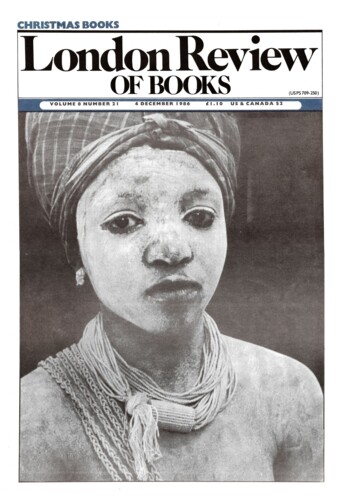
Peter Campbell, 4 December 1986

The earliest buildings in the 42nd volume of the Survey of London are late 17th and early 18th-century houses in Kensington Square. The market gardens and nurseries which surrounded this urban housing disappeared rather slowly, as land to the south of Kensington High Street was developed. The modest scale of the brick houses of Kensington Square, the neat brick and stucco of Edwardes Square (1811-25) and the Italian-villa-like elevations of Launceton Place (1840-3) gave way to cliffs of Italianate stucco (like Cornwall Gardens, late 1860s) and the red-and-yellow-brick mansion blocks of the 1880s and 1890s. These now dominate: this is Victorian London.
The New Lloyd’s

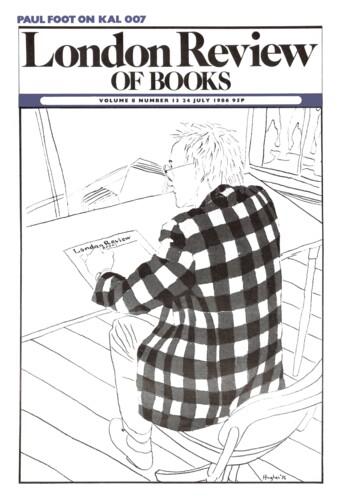
Peter Campbell, 24 July 1986

Richard Rogers’s new Lloyd’s building in London has begun business, to predictable complaints. A Guardian journalist asking for off-the-cuff comments from underwriters found them grumpy – the only appreciative voice was foreign and female. That is not surprising: the new Lloyd’s is an architectural statement of un-English vehemence. Un-modern-English, one corrects oneself, passing St Mary Woolnoth’s rusticated walls as one heads down Lombard Street to get another view of Lloyd’s.’

Someone Else

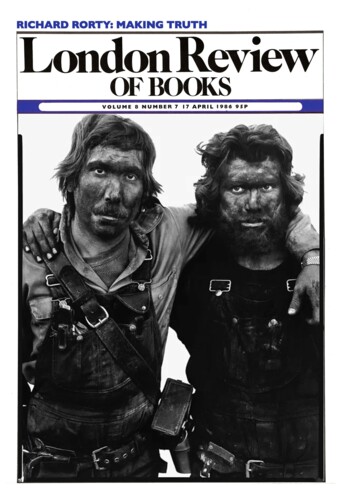
Peter Campbell, 17 April 1986

The first picture in Richard Avedon’s folio is captioned ‘Alan Silvey, drifter, Route 93, Chloride, Nevada’. Such photographs were taken in the Dustbowl fifty years ago. But this is art, not documentation. We have learned a lot about photography since the Thirties, and now no one believes that truth is simple – ‘all photographs are accurate. None of them is the truth’ is Avedon’s way of putting it. On the other hand, no one really doubts that photography is art. Meanwhile, in these pictures of the anonymous and deprived, ethnography and fashion join hands.’

English Art and English Rubbish

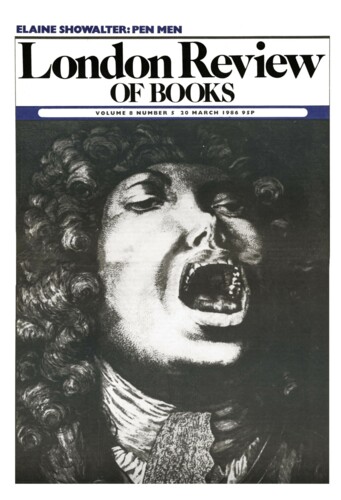
Peter Campbell, 20 March 1986

In England, where the opposite can easily seem to be the case, there is always someone around to say that the visual arts matter. Not just that they are life-enhancing or give pleasure, but that they are a test of the health of a society. Bad art means bad lives are being lived. Good policies will be known by the art they encourage. The works C.R. Ashbee is remembered for – a couple of original if slightly awkward houses in Chelsea, some pretty silver and jewellery of an almost Art Nouveau sinuousness, some indifferent private press books – would not by themselves have warranted a book on the scale of Alan Crawford’s admirable biography. It is Ashbee’s attempts to give practical expression to the idea that art matters that make Crawford’s apology for a book ‘more ponderous than its subject deserves’ unnecessary.’

Adrian

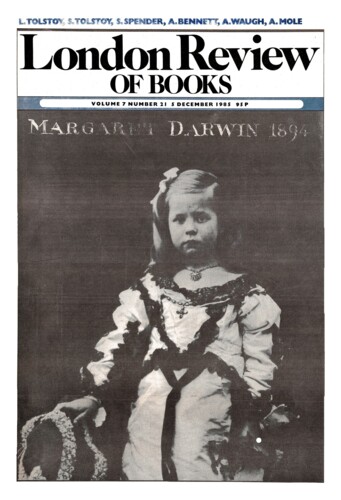
Peter Campbell, 5 December 1985

Squawks are heard all over London these days from newly-fledged birds being pushed off the twig. The reasons for not leaving home multiply: no money, no job, rents high, flats scarce. With the decay of the old custom of not fornicating under the parental roof the strongest reason for having a place of your own has gone. Forced contiguity is exacerbated by the New Frankness. The children of the Sixties (the ones born then) have a view of the infantile passions, the neurotic insecurity, and the vulnerability, of their parents which might accompany a severe scepticism about all human relationships. Have age and experience done nothing for these parents? they ask. Their younger brothers and sisters, born in the Seventies, have even worse cases to manage. But at least they now have a laureate.

Read anywhere with the London Review of Books app, available now from the App Store for Apple devices, Google Play for Android devices and Amazon for your Kindle Fire.

Sign up to our newsletter

For highlights from the latest issue, our archive and the blog, as well as news, events and exclusive promotions.

Newsletter Preferences