Peter Campbell

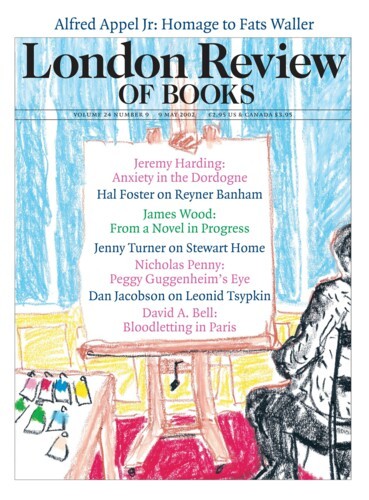
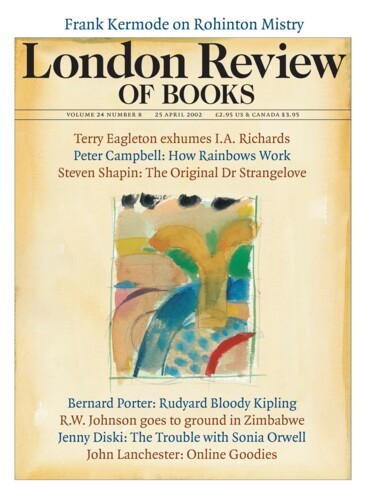
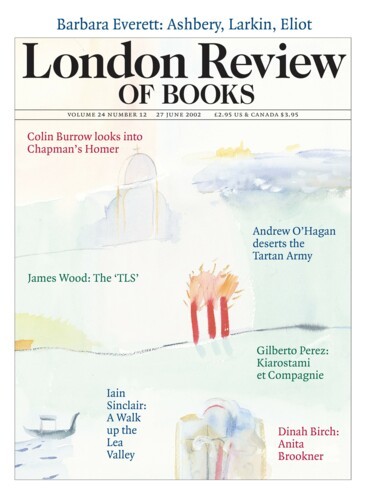
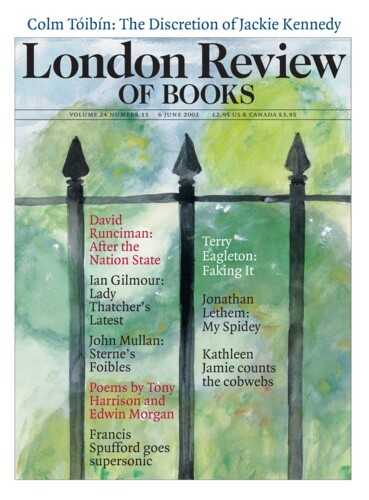
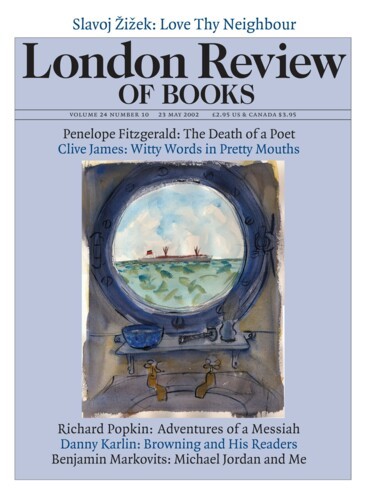
Peter Campbell, who was born in Wellington in New Zealand in 1937 and died in London in 2011, designed the LRB and wrote more than three hundred pieces for the paper, including, from 2000, a regular gallery piece. He also did the cover illustrations from 1993 until his death: his last, a fox in the street outside his house, was painted only a few weeks earlier. Many of these covers, as well as some of his other illustrations and book designs, can be seen in the collection Artwork and at petercampbell.org.uk.

Mary-Kay Wilmers, who first worked with him on the Listener in the late 1960s, when he designed the books for such BBC series as Kenneth Clark’s Civilisation and Jacob Bronowski’s The Ascent of Man, wrote about his capacious interests. When there wasn’t an exhibition he liked, he described what he saw around him: gasometers, plane trees, beaches (and untucked shirts), funfairs, the squares of Bloomsbury (where the LRB offices are), the timber-framed houses of Wellington. He was also interested in how things work, writing memorably about escalators. There were, as Wilmers wrote, ‘few aspects of the world that Peter didn’t wish to honour’.

Hide your wives and daughtersHide the groceries tooGreat Nations of Europe coming through . . .

They came in good ships; their guns were the best. First were the Portuguese, then the Dutch. The English followed. The destinations were India, Sumatra, Java, Japan, China and the Spice Islands. It had taken the crews the best part of a year of foul food and slow sailing to get there. Many...
In Venice: Tourist Trouble

Peter Campbell, 6 June 2002

Venice is an astonishing survival, preserved from change above all, perhaps, by everyone’s desire to save its fair face. Although Venice in Peril: The British Appeal for the Preservation of Venice works for the good of the city’s fabric, the symposium it arranged there a couple of weeks ago under the title ‘Residential Vernacular Architecture in Venice: The Other 90 Per...

The Brighton Museum is open again. Ten million pounds has been well spent: it is tidier, lighter, more extensive and more coherent than it was. The rich, crammed display style, which always suited its heterogeneous holdings, has been brought up to date rather than abandoned for something cooler.

Brighton life joins hands with what the museum shows. People come festively to the seaside. They...

At Tate Britain: Hamish Fulton

Peter Campbell, 9 May 2002

Aretrospective exhibition of the work of Hamish Fulton is at Tate Britain until 4 June. Walking Journey is downstairs from, and in a sense complementary to, American Sublime, another celebration of wilderness, which David Craig wrote about in the last issue of the LRB.

Fulton has made many walks of many kinds in many places over the last thirty years. But because a walk must exist in the...

After the Deluge: How Rainbows Work

Peter Campbell, 25 April 2002

First the rainbow brought messages, later it demanded explanations. In the story of Noah it is God’s promise of an end to floods; in Greek mythology, Iris was both goddess of the rainbow and the messenger of the gods. Then, once a scientific theory was called for, it proved far from easy to come up with a satisfactory one.

Most natural historians can store their specimens: butterflies on...

Read anywhere with the London Review of Books app, available now from the App Store for Apple devices, Google Play for Android devices and Amazon for your Kindle Fire.

Sign up to our newsletter

For highlights from the latest issue, our archive and the blog, as well as news, events and exclusive promotions.

Newsletter Preferences