Peter Campbell

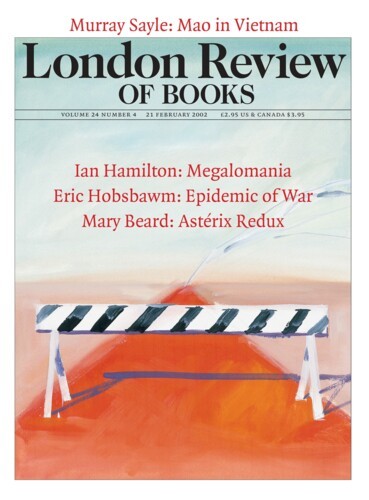
Peter Campbell, who was born in Wellington in New Zealand in 1937 and died in London in 2011, designed the LRB and wrote more than three hundred pieces for the paper, including, from 2000, a regular gallery piece. He also did the cover illustrations from 1993 until his death: his last, a fox in the street outside his house, was painted only a few weeks earlier. Many of these covers, as well as some of his other illustrations and book designs, can be seen in the collection Artwork and at petercampbell.org.uk.

Mary-Kay Wilmers, who first worked with him on the Listener in the late 1960s, when he designed the books for such BBC series as Kenneth Clark’s Civilisation and Jacob Bronowski’s The Ascent of Man, wrote about his capacious interests. When there wasn’t an exhibition he liked, he described what he saw around him: gasometers, plane trees, beaches (and untucked shirts), funfairs, the squares of Bloomsbury (where the LRB offices are), the timber-framed houses of Wellington. He was also interested in how things work, writing memorably about escalators. There were, as Wilmers wrote, ‘few aspects of the world that Peter didn’t wish to honour’.

At the Barbican: Martin Parr

Peter Campbell, 4 April 2002

Iwas reading in a coffee shop a couple of months ago when a young man asked if he might take my photograph. I said that I would rather he didn’t – which was churlish, because I have taken pictures of strangers myself. I was rude, I guess, because the more wonderfully apt and sensitive his picture of a grumpy, grey-haired man reading might be the less I wanted that man to be me. In...

At the Hayward: Paul Klee

Peter Campbell, 21 March 2002

Paul Klee drew many different kinds of picture, and the exhibition on at the Hayward Gallery until 1 April, Paul Klee: The Nature of Creation, arranges them by kind rather than chronologically. The juxtapositions are both logical and illuminating. (‘Drew’ because in most of his work there is more drawing, or drawing and filling in, than painting.)

The first kind is pictures made...

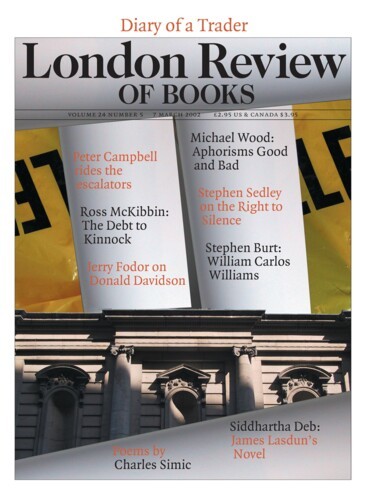
Stepping onto an escalator is an act of faith. From time to time you see people poised at the top, advised by instinct not to launch themselves onto the river of treads. Riding the moving stairs is an adventure for the toddling young and a challenge to the tottering old. Natural hesitancy puts a limit on throughput. London Underground escalators carry passengers at a top speed of 145 feet per minute – close to the maximum allowed under the British Standard specification. There is little temptation to run the machines faster, as trials show that above 160 feet per minute so many people pause timidly that fewer are carried. In the early days they had to be persuaded to get on at all. A one-legged man, ‘Bumper’ Harris, was hired to ride for a whole day on the first installation – it was at Earls Court – to show how easy it was. Some people were sceptical (how had he lost his leg?) but others broke their journey there just to ride up and down.

At the National Gallery: Aelbert Cuyp

Peter Campbell, 7 March 2002

Once again the National Gallery visits the Dutch at home. This time not Vermeer and de Hooch’s Delft but Aelbert Cuyp’s Dordrecht: instead of brick courtyards and side-lit rooms where music is played and good housewifery rules, we have boats, meads, cows, horsemen and horsewomen. The people are not so refined – Cuyp’s high finish and urbanity can’t disguise the...

In New Zealand: Timber-frame

Peter Campbell, 21 February 2002

Iam in Wellington, where I spent my first twenty years. I have walked, as I used to then, down the hill from Wadestown. The pines are now taller and blacker and the glossy mounded foliage of native shrubs covers the banks of cuttings more densely. In those days, after heavy rain, there were landslips. It has been very wet this year but only one yellow patch shows where a few tons of rotten...

Read anywhere with the London Review of Books app, available now from the App Store for Apple devices, Google Play for Android devices and Amazon for your Kindle Fire.

Sign up to our newsletter

For highlights from the latest issue, our archive and the blog, as well as news, events and exclusive promotions.

Newsletter Preferences