Michael Wood

Michael Wood is an emeritus professor at Princeton. He has written books on Yeats, Nabokov, Stendhal, Hitchcock and Empson, among other things.

Secession

Michael Wood, 23 March 1995

We all know what a Euro-novel is. It’s clever and shallow, full of allusions to fashionable figures, and elaborately interested in its own making. The home product, by contrast, is solid and deep, staunchly unaware that there are any other cultural products in the world, and firmly convinced that the art which conceals art is the next best thing to having no art at all. On my left, Umberto Eco; on my right … there are too many contenders, I can’t make out any individual faces in the crowd. I’m not suggesting there are no British Europeans, or that all Continental Europeans write Euro-novels; or that there aren’t solid and unfashionable novels which are distinctly shallow as well. But what if behind this caricature of a comparison there were genuine literary differences? What if there is a European habit or tradition, and our suspicion of it is chiefly a failure to recognise it for what it is?
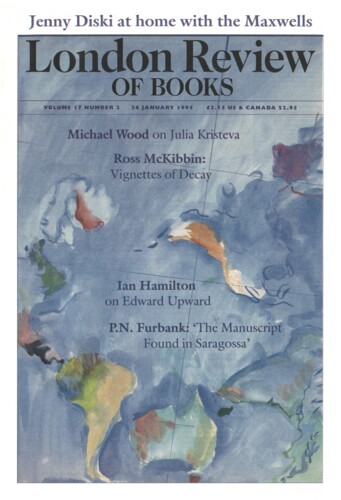
The Heart’s Cause

Michael Wood, 9 February 1995

Slugging it out with Diana Trilling in the pages of Commentary, Robert Lowell remarked: ‘Controversy is bad for the mind and worse for the heart.’ Mrs Trilling, for all the world like Dorothea Brooke or some other 19th-century heroine of the strenuously examined life, replied: ‘I have never thought controversy bad for either the mind or the heart.’ She missed the grace and weariness of Lowell’s phrase, as well as the sense of genuine damage which lurked in his irony, but she had found a triumphant definition of what she herself was about. She was a controversialist not out of belligerence or righteousness or arrogance, but out of cultural conviction. There are things we don’t need to argue about, she would say, but not many. Argument is the visible, sequential life of ideas. Controversy is good for the heart, and indispensable for any but the lazy mind.

Time of the Assassin

Michael Wood, 26 January 1995

‘And so,’ Bréhal said, ‘love would be time become available to the senses.’

Wonder

Michael Wood, 10 November 1994

When asked what part of the Middle West he comes from, Jay Gatsby says: ‘San Francisco.’ This is usually taken as a sign of his shaky geography or his eagerness to cover up his origins, or both. But the response seems too blunt and broad for that – too blunt and broad for either Gatsby or Fitzgerald. If Gatsby were at all given to making jokes, we might think this was one.’

Yossarian rides again

Michael Wood, 20 October 1994

‘Logic is doubtless unshakeable,’ Joseph K. thinks towards the end of The Trial, ‘but it cannot withstand a man who wants to go on living.’ He is wrong, of course, since he is killed within a page by the brutal logic of the novel he is in. But there is a logic that resists such logic, and one of its masters is Joseph H., author of Catch 22 and other objections to the absurdity of dying.

Pirouette on a Sixpence: Untranslatables

Christopher Prendergast, 10 September 2015

O n​ the face of it a Dictionary of Untranslatables looks like a contradiction in terms, either self-imploding from the word go, or, if pursued, headed fast down a cul-de-sac in which it is...

Read more reviews

It took a very special kind of invention to get an awareness of the ‘erratic truth of death’s timing’ into a medium of mass entertainment.

Read more reviews

I told you so! oracles

James Davidson, 2 December 2004

I don’t believe in astrology, but I also know that not believing in astrology is a typically Taurean trait. When I first caught a bright young friend browsing in the astrology section of a...

Read more reviews

And That Rug! images of Shakespeare

Michael Dobson, 6 November 2003

Above the entrance to the saloon bar there is a picture of Shakespeare on the swinging sign. It is the same picture of Shakespeare that I remember from my schooldays, when I frowned over Timon of...

Read more reviews

Unspeakability

John Lanchester, 6 October 1994

Musing over Don Juan, Byron asked his banker and agent Douglas Kinnaird a rhetorical question: ‘Could any man have written it – who has not lived in the world? – and tooled in a...

Read more reviews

Read anywhere with the London Review of Books app, available now from the App Store for Apple devices, Google Play for Android devices and Amazon for your Kindle Fire.

Sign up to our newsletters

For highlights from the latest issue, our archive and the blog, as well as news, events and exclusive promotions.

Newsletter Preferences