Michael Wood

Michael Wood is an emeritus professor at Princeton. He has written books on Yeats, Nabokov, Stendhal, Hitchcock and Empson, among other things.

Where the hell?

Michael Wood, 6 October 1994

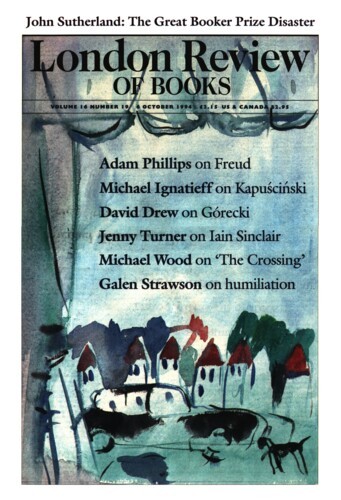
Cormac McCarthy comes to us with a tremendous reputation: not only the National Book Award but a critical chorus comparing him to Melville, Shakespeare, Conrad, Faulkner, Dostoevsky. There have also been voices crying hokum, but not many. The Crossing is McCarthy’s seventh novel, and you have only to open one of them to see what has set everyone reeling. Obsessions and hallucinations litter the pages, strange, silent shapes fall off mountains or patrol plains, everyone who speaks at all speaks like an oracle. There is blood everywhere. It’s eerie to hear a 19th-century cowboy paraphrasing Swift (‘They’d been skinned and I can tell ye it does very little for a man’s appearance’); eerier still to see a distorted after-image of King Lear set loose in a Western desert, ‘like some scurrilous king stripped of his vesture and driven together with his fool into the wilderness to die’. In another cultural register, Western fans will recognise a scene or two borrowed from The Outlaw Josey Wales, and people spit in these novels as if they were Eastwood dolls who didn’t know how to stop the machinery. ‘He leaned and spat.’ McCarthy never tires or writing this sentence, the prelude to every raw and cryptic cowboy comment. It signals the westernness of the West, the way the fringes in Mankiewicz’s film Julius Caesar, according to Roland Barthes, were the quick and surefire sign of Romanness. Everything is mythic in McCarthy, and at times he seems to smile at this himself. Not often.
Instant Depths

Michael Wood, 7 July 1994

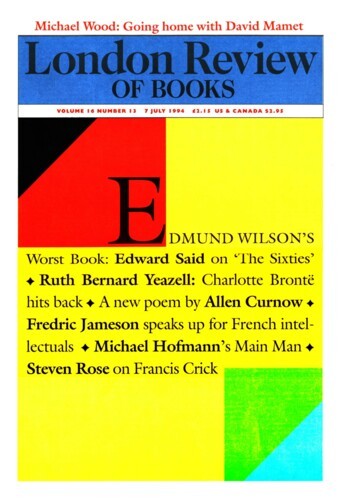
The earlier plays of David Mamet seemed to spring from a meeting between Arthur Miller and Harold Pinter, as if the characters from The Caretaker or The Homecoming had caught the American anxieties of Death of a Salesman. Pinter is also never far from the later plays, and he directed Oleanna in London; but other, more oblique influences now hover in the air. Gregory Mosher, the director of The Cryptogram, thinks Oleanna was ‘Shavian’, and the new play has undercurrents of Chekhov, even Ibsen. At the end, as in The Wild Duck, a child takes off to an attic to die, the victim of the games adults don’t quite know how to play.

Sad Nights

Michael Wood, 26 May 1994

One of the strangest recurring moments in the Spanish invasion of the Americas was the reading of the Requerimiento, the Requisition, a document which both proclaimed possession of a territory and converted its natives into subjects of the Spanish Crown; all resistance, therefore, could be called rebellion. The natives were supposed to be present at the reading, although it seems they weren’t always. Even when they were, of course, they would have no way of grasping the language or even the gist of the proclamation. What was needed was that the words should be spoken, not that they should be understood; and the person who always was present was a notary. Fray Bartolomé de las Casas, the defender of the American Indians, said in the 16th century that he didn’t know whether to laugh or to cry at the procedure, and two Colombian Indians are reported by Hugh Thomas as saying, in 1515, that the Pope must have been drunk when he divided between the Spanish and the Portuguese so much land which wasn’t his to give.

So sue me

Michael Wood, 12 May 1994

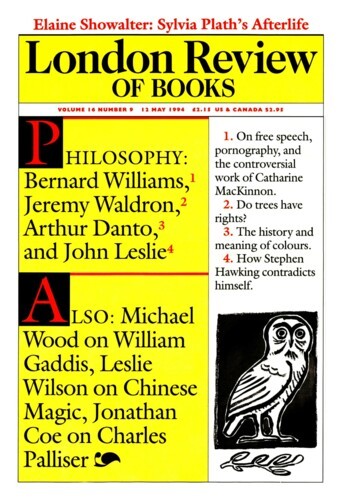
It’s hard to think of a writer who publishes a book every ten or twenty years as garrulous, or of a person who produces his fourth novel at the age of 72 as prolific; but we need some such terms if we are to begin to describe the extraordinary work of William Gaddis, born 1922, the author of The Recognitions (1955), JR (1975), Carpenter’s Gothic (1985) and now A Frolic of His Own.

Why the birthday party didn’t happen

Michael Wood, 10 March 1994

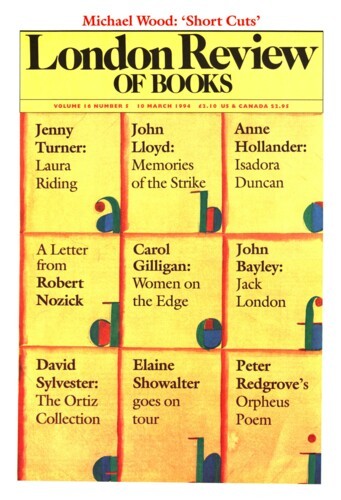
Robert Altman’s Short Cuts is a long, loose-looking movie, but the looseness is an effect, carefully worked for. Plenty of themes recur throughout – insecurity, chance, rage, damage, the long, bruising war between men and women – and although there are fourteen or fifteen stories here (based on extrapolated from ten stories by Raymond Carver – the handouts and the introduction solemnly say nine stories and a poem, but the so-called poem is also a prose narrative), they are intricately stitched together, like a miniaturised Comédie humaine set in Los Angeles.’’

Pirouette on a Sixpence: Untranslatables

Christopher Prendergast, 10 September 2015

O n​ the face of it a Dictionary of Untranslatables looks like a contradiction in terms, either self-imploding from the word go, or, if pursued, headed fast down a cul-de-sac in which it is...

Read more reviews

It took a very special kind of invention to get an awareness of the ‘erratic truth of death’s timing’ into a medium of mass entertainment.

Read more reviews

I told you so! oracles

James Davidson, 2 December 2004

I don’t believe in astrology, but I also know that not believing in astrology is a typically Taurean trait. When I first caught a bright young friend browsing in the astrology section of a...

Read more reviews

And That Rug! images of Shakespeare

Michael Dobson, 6 November 2003

Above the entrance to the saloon bar there is a picture of Shakespeare on the swinging sign. It is the same picture of Shakespeare that I remember from my schooldays, when I frowned over Timon of...

Read more reviews

Unspeakability

John Lanchester, 6 October 1994

Musing over Don Juan, Byron asked his banker and agent Douglas Kinnaird a rhetorical question: ‘Could any man have written it – who has not lived in the world? – and tooled in a...

Read more reviews

Read anywhere with the London Review of Books app, available now from the App Store for Apple devices, Google Play for Android devices and Amazon for your Kindle Fire.

Sign up to our newsletters

For highlights from the latest issue, our archive and the blog, as well as news, events and exclusive promotions.

Newsletter Preferences