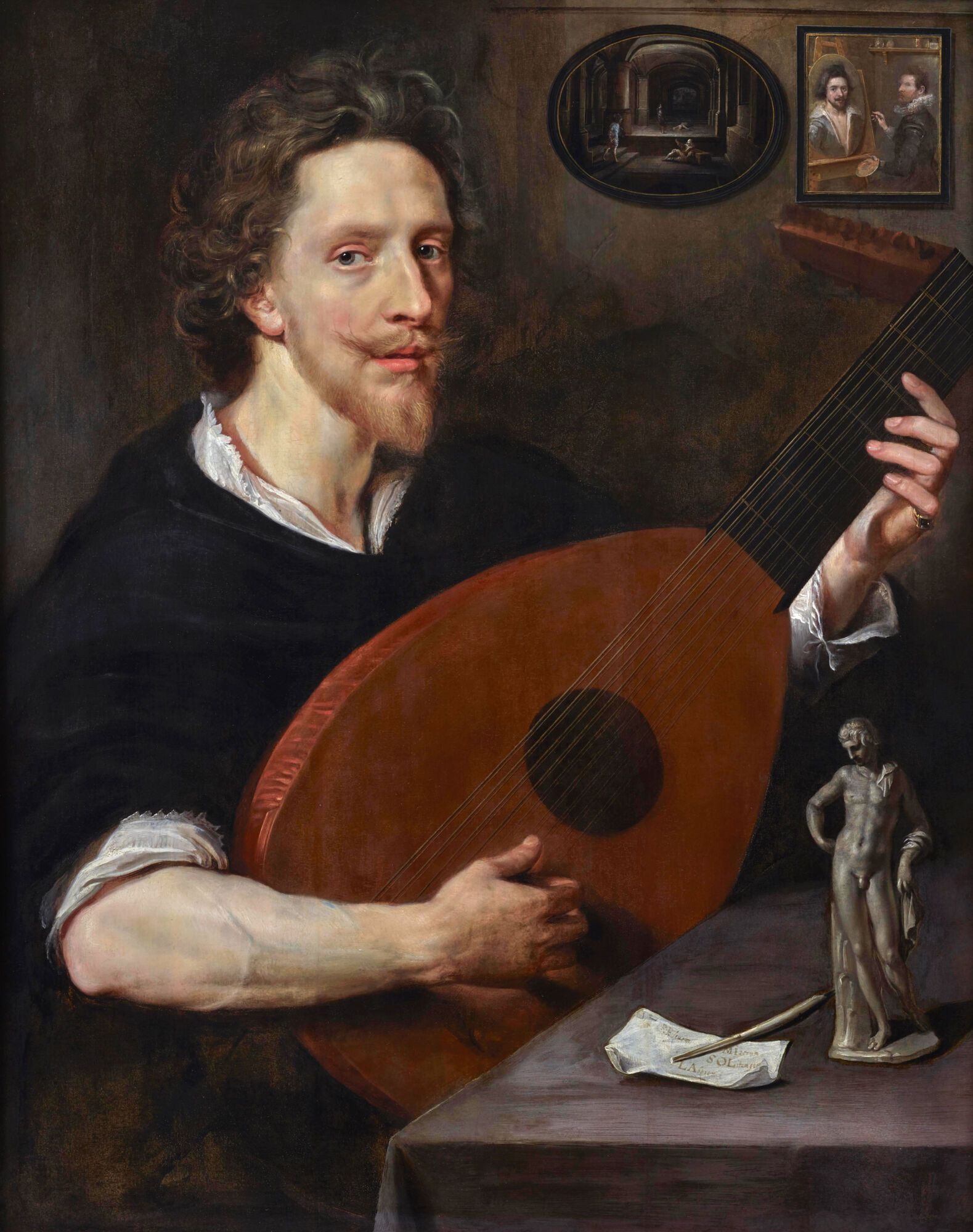
Frieze Masters , the more subdued sister of the contemporary art fair, is a reliably rewarding outing for fans of medieval manuscripts, Renaissance armour, Bronze Age spearheads and ancient Egyptian cat statuettes. One expects to see marble busts and antique maps, but perhaps not an old friend. This year, the stand allotted to the Weiss Gallery in Mayfair had as its centrepiece a painting that emerged sixteen years ago, but which has a much more venerable pedigree. It was identified in 2009 as a portrait of Nicholas Lanier, one of the most intriguing figures of the 17th century, and much conservation work was undertaken to remove centuries of dirt and mistreatment. What emerged was the image of a young man, pale but vigorous, with alert blue eyes and strong arms, playing a lute. In front of him on a table stands a small replica of the Belvedere Antinous, a piece of paper and a quill. The paper is inscribed with the epigram ‘Ut Relevet Miserum Fatum Solitosque Labores’, a useful mnemonic for the notes of the hexatonic scale as well as a manifesto for the virtues of music, which ‘relieves wretched fate and accustomed labours’.
The author of the painting has not been established. While there are deficits in the foreshortening, the face and hands are of an unusual quality for British painting in the early 17th century. It has been dated to 1613, when Lanier was 25. He was born into a family of court musicians with French and Italian connections. His father and grandfather were both flautists in the service of Henri II; they fled Paris in 1561 amid a wave of Protestant repression. In London, Nicholas Lanier the Elder married Lucretia Bassano, the daughter of the Italian musician Anthony Bassano. The family prospered and forty years later, Nicholas’s grandson and namesake became a singing boy in the household of Robert Cecil, where he learned the lute and viol. The first of young Lanier’s (for want of a better term) diplomatic missions came in 1611, when Cecil sent him to Venice. Musicians and artists were often used as couriers and spies, and Lanier had the advantage of fluent French and Italian. Perhaps his interest in art, as represented in the portrait by the Belvedere Antinous, was kindled at this time; he almost certainly met Monteverdi and the other composers who were attempting to return poetry to its classical declamatory tradition, a development Lanier would help to introduce to Britain.
This was the era of Ben Jonson and Inigo Jones, when the masque was at its extravagant height under James I, and in 1613, around the time this portrait was painted, Lanier composed his first masque song, ‘Bring away this sacred tree’, and performed it at court in The Squires’ Masque. Lanier was looking for advancement and perhaps having his picture painted was a form of advertisement: here is an accomplished young man looking to take his next steps in the world. He was soon invited to join the circle of royal musicians that included several of his relatives. Over the next decade he would contribute to a number of masques, not only as composer and musician but as painter and scenographer.
It is tempting to see hints of this activity in the two pictures on the wall behind him in the portrait, strange emblems that seem superimposed and may have been painted by another hand. In an essay on the painting published in 2010, Tim Wilks points out that in most respects the portrait fits the model of the recently established Venetian chamber portrait, with a half-length sitter and a covered table bearing significant objects. Where there should be a window, there are instead two small images, one of which has been identified as a version of Hendrick van Steenwyck’s Liberation of St Peter, a theme van Steenwyck painted many times. The other image, of an artist at the easel, is less easily resolved. Neither the painter nor his subject has been satisfactorily identified and the significance of this image within an image is ambiguous. It could be a homage or a further act of self-fashioning or a private joke. I like to think that the two images point to Lanier’s varied artistic roles to come: as sitter in many portraits, a portrait painter himself, a designer and painter of dramatic scenery (the van Steenwyck looks like a stage set), and a connoisseur and collector.
As a musician in the royal band, Lanier would have been known to the young Prince Charles, and must have impressed him because he was appointed the first Master of the King’s Musick in 1625, on the death of James I. Like his father, Charles was very interested in the arts (he had been well tutored by the Duke of Buckingham), and in ambition he far outstripped him. Soon after the funeral, Charles sent Lanier to Italy to acquire paintings for the royal collection. Through a Dutch contact in Venice, Daniel Nys, a ‘shady entrepreneur’, as Michael Wilson puts it, Lanier was introduced to the collection of Ferdinando Gonzaga, duke of Mantua. The story of that collection is a book in itself, but anyone who has visited the ducal palace in Mantua will know the eerie experience of walking through room after empty room in the great palazzo complex (the largest in Italy at the time, with more than a thousand apartments, halls and galleries) that once housed the grandest collection of paintings in the world. The inventory of Ferdinando’s collection ran to more than twenty thousand items, with works by Carracci, Correggio, Cranach the Elder, Lorenzo Lotto, Mantegna, Michelangelo, Guido Reni, Rubens, Tintoretto, Titian, Veronese and others.
Collecting and commissioning on such a breathtaking scale reduced the Gonzagas to bankruptcy, and by the time of Ferdinando’s death in 1626 it had become clear to the duke and his brother Vincenzo, who inherited the dukedom, that much of the collection would have to be sold. Lanier began negotiations right away. He was in ‘unutterable raptures’, Nys wrote, but there were serious obstacles to acquisition, not least the requirement for export licences and the resentment of the Mantuans at the proposed dispersal of their city’s riches. Lanier returned to England in early 1626 with a number of paintings bought in Rome and one special commission, his own portrait, painted by Van Dyck. It was through this dashing painting that Charles I was introduced to the work of Van Dyck, who would later become court painter. On the basis of the Rome works and Lanier’s report, Charles agreed to finance the Mantua acquisition – £30,000, exactly the amount that the Duke of Buckingham wanted to continue his siege of La Rochelle. As Jerry Brotton put it, ‘Charles bought the pictures and left his friend hanging.’
In 1627, Lanier returned to Venice to secure the first part of the Gonzaga collection. The paintings were moved in great secrecy to the island of Murano, and then dispatched to Antwerp by sea. Lanier travelled overland to meet the cargo, taking two Correggios and a Raphael – too precious for the waves – in his own luggage. It’s been claimed that on his previous trip, Lanier had fallen in love with Artemisia Gentileschi and, perhaps in return for a song, she had given him the secret of her paintings’ luminosity (a drop of amber varnish); if so, this would have come in useful when, on arriving in London, Lanier found that damp and travel had damaged some of the pictures. He restored them with the assistance of his uncle Jerome, a collector and amateur painter. This was the height of conservation in Britain at the time and it must have been good enough, because the king was delighted. Van Dyck, Rubens and Gentileschi were soon invited to the English court.

If only the story could stop here, with Lanier’s triumph and the inauguration of London as home to the greatest art collection ever known. For a brief time it was. Charles continued to commission and acquire; the second instalment from Mantua arrived in 1631 and included Mantegna’s magnificent Caesar series. But the Civil War and its ‘sale of the late king’s goods’ dispersed the paintings far and wide. After the Restoration, Charles II ordered the return of the paintings, but it was impossible to re-establish the collection. Lanier spent the interregnum in exile with the court and was later restored to Master of the King’s Musick, though by this time he was past seventy. Pepys recorded meeting him in 1665: ‘Lanier sings, in a melancholy method, very well.’ Fashions had changed. Lanier also resumed his activities on behalf of the royal collection. He was among the earliest collectors to appreciate works on paper in their own right, and many drawings in the British Museum and the King’s Gallery bear his star-shaped collector’s mark.
I first became interested in Lanier through his own compositions, of which around thirty survive. Most were lost during the Civil War. He set to music many of the great Elizabethan and Cavalier poets, in the melancholy method, inspiring the envy of John Dowland. His Hero and Leander, composed for the death of the Duke of Buckingham, is a scene-length dramatic piece, almost a small opera. Roger North reported that ‘the King was exceedingly pleased with this pathetick song and caused Lanneare often to sing it … with his hand upon his shoulder.’ Lanier’s songs moved many of his contemporaries. Herrick called him ‘rare Laniere’ while John Donne said he ‘gave a life and harmony to all that he set’. In his ‘Elegy on the Death of Sir Henry Morison’, Lucius Cary wrote: ‘Now all is lost that is upon me placed … As if Laniere should to a deaf one sing/ Or I should Helen to a blind man bringe.’ Although he had his portrait made many times, none can be easily seen in Britain. A strange and wonderful group portrait by William Dobson, showing a middle-aged Lanier in the early years of the Civil War, is in the collection of the Duke of Northumberland. (Dobson, a young court painter, was another casualty of the war, dying soon after the king’s defeat.) Guido Reni’s stylish drawing of Lanier is in Los Angeles. The Van Dyck is in the Kunsthistorisches Museum in Vienna. A surviving self-portrait, which Roy Strong, rather unfairly, called ‘feeble’, is in the Faculty of Music at Oxford.
The portrait that I came across so unexpectedly at Frieze doesn’t have the prestige of the Van Dyck or the special interest of the self-portrait, but it is the image that comes to mind whenever I think of Lanier. Its discovery is one of the great recent events in British art. Earlier this year, Tate Britain and the National Portrait Gallery secured for the nation a self-portrait by William Dobson. It cost £2,367,405. When the Lanier portrait was auctioned in 2009, it went for ten times its estimate, but still cost only a fraction of the Dobson painting. Gone are the days when Old Masters could be bought for a song and British art was underappreciated and undervalued. But I hope that a portrait of Lanier will one day be in the national collection. Indeed, this portrait would make an excellent addition to the NPG. Even for those unfamiliar with the sitter, the freshness of the picture must be immediately attractive – the light blush on his cheek, the swept-back hair, the rolled-up sleeves and overall sense of having walked in on a musician-composer at play. Who wouldn’t want to know more?
Send Letters To:
The Editor
London Review of Books,
28 Little Russell Street
London, WC1A 2HN
letters@lrb.co.uk
Please include name, address, and a telephone number.
