Tom Crewe’s first novel, The New Life, won the 2023 Orwell Prize for Political Fiction and the Sunday Times Young Writer of the Year Award, and is out now in paperback. He is a contributing editor at the LRB.
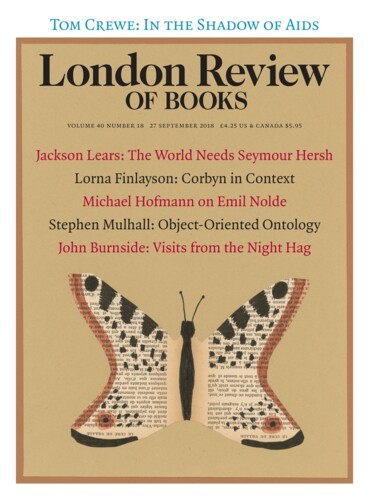
Aids starts with the deaths. With the dying. At first there was only confusion, incomprehension. Bodies that quickly became unintelligible to themselves. Nightsweats, shingles, thrush, diarrhoea, sores that crowded into mouths and made it impossible to eat. A fantastically rare form of pneumonia. Dementia in men of twenty: brains that shrank and withered. Tuberculosis of the stomach, of the bone marrow. A cancer meant to be slow-moving, to manifest benignly in elderly men from the Mediterranean, which burrowed from the outside in: from marks on the skin, to the stomach and lungs. Non-human illnesses: men dying from the blights of sheep, of birds, of cats, diseases no man had ever died of before. Men dying in the time it takes to catch and throw off a cold: ‘One Thursday,’ David France writes in How to Survive a Plague, ‘sexy Tommy McCarthy from the classifieds department stayed out late at an Yma Sumac concert. Friday he had a fever. Sunday he was hospitalised. Wednesday he was dead.’
It is a perfect Impressionist scene: a strangely empty stretch of the Seine, at the crossing-point between Suresnes and the Bois de Boulogne, where Parisians imagined themselves in the country. The view is from one side of the river, cropped so that the prow of a boat and the prongs of a tree intrude from the left; reflections seep and blur across its surface, like colours mixed into the...
‘What was it like growing up in black and white?’ was a question I asked my mother once. Until that moment her memories of childhood, so much more engrossing than any bedtime story, had unspooled in my head in perfect greyscale. (They do still, in childish defiance of the facts.) It wasn’t as if I’d seen many photographs of her as a girl – I still...
There are two portraits Roger Fenton took of himself, separated by only a year, one of them in the exhibition of his photographs of the Crimean War at the Queen’s Gallery in Edinburgh (until 26 November) and the other not. The first, from 1854, seems conventional: we see a Victorian gentleman – hair parted, beard trimmed to cover only the underside of his face, leaving the...
Tom Crewe talks to Lorna Finlayson about Jeremy Corbyn and Labour’s prospects in the general election and beyond.
William Davies talks to Tom Crewe about politics in the new media age.
Read anywhere with the London Review of Books app, available now from the App Store for Apple devices, Google Play for Android devices and Amazon for your Kindle Fire.
For highlights from the latest issue, our archive and the blog, as well as news, events and exclusive promotions.