Peter Campbell

Peter Campbell, who was born in Wellington in New Zealand in 1937 and died in London in 2011, designed the LRB and wrote more than three hundred pieces for the paper, including, from 2000, a regular gallery piece. He also did the cover illustrations from 1993 until his death: his last, a fox in the street outside his house, was painted only a few weeks earlier. Many of these covers, as well as some of his other illustrations and book designs, can be seen in the collection Artwork and at petercampbell.org.uk.

Mary-Kay Wilmers, who first worked with him on the Listener in the late 1960s, when he designed the books for such BBC series as Kenneth Clark’s Civilisation and Jacob Bronowski’s The Ascent of Man, wrote about his capacious interests. When there wasn’t an exhibition he liked, he described what he saw around him: gasometers, plane trees, beaches (and untucked shirts), funfairs, the squares of Bloomsbury (where the LRB offices are), the timber-framed houses of Wellington. He was also interested in how things work, writing memorably about escalators. There were, as Wilmers wrote, ‘few aspects of the world that Peter didn’t wish to honour’.

Scenes from the Movies

Peter Campbell, 5 August 1982

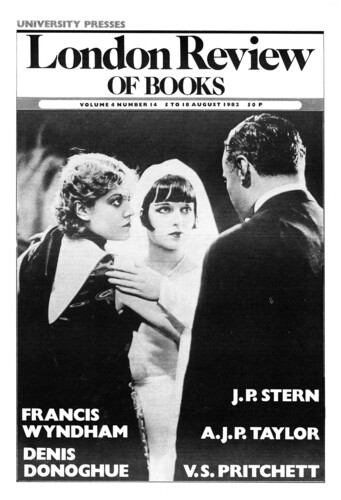
The photographs of Louise Brooks in Lulu in Hollywood show a face as beautiful, and almost as unchanging, as a Japanese mask. Both praise and criticism notice this inexpressiveness: ‘Louise Brooks exists with an overwhelming insistence … always enigmatically impassive,’ ‘Louise Brooks cannot act … she does not suffer … she does nothing.’ Her writing, on the other hand, is painfully self-revealing. Sometimes funny, sometimes angry, she is unfailingly perceptive about the arts of acting and film-making. The description of Pabst’s direction of Pandora’s Box is one of the best things in the book:
Super-Real

Peter Campbell, 18 March 1982

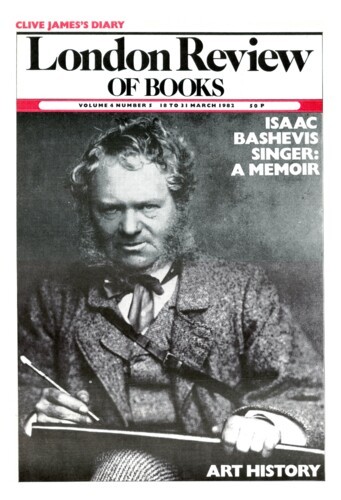
You know a Pre-Raphaelite picture when you see one, but definitions come hard. The paintings are likely to be detailed, but Rossetti’s are soft and generalised; they often take subjects from English poetry or the Bible, but can be pure landscapes, or illustrations of Greek myths, or even about modern politics. The Pre-Raphaelite programme – to replace an exhausted tradition, of painterly conventionalities and trivial subject-matter, with a style which paid close attention to the detail of natural appearances and took themes of an aesthetically and morally elevated sort – is clear enough. The results evoke responses which are nothing like as simple.

Problems

Peter Campbell, 1 October 1981

How many books have I read? Two hundred, three hundred, five hundred …? I could compile a list. But what would it tell me? What I know? What I have forgotten? What I was? What I wanted to be? What my mother and father wanted and expected and expect me to be? Millions of Cats, Goodnight Moon, Caps for Sale, Where the wild things are, The Blue Fairy Book, The Red Fairy Book, The Wind in the Willows, The Jungle Book, Stuart Little, The Secret Garden, The Borrowers, The Little Prince, Member of the Wedding, Gigi, Lord of the Flies, Return of the Native

A Better Life

Peter Campbell, 2 April 1981

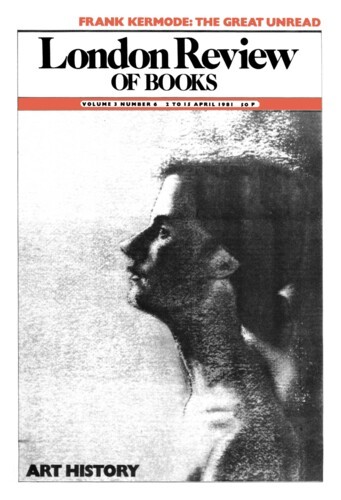
The ‘homes fit for heroes’ of Mark Swenarton’s title – or some relation of them – can be found on the outskirts of almost any British town. Yet they are more seen than noticed, and it may take a description to bring them to mind: ‘two-storey cottages, built in groups of four or six, with medium or low-pitched roofs and little exterior decoration, set amongst gardens, trees, privet hedges and grass verges, and often laid out in cul-de-sacs or around greens’. They enter architectural history as a footnote, to the English vernacular and Georgian revivals, or the Garden City movement, but appear in social history as an impressive statistic: one family in 20 still lives in this kind of inter-war council housing.

The Loneliness Thing

Peter Campbell, 5 February 1981

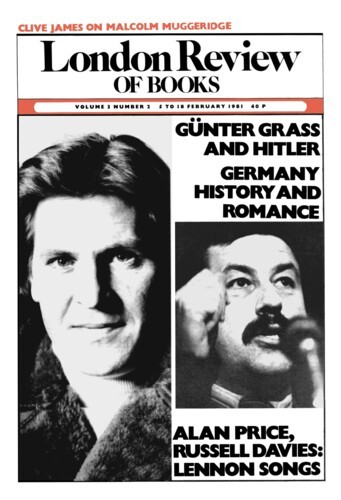
Edward Hopper’s 1920 etching ‘Les Deux Pigeons’

Read anywhere with the London Review of Books app, available now from the App Store for Apple devices, Google Play for Android devices and Amazon for your Kindle Fire.

Sign up to our newsletter

For highlights from the latest issue, our archive and the blog, as well as news, events and exclusive promotions.

Newsletter Preferences