Peter Campbell

Peter Campbell, who was born in Wellington in New Zealand in 1937 and died in London in 2011, designed the LRB and wrote more than three hundred pieces for the paper, including, from 2000, a regular gallery piece. He also did the cover illustrations from 1993 until his death: his last, a fox in the street outside his house, was painted only a few weeks earlier. Many of these covers, as well as some of his other illustrations and book designs, can be seen in the collection Artwork and at petercampbell.org.uk.

Mary-Kay Wilmers, who first worked with him on the Listener in the late 1960s, when he designed the books for such BBC series as Kenneth Clark’s Civilisation and Jacob Bronowski’s The Ascent of Man, wrote about his capacious interests. When there wasn’t an exhibition he liked, he described what he saw around him: gasometers, plane trees, beaches (and untucked shirts), funfairs, the squares of Bloomsbury (where the LRB offices are), the timber-framed houses of Wellington. He was also interested in how things work, writing memorably about escalators. There were, as Wilmers wrote, ‘few aspects of the world that Peter didn’t wish to honour’.

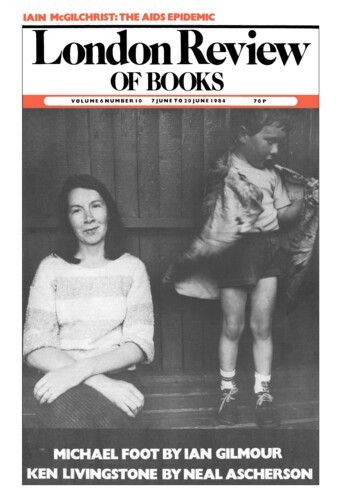
England’s End

Peter Campbell, 7 June 1984

They should be called the Kondratieff Laureates. Fifty years ago, when the economic cycle last hit bottom, J.B. Priestley made his English Journey. A few years later Orwell wrote The Road to Wigan Pier, and Edwin Muir Scottish Journey. Now, as the succeeding wave reaches the bottom of its downward swing, the BBC send out Bainbridge to follow Priestley, and James Campbell records travels which were in the spirit, if not the footsteps of Muir. Why novelists? Perhaps because it is reckoned that they will give a human dimension to the changes documented in unemployment statistics and land-use maps.
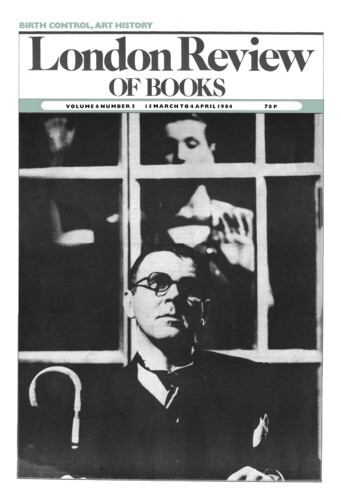
Francis and Vanessa

Peter Campbell, 15 March 1984

In Elizabeth Taylor’s novel The Wedding Group, published in 1968, there is a grand old painter called Harry Bretton. He is modelled, I would guess, on Eric Gill, for the Life, and Stanley Spencer, for the Work. Musing by the studio window, he considers his place in history:

End of the Road

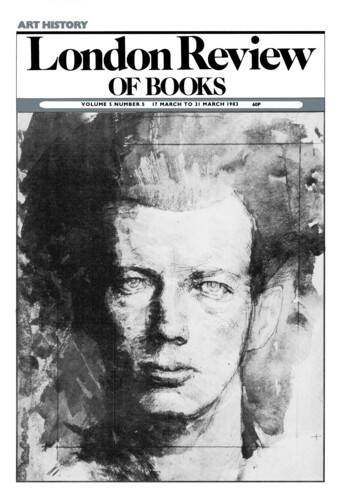
Peter Campbell, 17 March 1983

Charlatans spread scepticism. Frauds unmasked make critics look fools. When new work looks very simple, and very easy to do, eyes narrow and muttering starts about the emperor’s new clothes. The gap, between those willing to take risks and those unwilling to look fools, widens. Lawrence Weschler’s life of the Californian artist Robert Irwin is the best description I know of why spending months deciding how to put two orange lines on an orange square, or why offering a strip of black tape round the skirting of a gallery as your contribution to an exhibition, could be serious, intellectually-taxing activities. Enough critics have seen in Irwin’s work what he said he was trying to put there for communication at some level to have been established. For us, the success of what he has done is something which must be taken on trust. Much of Irwin’s work was ephemeral; those pieces now in public galleries are, we are told, displayed in ways which nullify the effects they were made to produce. Photographs are beside the point. The works depend on those things – scale, texture, the third dimension – which photography can record but not recreate. Yet the life would have been worth writing even if the work was not worth seeing.

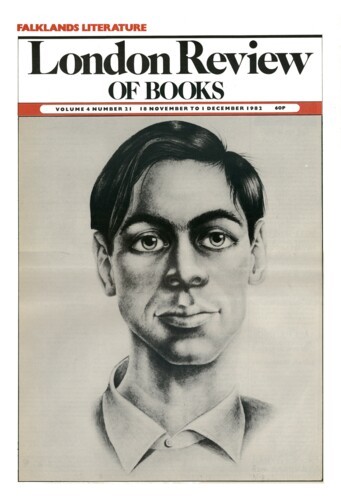
Editor’s Story

Peter Campbell, 18 November 1982

When Tom Hopkinson was nine years old his father called the family together. He had decided, he said, to become a clergyman. Later he told his son that he had been persuaded to take this long-contemplated step by hearing a sermon ‘so distracted and confused that he had realised the clergyman delivering it must be overwhelmed with the burden of his work.’ He had seen that the only thing to do was to go out and help him. So the Hopkinson family was translated from the comfortable life of a lecturer in Classical archaeology in the University of Manchester to the comparative hardships of an industrial parish. The need to serve was in the blood: Tom’s sister Esther spent most of her life as a missionary in South Africa and Rhodesia, his brother Stephan became a clergyman. Tom edited Picture Post.

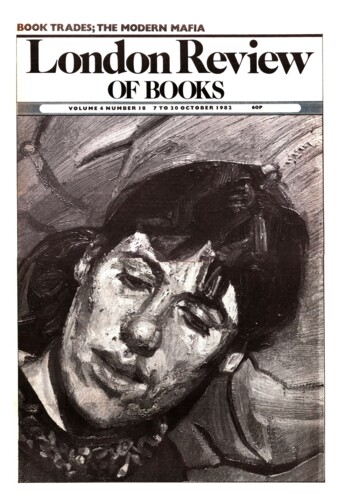
Green Minna

Peter Campbell, 7 October 1982

George Grosz made the drawings and paintings for which he will be remembered during the First World War and in the Twenties and Thirties. In his autobiography (first published in German in 1955), Old Grosz looks back at Young Grosz, and considers the change of direction which came in his work when he went to America. ‘My life in America began with an inner confrontation – a confrontation with my past. It taught me that caricatures are prized chiefly in periods of cultural decline, that life and death are too fundamental to be subjects of mockery and cheap jibes.’ The lesson was only half-learned. The best parts of his book are coloured by a taste for grotesque detail which recalls his earlier drawings rather than his later ones, and it is never clear how far he rejects, or regrets, his early work. He can be ironical about his desire to float along in the warm stream of American popular illustration: ‘My new motto was: harm none and please all. Assimilation comes easily when you have rejected the common superstition that character is of supreme importance. “Character” does duty as a synonym for inflexibility, and anyone anxious to get on in life had best dispense with it altogether.’ It is sad, almost comical, that the ‘Mild Monster’ (Time’s description) should have expected to find a place for his kind of drawing in the New Yorker – yet one can understand how the bitter taste of his talents could have failed to please him. There is no reason to believe he is being satirical when he writes that ‘even when I was following along insane Dadaist paths or making “angular” expressionist drawings and paintings I had kept sneaking looks over my shoulder at normal true-to-life illustrations. This was genuine art for the masses … I preferred their saccharine quality to those outpourings of acid, of bogus colours and forms that paraded under the name of modern art.’

Read anywhere with the London Review of Books app, available now from the App Store for Apple devices, Google Play for Android devices and Amazon for your Kindle Fire.

Sign up to our newsletter

For highlights from the latest issue, our archive and the blog, as well as news, events and exclusive promotions.

Newsletter Preferences