Peter Campbell

Peter Campbell, who was born in Wellington in New Zealand in 1937 and died in London in 2011, designed the LRB and wrote more than three hundred pieces for the paper, including, from 2000, a regular gallery piece. He also did the cover illustrations from 1993 until his death: his last, a fox in the street outside his house, was painted only a few weeks earlier. Many of these covers, as well as some of his other illustrations and book designs, can be seen in the collection Artwork and at petercampbell.org.uk.

Mary-Kay Wilmers, who first worked with him on the Listener in the late 1960s, when he designed the books for such BBC series as Kenneth Clark’s Civilisation and Jacob Bronowski’s The Ascent of Man, wrote about his capacious interests. When there wasn’t an exhibition he liked, he described what he saw around him: gasometers, plane trees, beaches (and untucked shirts), funfairs, the squares of Bloomsbury (where the LRB offices are), the timber-framed houses of Wellington. He was also interested in how things work, writing memorably about escalators. There were, as Wilmers wrote, ‘few aspects of the world that Peter didn’t wish to honour’.

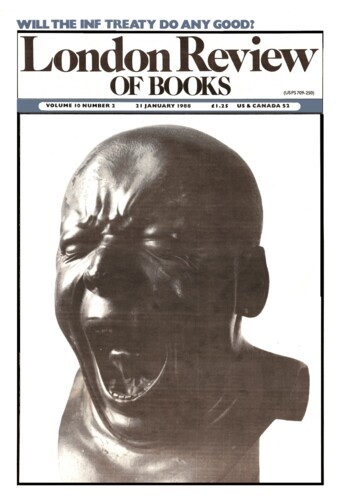
Foxy

Peter Campbell, 21 January 1988

The red fox is found throughout Europe, Asia and North America. It was introduced to Australia, although Tasmania is fox-less as the brace which hunting military men took there were destroyed. Foxes live in deserts and cities as well as in the hunting shires. They are opportunists, and not loved for it. Plain hunting has a long history: fancy persecutions were invented later. In 18th-century Germany fox-tossing was fashionable: ‘foxes were persuaded to run over narrow slings of webbing of which one end was held by a gentleman, the other by a lady. The “players” tossed the fox as it walked the tightrope – a good toss being up to twenty-four feet high. Augustus the Strong of Saxony was an enthusiastic fox-tosser and is reputed to have tossed to death some 687 foxes in one session.’ But hunters were also early systematic observers. Edward, second Duke of York, in his Master of the Game noticed what David Macdonald’s research has confirmed: foxes eat worms. As it became a more respectable quarry the fox was pampered: its habitat was protected, its enemy, the farmer with chickens, bought off, and the long argument between preservers of game and chasers of foxes began. An 18th-century hound-breeder said that ‘the murder of foxes is a most absurd prodigality.’ Those who hunt animals find the fox such a satisfying quarry that if hunting with hounds does die out it is more likely to be as a result of intensive farming – wire and spring clover do not go well with jumping horses – than thanks to the efforts of hunt saboteurs. Foxes in cold climates dress too warmly for safety, but even the British trade in fox furs peaked at over fifty thousand pelts in the late Seventies,’
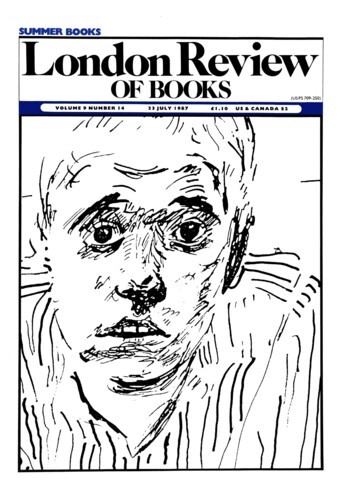
Sea Creatures

Peter Campbell, 23 July 1987

Sidney Nolan was born in Melbourne in 1916. His father was on the trams, but did rather better at illegal bookmaking. They were Irish, working-class, lapsed Catholics. Sidney left school at 14 and spent his late teens in irregular employment and part-time art education. He could not draw well enough for Mr Leyshon-White’s commercial art agency, so he ran the correspondence course. He enjoyed writing to rural amateurs telling them how bad their work was. Later he made advertising displays and did a little modelling for a hat company. He read a great deal, and made illustrations for Joyce’s Ulysses, which was banned and could only be read at the National Library. He lived for a while in a ‘weekender’ (a cottage in the bush) and tried to stow away on a ship to Britain. By the time he was 21 he had worked as cook in a hamburger bar, helped lead a strike in the hat factory, and married.

Solus lodges at the Tate

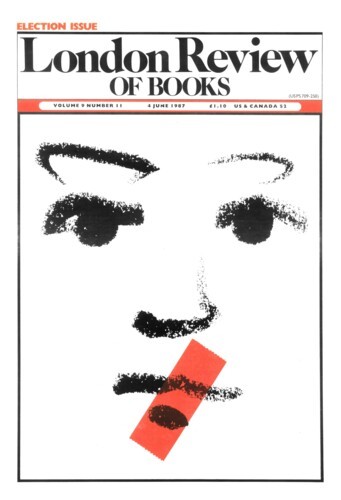
Peter Campbell, 4 June 1987

It was wet on the night of the opening of the new Turner galleries. The fireworks celebrating the occasion made the clouds of misty rain substantial. Reflections in the windows of the dismal wall of offices which faces the Tate across the Thames mixed with car lights and street lamps. A crowd from the party inside gathered on the steps under umbrellas. The bigger starbursts were applauded, much as the flames bursting through the roof of the Lords’ chamber were applauded by the crowd watching the burning of the Houses of Parliament in 1834. The fireworks roused the sense of the sublime from the distant thicket in the 20th-century mind to which it has retreated.

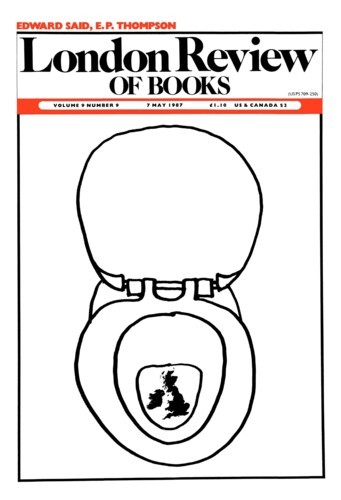
Toad-Kisser

Peter Campbell, 7 May 1987

That Patrick O’Brian would write a good book about the early life of Joseph Banks was to be expected. Banks combined the enthusiasm and practical competence of one of O’Brian’s fictional heroes, Jack Aubrey, with the passion for natural history of another, Stephen Maturin. Moreover O’Brian’s accounts in his novels of 18th-century seamanship are, like Tolstoy’s battle pieces, better historical description than most historians manage: it was clear that the variety of incident in Banks’s voyage to the Great South Sea with Cook, which matches that of any fictional adventure, was a subject made for him. What was not so obvious was that Sir Joseph’s long years of official business, as President of the Royal Society and member of various boards and committees, would be made, if anything, more interesting than the excitements of young Banks’s few years of active exploration. The book, like Reynolds’s picture of Banks in his twenties, which O’Brian much admires, is an attractive portrait. It is continuously interesting and coloured by the cheerfulness of a lucky subject.

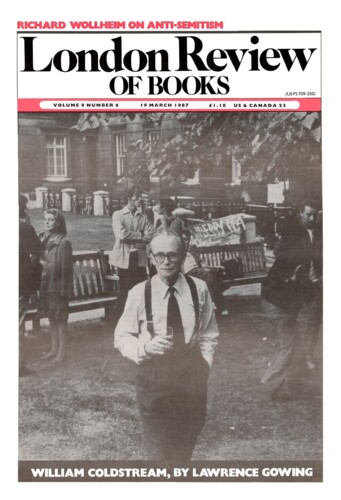
Agreeing with Berger

Peter Campbell, 19 March 1987

John Berger is 60. He is not forgotten. Permanent Red, his criticism from the Fifties, is in print. Ways of Seeing is the antidote put in the hands of students who have drunk too deeply of Courtauld art history. His novels, too, have created a stir. His first, A Painter of Our Time, had such vitriolic reviews that the publishers withdrew it, and G won the Booker Prize: Berger’s hard swallow on that sugarplum made him briefly notorious. His behaviour was un-English – but that was to be expected, for his work had never fitted English pigeonholes. In A Fortunate Man he and Jean Mohr produced a report from rural England which, like Let us now praise famous men, Agee’s report from the American Dust Bowl, imposed a solemn simplicity on its subject (Mass-Observation would have been nosier). G is an un-English mix of fiction and essay-like elements. His fiction has been didactic and his criticism passionate. He is also adaptable: as well as half a dozen novels and volumes of essays there have been television programmes and films. This varied body of work hangs together. The epigraph to the first chapter of Geoff Dyer’s book, a quotation from 1956 – ‘I am a political propagandist … But my heart and eye have remained those of a painter’ – could apply equally well to the later work at the other end of the book.’

Read anywhere with the London Review of Books app, available now from the App Store for Apple devices, Google Play for Android devices and Amazon for your Kindle Fire.

Sign up to our newsletter

For highlights from the latest issue, our archive and the blog, as well as news, events and exclusive promotions.

Newsletter Preferences