Peter Campbell

Peter Campbell, who was born in Wellington in New Zealand in 1937 and died in London in 2011, designed the LRB and wrote more than three hundred pieces for the paper, including, from 2000, a regular gallery piece. He also did the cover illustrations from 1993 until his death: his last, a fox in the street outside his house, was painted only a few weeks earlier. Many of these covers, as well as some of his other illustrations and book designs, can be seen in the collection Artwork and at petercampbell.org.uk.

Mary-Kay Wilmers, who first worked with him on the Listener in the late 1960s, when he designed the books for such BBC series as Kenneth Clark’s Civilisation and Jacob Bronowski’s The Ascent of Man, wrote about his capacious interests. When there wasn’t an exhibition he liked, he described what he saw around him: gasometers, plane trees, beaches (and untucked shirts), funfairs, the squares of Bloomsbury (where the LRB offices are), the timber-framed houses of Wellington. He was also interested in how things work, writing memorably about escalators. There were, as Wilmers wrote, ‘few aspects of the world that Peter didn’t wish to honour’.

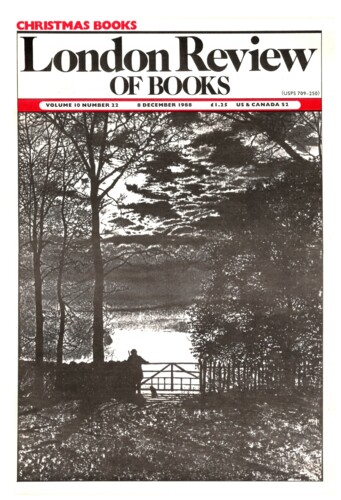
So, puss, I shall know you another time

Peter Campbell, 8 December 1988

Evolution does a wonderful job on eyes. In the matter of seeing in dim light, for example, we are not just supplied with a good tool, but with the very best the system – the rest of the body – will allow. A recent paper in Nature describes work on human and toad perception. Humans are very sensitive – a dozen or so photons are enough to trigger dim sensation; but toads will make a strike at a moving target at light levels where humans can see nothing. The best explanation of the difference between ourselves and toads seems to lie in our higher blood temperature. This sets the level of random change in the photoreceptor molecules – the level of background ‘noise’ – which in turn determines the level below which seeing is impossible.’
Wright and Wrong

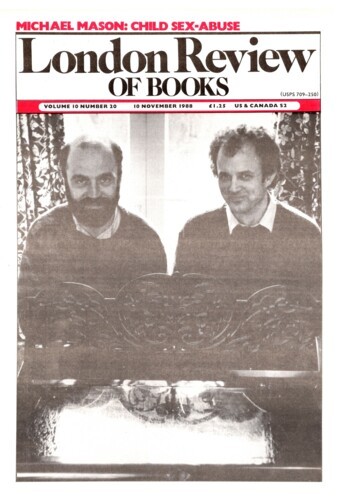
Peter Campbell, 10 November 1988

Those who have tried to make sense of Frank Lloyd Wright’s own account of his life will be grateful to Brendan Gill. He relieves us of doubts about our intelligence. As you read the Autobiography much does not quite fit. The feeling grows on you, as it must on the victims of confidence tricksters, that you cannot follow the story because you are stupid. Gill makes it clear that Wright was a fluent liar, an inventor and arranger of his past, and a re-writer of history.

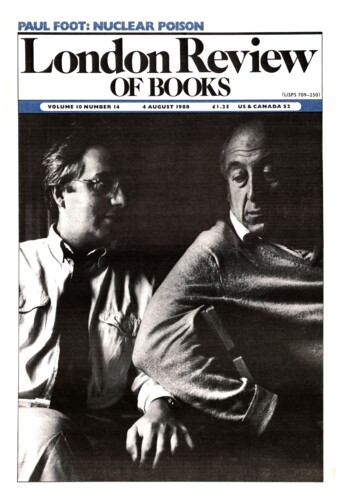
Thinking

Peter Campbell, 4 August 1988

I was in Los Angeles this spring on the day Richard Feynman died. The next morning I saw a banner lowered from the top of the tower block which stands in the middle of the Caltech campus. It read: ‘WE LOVE YOU DICK.’ The obituary of Feynman in the LA Times was awed and affectionate. It listed his achievements – his work in physics, the Nobel Prize it earned him and his work on the nuclear bomb. It also recalled his reputation as a womaniser, a drummer and a teacher, and the broadcast hearings of the inquiry into the Challenger disaster, and how Feynman demonstrated what might have gone wrong: he called for a glass of ice water, dunked in it for a few minutes a piece of the rubber used to seal the joints between the rocket stages, and showed how it had lost all its resilience. This example of practical science caught the imagination of the country in the same way that his lectures caught the imagination of students at Caltech. Here was the Sane Scientist – the heir of Benjamin Franklin. Feynman appears several times in Ed Regis’s wonderful book about the Institute for Advanced Study at Princeton (the members of which often appear in the Mad Scientist mode) as an advocate of worldly engagement. His words head an epilogue which asks difficult questions about the productivity of ivory towers:’

New Looks, New Newspapers

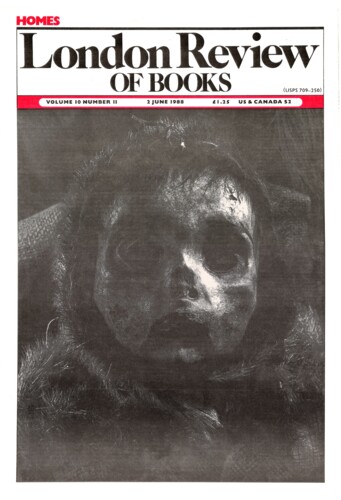
Peter Campbell, 2 June 1988

Neville Brody is advertised as the most influential graphic designer of his generation, which means something in a Britain where we have at last found what we are really good at: charming money out of each other. If appetites are not refreshed, the clothes racked in Next and the produce tumbling from supermarket horns of plenty will be food for the moth and the worm. When the words and images which sharpen desire themselves need sharpening, the graphic artist (or copywriter, or director) is called in to examine the entrails for signs of which dreams will ring tills. If you are losing the style wars, and the true guerrillas of graphics are unwilling to rally to the flag, you can at least borrow their tactics. So Brody, whose launch-pad was the independent fringe of the record business and whose orbiting vehicle was the fashion/art/interview magazine The Face, found his recipes borrowed and his mannerisms aped in work with which he had no sympathy. His revolutionary war-cries and banners were misunderstood and plagiarised at the same time. In his account of Brody’s work Jon Wozencroft describes how The Face ‘combined pop consumerism with a critique of its culture … both questioned and celebrated the growing profusion of styles in the same breath – the worst effects of “Style Culture” in the same issue that included items on “radical footwear” and “travelling hats” ’. The ambivalence this description identifies shows up in Brody’s comments on the place of design in communication. Both The Graphic Language of Neville Brody and The Making of the ‘Independent’ cast light on the relationship between writing and the medium of print. The magazines Brody has designed and the Independent are at opposite ends of the spectrum of style, but in both cases graphic design allows scanning (as against reading), and allows those buyers who read very little of the continuous text to feel that they have had their money’s worth from the paper.’

Pleasing himself

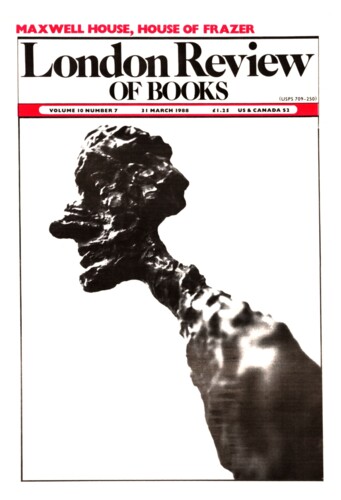
Peter Campbell, 31 March 1988

In his grand old age Rodin became a notorious toucher. One account has it that ‘in the course of a conversation he would embrace every breast and phallus within reach,’ his large hands recapitulating the act of modelling – unless it was modelling that recapitulated touching. Frederic Grunfeld suggests that Rodin’s tactile exploration of the world was in part at least a consequence of his congenital short sight. Whatever the truth of that, the bodies he made were not a product of clinical objectivity, and Pygmalion-like ambiguities concerning the relation of flesh to clay abound. It makes it hard to place him: he had allies among the Impressionists, but his work makes more sense when viewed in a tradition which includes Carpeaux, or even Sargent.’

Read anywhere with the London Review of Books app, available now from the App Store for Apple devices, Google Play for Android devices and Amazon for your Kindle Fire.

Sign up to our newsletter

For highlights from the latest issue, our archive and the blog, as well as news, events and exclusive promotions.

Newsletter Preferences