Peter Campbell

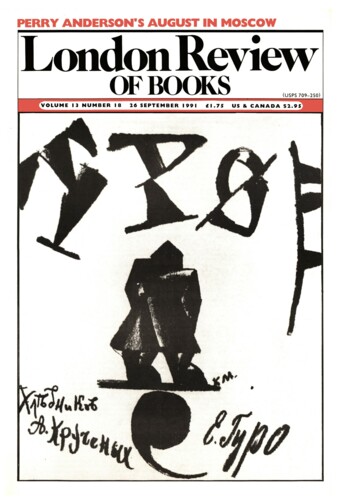
Peter Campbell, who was born in Wellington in New Zealand in 1937 and died in London in 2011, designed the LRB and wrote more than three hundred pieces for the paper, including, from 2000, a regular gallery piece. He also did the cover illustrations from 1993 until his death: his last, a fox in the street outside his house, was painted only a few weeks earlier. Many of these covers, as well as some of his other illustrations and book designs, can be seen in the collection Artwork and at petercampbell.org.uk.

Mary-Kay Wilmers, who first worked with him on the Listener in the late 1960s, when he designed the books for such BBC series as Kenneth Clark’s Civilisation and Jacob Bronowski’s The Ascent of Man, wrote about his capacious interests. When there wasn’t an exhibition he liked, he described what he saw around him: gasometers, plane trees, beaches (and untucked shirts), funfairs, the squares of Bloomsbury (where the LRB offices are), the timber-framed houses of Wellington. He was also interested in how things work, writing memorably about escalators. There were, as Wilmers wrote, ‘few aspects of the world that Peter didn’t wish to honour’.

Total Knowledge

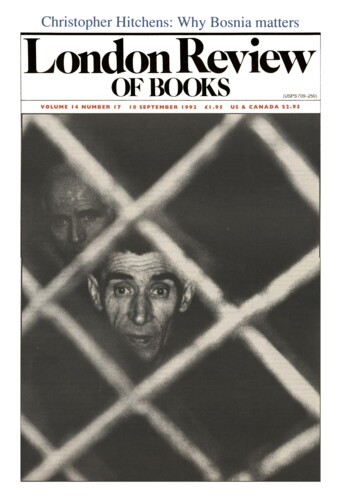
Peter Campbell, 10 September 1992

In the late Fifties, at university in New Zealand, I did the kind of degree in which you are allowed to mix subjects. I spent my first year reading philosophy, geology and English. 1 never quite got a grip on these subjects, and certainly have not kept up with them, but the memory of what it is like to do philosophy or geology remains; and when I read about debates that are going on in these areas I believe I know, even if I cannot follow it all, what kind of row or celebration is taking place.

Better than literature

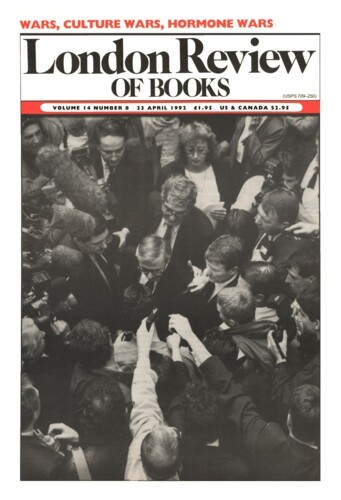
Peter Campbell, 23 April 1992

The frights the news brings – from child abuse to acid rain – prepare the mind for fictional scares. Carl Hiaasen’s comic thrillers deal with crimes against the planet. He puts wetland clearance and condominium building up alongside bank robbery and murder. His books do not offer hope. Right can only win in the short term. We are all guilty of existence and our sheer numbers...

The wearer as much as the frock

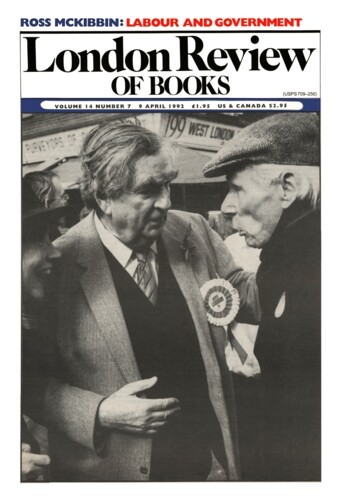
Peter Campbell, 9 April 1992

Time can play dirty tricks on architects when launch-time promises are recalled to mock crumbling fabric. The progenitors of much post-war public housing suffered in this way. Time finds out bad bets; entrepreneurs are bankrupted financially, planners intellectually. But it has always been like that. Linda Clarke’s Building Capitalism illustrates its argument with a study of Somers Town, where a late 18th-century planner’s promise – to develop an estate of middle-class houses north of the Euston Road – went just as badly wrong as any Sixties development. General Booth himself (the Salvation Army now occupy buildings only a few hundred yards from where Somers Town stood) reckoned it a centre of frightful moral and physical contagion.’

Perfectly dressed

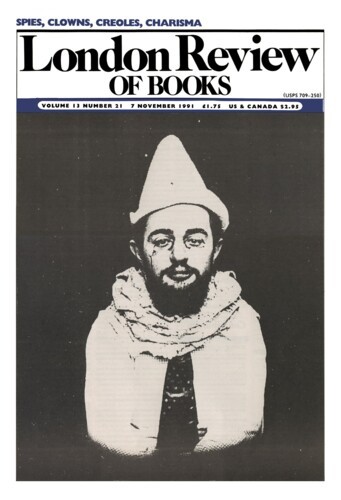
Peter Campbell, 7 November 1991

Words about pictures are often commentaries which justify categories. They give reasons for inclusions, exclusions and orderings. Connoisseurs distinguish genuine works from misattributions, and historians establish chronologies which support claims about why and how things have changed. What they write can be challenged by facts. A new X-ray or a contemporary inventory may destroy the argument a group of paintings was chosen to illustrate. Critics, by contrast, invent categories which facts cannot invalidate. For example, Kenneth Clark’s distinction between the naked and the nude stands as long as we agree that pictures of unclothed people can be assigned to either the nakedness pile or the nudity pile. A comparison or anecdote may suggest why pictures in a critical category look similar, or may be the catalyst which leads the reader to react as the writer wishes, but no revelation about a painter’s intentions, no change in attribution, no proof of forgery, can force the removal or inclusion of a particular image.

Thinking big

Peter Campbell, 26 September 1991

Great ideas share skulls with foolish thoughts. Nonsense runs with greatness, like vermin in a zoo, and no intellectual pesticide can guarantee to kill it and leave truth alive. Common sense has a particularly bad track record as a check on what is possible. So Newton, who dabbled in alchemy, would understand the characters in Ed Regis’s history of fin-de-siècle scientific hubris – subtitled ‘Science Slightly over the Edge’, it tells stories, mainly from the Seventies and Eighties, of some of the wilder projects of scientists, engineers and DIY enthusiasts. Once you start thinking on a really big scale there is no simple way of of separating the reasonable from the silly. Today’s impossibilities (immortality, travelling to the ends of the galaxy, mining the Sun, building living organisms from scratch) seem only a step or two away from a project like getting a man on the Moon. And that, only yesterday, was said by Astronomers Royal and leader writers on the New York Times to be, demonstrably, not on. Why should one be talked down from one’s tree by the kind of people who made that booboo?’

Read anywhere with the London Review of Books app, available now from the App Store for Apple devices, Google Play for Android devices and Amazon for your Kindle Fire.

Sign up to our newsletter

For highlights from the latest issue, our archive and the blog, as well as news, events and exclusive promotions.

Newsletter Preferences