Peter Campbell

Peter Campbell, who was born in Wellington in New Zealand in 1937 and died in London in 2011, designed the LRB and wrote more than three hundred pieces for the paper, including, from 2000, a regular gallery piece. He also did the cover illustrations from 1993 until his death: his last, a fox in the street outside his house, was painted only a few weeks earlier. Many of these covers, as well as some of his other illustrations and book designs, can be seen in the collection Artwork and at petercampbell.org.uk.

Mary-Kay Wilmers, who first worked with him on the Listener in the late 1960s, when he designed the books for such BBC series as Kenneth Clark’s Civilisation and Jacob Bronowski’s The Ascent of Man, wrote about his capacious interests. When there wasn’t an exhibition he liked, he described what he saw around him: gasometers, plane trees, beaches (and untucked shirts), funfairs, the squares of Bloomsbury (where the LRB offices are), the timber-framed houses of Wellington. He was also interested in how things work, writing memorably about escalators. There were, as Wilmers wrote, ‘few aspects of the world that Peter didn’t wish to honour’.

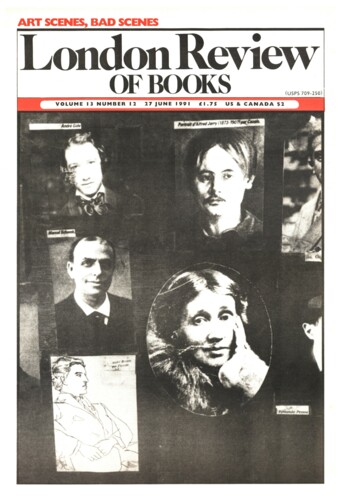
John Minton’s face is familiar – if not from the self-portrait now in the National Portrait Gallery, then from the likeness he commissioned from Lucian Freud and bequeathed to the Royal College of Art. It is very long, large-eyed, hollow-cheeked, with a receding chin and dark tousled hair. Photographs suggest that the self-portrait is a better physical likeness; the truth about his emotional state seems to lie with Lucian Freud. The manic side of his personality shows only in photographs, where the mouth stretches into a toothy grin. His work, once famous, is now probably best remembered by those who saw it when it first appeared in Penguin New Writing, or on book jackets and in magazines.’

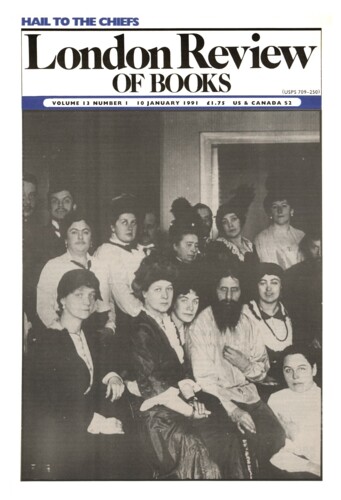
Among the quilters

Peter Campbell, 21 March 1991

Asya, the heroine of Michael Ignatieff’s novel of revolution and exile, is born into an aristocratic Russian family in 1900. As a child, she nearly drowns walking out over the thawing ice beneath which the River Vasousa roars. She has a vision there of a great skater. Her brush with death changes her and leaves her with a belief ‘even when fear had her in its clasp … that it would let her go.’ The reader is thus guaranteed a courageous heroine. And a beautiful one. She is no Jane Eyre with only grit and tenacity to compel a hero’s love: ‘she had inherited her mother’s tall thin good looks. “You look like a fine pair of Borzoi hounds,” Father used to say of them in his jocular manner, meaning that they were fineboned and delicate of feature, with long, finely tuned limbs … She had curly black hair, pale white skin and lustrous black eyelashes.’ But her father admires most her strong chin, wide downy upper lip and moth-grey eyes. About such a heroine a vast amount of tosh could be written. Ignatieff’s novel is subtitled ‘a love story’, which suggests it will rise, for better or worse, into the upper emotional register. Despite every opportunity of scene and action, it never does. He is too self-aware, or perhaps too fastidious, to abandon himself to a coloratura line. Instead, he chills Asya’s character to the point where he as narrator can safely handle it: ‘When in later life people said she was cold, she never disagreed. For she knew, and some inner recess of her body never forgot, how cold the river torrent had been.’

Letter
Barbara Everett quotes several passages from Kipling’s Something of Myself in her discussion of ‘Mrs Bathurst’ (LRB, 10 January), but not the sentences in which Kipling describes the genesis of that story: ‘All I carried away from the magic town of Auckland was the face and voice of a woman who sold me beer at a little hotel there. They stayed at the back of my head until ten years later when,...

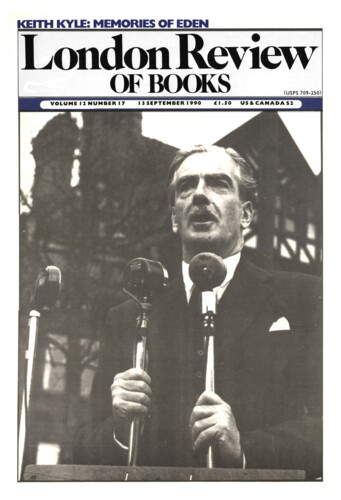
Taken with Daisy

Peter Campbell, 13 September 1990

Penelope Fitzgerald’s new novel, like her last one, The Beginning of Spring, is set just before the First World War. Its locale, 1912 Cambridge, is not much less exotic than its predecessor’s Moscow, but it is entirely convincing: Fitzgerald’s pre-1914 worlds are wonderfully circumstantial. The book is short and full of activity. The story moves swiftly in unexpected directions. It is inspiring, funny and touching. One cannot write about it without giving away a lot of the plot, which is a pity when the story is so briskly anecdotal. However, the book has a fine, strange beginning which may be enough to make you decide to get it into your hands immediately:

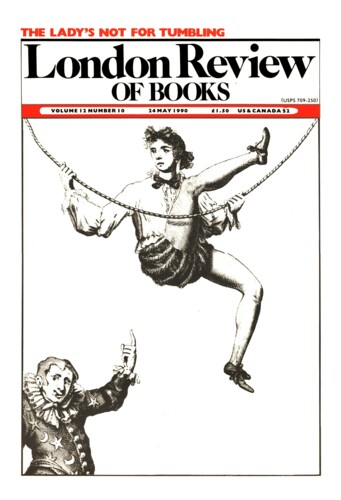
Concini and the Squirrel

Peter Campbell, 24 May 1990

In Innumeracy, a sane, amusing, unintimidating introduction to the consequences of mathematical illiteracy, John Allen Paulos shows how a little arithmetic can cast light on the cohesiveness of cultures. He quotes an experiment in which the psychologist Stanley Milgrim gave each member of a randomly-selected group of people a document and a ‘target individual’ to whom the document was to be transmitted:

Read anywhere with the London Review of Books app, available now from the App Store for Apple devices, Google Play for Android devices and Amazon for your Kindle Fire.

Sign up to our newsletter

For highlights from the latest issue, our archive and the blog, as well as news, events and exclusive promotions.

Newsletter Preferences