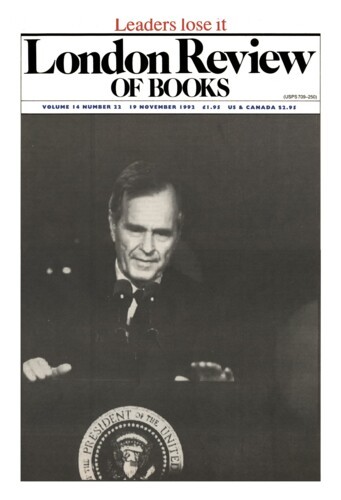
Peter Campbell

Peter Campbell, who was born in Wellington in New Zealand in 1937 and died in London in 2011, designed the LRB and wrote more than three hundred pieces for the paper, including, from 2000, a regular gallery piece. He also did the cover illustrations from 1993 until his death: his last, a fox in the street outside his house, was painted only a few weeks earlier. Many of these covers, as well as some of his other illustrations and book designs, can be seen in the collection Artwork and at petercampbell.org.uk.

Mary-Kay Wilmers, who first worked with him on the Listener in the late 1960s, when he designed the books for such BBC series as Kenneth Clark’s Civilisation and Jacob Bronowski’s The Ascent of Man, wrote about his capacious interests. When there wasn’t an exhibition he liked, he described what he saw around him: gasometers, plane trees, beaches (and untucked shirts), funfairs, the squares of Bloomsbury (where the LRB offices are), the timber-framed houses of Wellington. He was also interested in how things work, writing memorably about escalators. There were, as Wilmers wrote, ‘few aspects of the world that Peter didn’t wish to honour’.

School of Hard Knocks

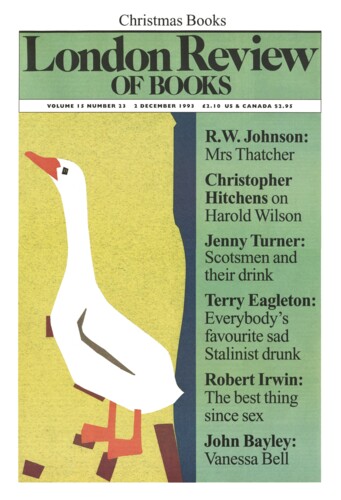
Peter Campbell, 2 December 1993

There are two forces at work in sculpture. One pushes it towards the waxwork, where materials suggest something quite contrary to their native qualities – marble flesh, wooden flowers, metal drapery and so on. The other takes it towards material for material’s sake, towards the pebble which lives by its pebble-ish nature alone. Nicholas Penny’s book shows how these forces are reconciled.’

Consider the lions

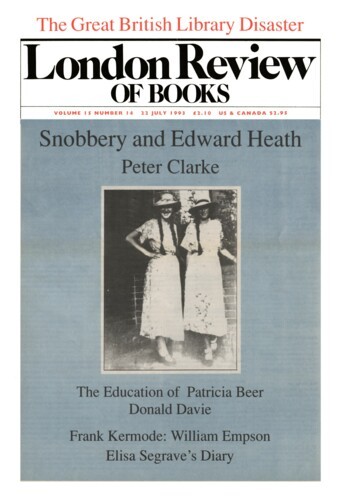
Peter Campbell, 22 July 1993

Around 1421 Marin Contarini – a member of one of the ruling Venetian families – began building a house on a site across the Grand Canal from the Rialto. This new palace replaced another, on the same site, which he had bought from his wife’s family. More than twenty years later the scaffolding came down to reveal the most resplendent domestic Venetian-Gothic façade of them all. The house was a place to live and do business. It was also, and more obviously, an advertisement for the power and wealth of the Contarini clan. It is still among the most splendid buildings in Venice. More than two hundred years later, Louis XIV built a monument to power on a much grander scale. His palace frontage is not the jolliest Classical building in Paris, but it is still the most impressive and among the most magisterially consistent.’

To hell with the lyrics

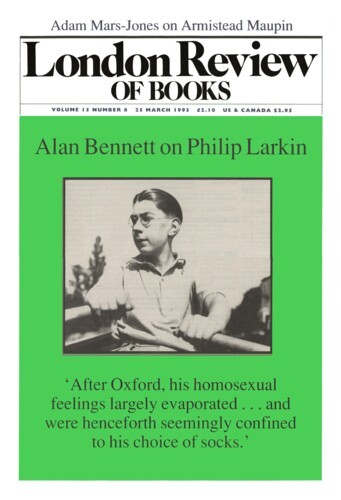
Peter Campbell, 25 March 1993

In her essay ‘Good Boys and Dead Girls’ Mary Gordon identifies the ‘American innocent’. She tracks him – young, restless and bad news for women – through the novels of Faulkner, Dreiser and Updike. ‘All that matters is that his heart must be pure, and he must move forward to the quest which for so many male American writers is the most crucial one: the search for the unfettered self.’ The ‘unfettered self’, or rather its expression in paint, was exactly what the makers of Abstract Expressionism in the Forties and Fifties pursued. Robert Motherwell was one of them, and his collected writings – a revealing gloss on artists of the School of New York and on modern painting in general – reflect one of history’s ironies.’

Bachelor Life

Peter Campbell, 28 January 1993

Delacroix should be an open book to the British. He respected them. He was a dandy with a taste for English clothes. The English taught him to paint in watercolour. He admired and was influenced by English painters – Lawrence, Wilkie, Bonington and Constable – and took subjects from Scott, Byron and Shakespeare. While others crossed the Alps to see Rome, Delacroix crossed the Channel to England, and rather liked it (although he did think he might have liked Italy better). And yet his temperament and his way of life were shaped by social conventions, family attachments and political connections which were so distinctively of the French 19th century in character that Timothy Wilson-Smith’s biography leaves the British reader feeling around for something familiar to get a grip on. Perhaps one should first rid oneself of the idea that Delacroix’s Anglophilia is going to be any help, and assume that England, as much as Morocco, was attractive because it was exotic. The source of one’s puzzlement goes deeper than national differences, however. To make sense of Delacroix’s life one must understand how the disdainful Delacroix, who said he preferred to converse with things, could cohabit with the Delacroix who was constantly dining out and eager for public recognition.’

Can I have my shilling back?

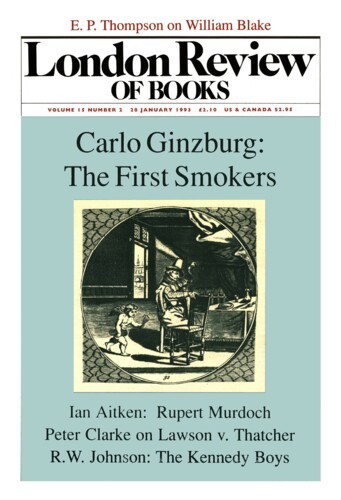
Peter Campbell, 19 November 1992

Jacob Epstein made, roughly speaking, three kinds of sculpture. There were busts and portrait heads in bronze, which pretty well everybody liked. I remember returning again and again to the photographs of them in his autobiography, particularly to the long-necked high-cheekboned girls who seemed as romantic as Picasso’s sad blue and pink people, but more substantial. Then there were the monumental bronzes: the Madonna and Child in Cavendish Square and the St Michael at Coventry, for example. These were well-liked by most people and liked very much indeed by many. Because they are whole figures, not just heads, you can see how Epstein handled poses: they tend to be solemn, formal and frontal, the palms of the hands often turned towards you. These pieces made me uneasy: were they serious, or were they just making serious gestures? They seemed uncomfortably close to allegorical figures on public monuments and war memorials which use solemn language with rhetorical mendacity. And finally there were the carvings, some very large, some modest in size, mostly smoother, more stylised, and more in the tradition of early 20th-century Modern than the cast sculptures (with the startling exception of Rock-Drill). Among these carvings are the doves, of around 1915, which were Epstein’s shot at Brancusi’s kind of abstraction and simplification, and a whole string of allegorical figures. Some owe more than others to his study of non-European sculpture, many, like Adam and Genesis, are figures composed of tight intersecting curves. This gives them a great deal of surface energy. Too much to my eye: Adam seems to be pumping iron and the pregnant figure of Genesis to be painfully swollen. Although some people liked as much these carved figures, from the BMA sculptures of 1908 to the TUC memorial of 1958 as much as the bronzes, they were almost pathologically, and very publicly loathed by others

Read anywhere with the London Review of Books app, available now from the App Store for Apple devices, Google Play for Android devices and Amazon for your Kindle Fire.

Sign up to our newsletter

For highlights from the latest issue, our archive and the blog, as well as news, events and exclusive promotions.

Newsletter Preferences