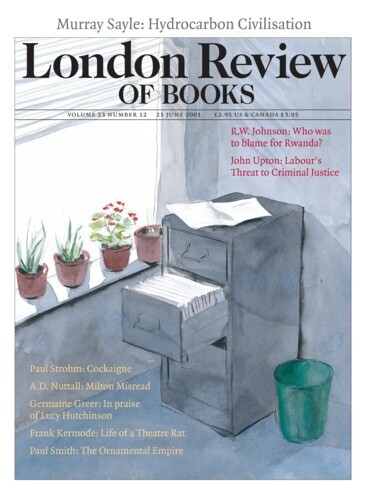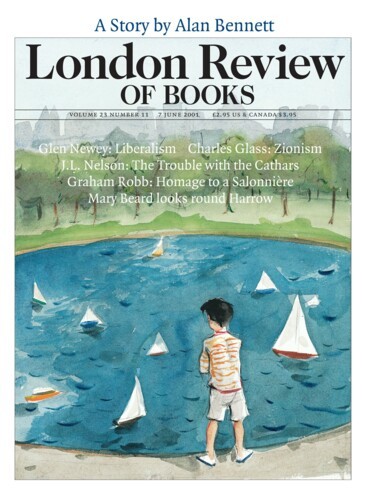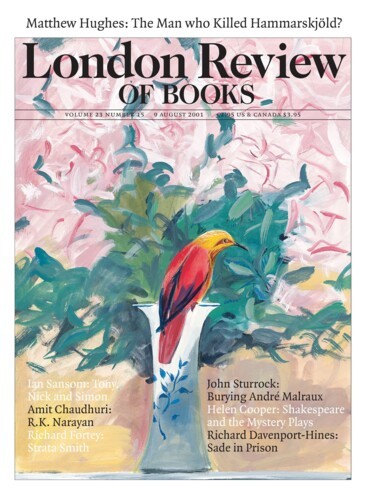
Peter Campbell

Peter Campbell, who was born in Wellington in New Zealand in 1937 and died in London in 2011, designed the LRB and wrote more than three hundred pieces for the paper, including, from 2000, a regular gallery piece. He also did the cover illustrations from 1993 until his death: his last, a fox in the street outside his house, was painted only a few weeks earlier. Many of these covers, as well as some of his other illustrations and book designs, can be seen in the collection Artwork and at petercampbell.org.uk.

Mary-Kay Wilmers, who first worked with him on the Listener in the late 1960s, when he designed the books for such BBC series as Kenneth Clark’s Civilisation and Jacob Bronowski’s The Ascent of Man, wrote about his capacious interests. When there wasn’t an exhibition he liked, he described what he saw around him: gasometers, plane trees, beaches (and untucked shirts), funfairs, the squares of Bloomsbury (where the LRB offices are), the timber-framed houses of Wellington. He was also interested in how things work, writing memorably about escalators. There were, as Wilmers wrote, ‘few aspects of the world that Peter didn’t wish to honour’.

At Tate Britain: Michael Andrews

Peter Campbell, 9 August 2001

Michael Andrews was born in 1928 and died in 1995. He didn’t produce many paintings (although the ones he made tended to be large). In the exhibition at Tate Britain until 17 October the full range of his work can be appreciated for the first time. Andrews followed a route which depersonalises the act of looking. He was taught by William Coldstream, and said: ‘Bill gave me my first...
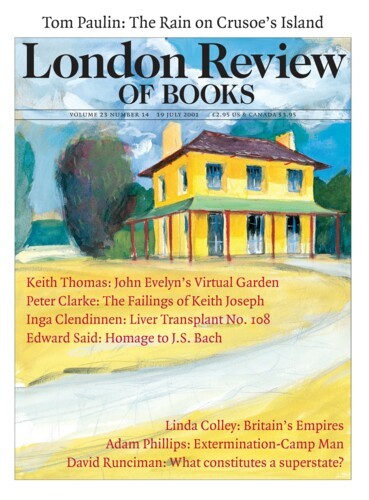
At Condor Cycles: The Tour

Peter Campbell, 19 July 2001

On 7 July the Tour de France began in Dunkirk. Lance Armstrong, who won in 1999 and 2000, has called it ‘a contest of purposeless suffering’. Cycling more than two thousand miles (many of them mountainous) in 21 days is as brutal a challenge as sport can offer. To meet it the human body is treated like a machine – the engine of the bike/body vehicle. The rider’s...

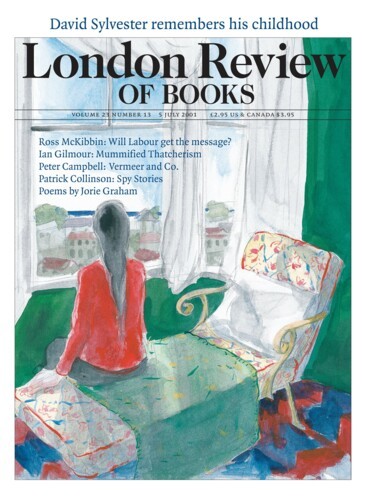
Three masters – Carel Fabritius, Pieter de Hooch and Johannes Vermeer – dominate the exhibition Vermeer and the Delft School, at the National Gallery until 16 September. It shows painting done in the town during the first 75 years of the 17th century. Of the three masters Fabritius is the least Delft-like. His subject-matter is not domestic, predictable or repetitious – and...

At Tate Britain: James Gillray

Peter Campbell, 21 June 2001

Caricature is visible metaphor. Expressed in words, the idea that ‘Napoleon sliced off Europe as France’s share of the global pudding while Pitt took the oceans for Britain,’ is unremarkable. But drawn by Gillray, as The Plumb-pudding in Danger; – or – State Epicures taking un Petit Souper, it comes alive. The two men in absurdly large hats who stab vigorously at...

The market in new paintings is exceptionally skittish. Creative Quarters,* an entirely agreeable and pleasingly discursive exhibition at the Museum of London until 15 July, maps the way money – in the form of cheap rents and unpredictable fashions – causes the artist herd to migrate back and forth across an ever-expanding city. Over the centuries cheapness drew the young and...

Read anywhere with the London Review of Books app, available now from the App Store for Apple devices, Google Play for Android devices and Amazon for your Kindle Fire.

Sign up to our newsletter

For highlights from the latest issue, our archive and the blog, as well as news, events and exclusive promotions.

Newsletter Preferences