Peter Campbell

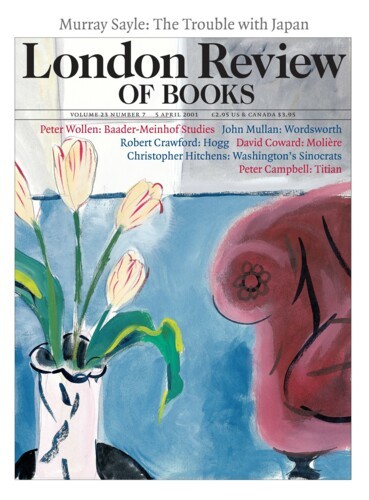
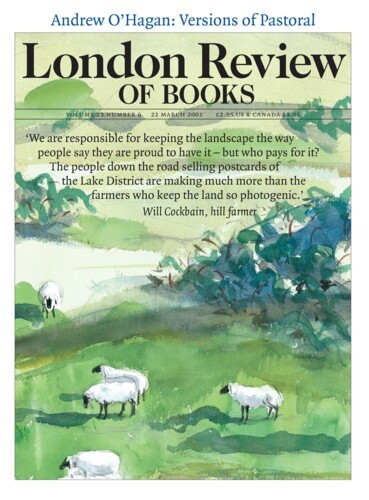
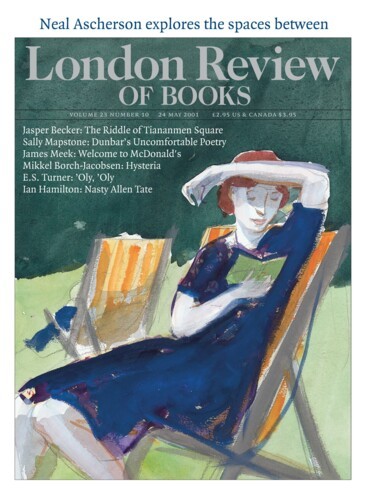
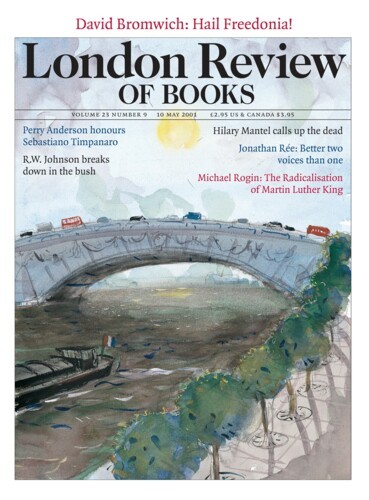
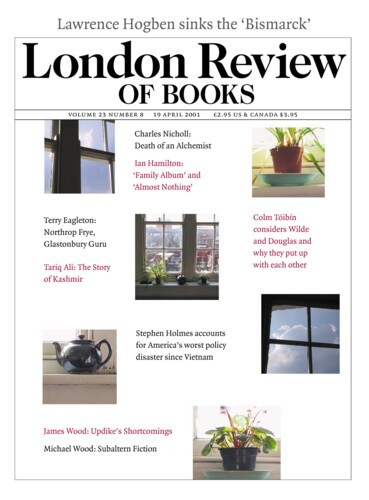
Peter Campbell, who was born in Wellington in New Zealand in 1937 and died in London in 2011, designed the LRB and wrote more than three hundred pieces for the paper, including, from 2000, a regular gallery piece. He also did the cover illustrations from 1993 until his death: his last, a fox in the street outside his house, was painted only a few weeks earlier. Many of these covers, as well as some of his other illustrations and book designs, can be seen in the collection Artwork and at petercampbell.org.uk.

Mary-Kay Wilmers, who first worked with him on the Listener in the late 1960s, when he designed the books for such BBC series as Kenneth Clark’s Civilisation and Jacob Bronowski’s The Ascent of Man, wrote about his capacious interests. When there wasn’t an exhibition he liked, he described what he saw around him: gasometers, plane trees, beaches (and untucked shirts), funfairs, the squares of Bloomsbury (where the LRB offices are), the timber-framed houses of Wellington. He was also interested in how things work, writing memorably about escalators. There were, as Wilmers wrote, ‘few aspects of the world that Peter didn’t wish to honour’.

In Soho: Richard Rogers Partnership

Peter Campbell, 24 May 2001

John Nash’s commentary on his 1810 plan for Regent Street was clear about the social implications of what he was suggesting: ‘The whole communication from Charing-Cross to Oxford Street will be a boundary, and complete separation between the Streets and the Squares occupied by the Nobility and Gentry, and the narrower streets and meaner houses occupied by mechanics and the trading...
Imagination must take the strain when facts are few. As information about the domestic life of polygamous Oriental households was fragmentary, 17th, 18th and 19th-century European writers and painters filled gaps with gaudy embroidery. Only the barest descriptions and a little gossip about the seclusion of women were necessary to seed fantasies about sex, submission, jealousy, power and...

At Tate Britain: Stanley Spencer

Peter Campbell, 19 April 2001

Official art has a bad name, yet the pictures commissioned in Britain to record the two world wars were often as good, or better, than anything else the artists did. The paintings Stanley Spencer based on his memories of service in the First War – represented in the exhibition at Tate Britain by his picture of a field dressing station in Salonika – and those commissioned in 1940...

A Wonder and a Scandal: Titian

Peter Campbell, 5 April 2001

If you are willing to define what you mean by it, the idea of progress in the arts is useful. Take Titian’s portraits. Whether or not those who first saw them understood that a new way of recording likeness was evolving, that way would define the technical ambitions of European portrait painting until photography put an end to them. In portraiture, as Titian proved, accurate drawing and...

‘A Billet outside Paris’ (1894) by Anton von Werner

That the 19th-century paintings from the Berlin Nationalgalerie should be exhibited at the National Gallery, London (which is, of course, as a collection, international) is a little confusing. They would be more at home alongside the 19th-century pictures in (or once in) the British national collection at the Tate. The Berlin...

Read anywhere with the London Review of Books app, available now from the App Store for Apple devices, Google Play for Android devices and Amazon for your Kindle Fire.

Sign up to our newsletter

For highlights from the latest issue, our archive and the blog, as well as news, events and exclusive promotions.

Newsletter Preferences