Peter Campbell

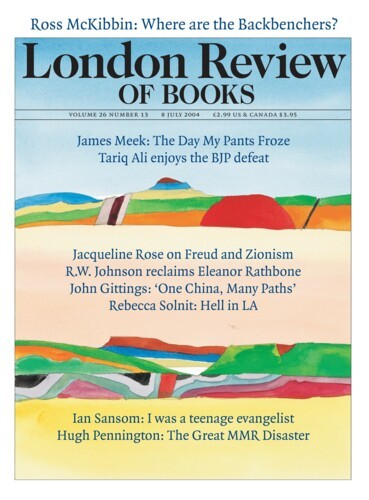
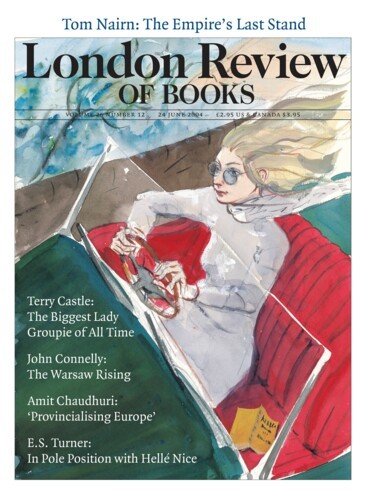
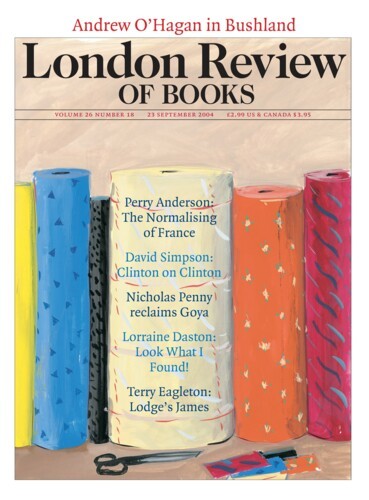
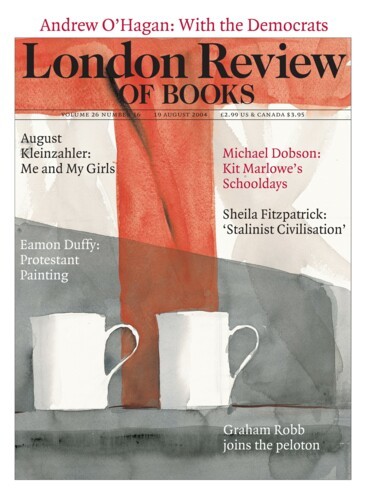
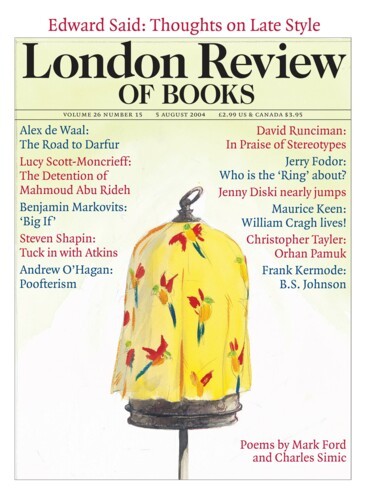
Peter Campbell, who was born in Wellington in New Zealand in 1937 and died in London in 2011, designed the LRB and wrote more than three hundred pieces for the paper, including, from 2000, a regular gallery piece. He also did the cover illustrations from 1993 until his death: his last, a fox in the street outside his house, was painted only a few weeks earlier. Many of these covers, as well as some of his other illustrations and book designs, can be seen in the collection Artwork and at petercampbell.org.uk.

Mary-Kay Wilmers, who first worked with him on the Listener in the late 1960s, when he designed the books for such BBC series as Kenneth Clark’s Civilisation and Jacob Bronowski’s The Ascent of Man, wrote about his capacious interests. When there wasn’t an exhibition he liked, he described what he saw around him: gasometers, plane trees, beaches (and untucked shirts), funfairs, the squares of Bloomsbury (where the LRB offices are), the timber-framed houses of Wellington. He was also interested in how things work, writing memorably about escalators. There were, as Wilmers wrote, ‘few aspects of the world that Peter didn’t wish to honour’.

‘The Apotheosis of the Bicycle’ (‘Vogue’, 1944).

The National Portrait Gallery​ has put up a dozen or so photographs by Norman Parkinson to accompany the publication of Portraits in Fashion,* an overview of his contribution to fashion photography, the category to which the greater part of his work belongs. He began as a court photographer, taking pictures of debs,...
Diary: In the Park

Peter Campbell, 19 August 2004

In 1963 we bought a house in Southfields, a few hundred yards from the All England Lawn Tennis Club. Every year since then we have, for a fortnight, had to elbow our way crossly through tides of tennis fans. During those weeks, Wimbledon Park, which lies beyond the wall at the end of our street, is given over to cars. That invasion irritates me as much as the human traffic. The park is shared...

In the early days of colour television you could buy a device which, it was said, would convert your black and white set. It consisted of a transparent plastic sheet, half blue and half green. You stuck it over the screen, in the hope that once in a while the sky and the prairie would divide the picture in the right proportions. Arkhip Kuindzhi’s Landscape: The Steppe of 1890 is the only...

At Tate Britain: gardens

Peter Campbell, 8 July 2004

From the top window at the back of our house I look down on three gardens. To the right is a wilderness, abandoned to brambles, ground elder, bindweed and buddleia. Then our patch: some of it is paved, there is a frog pond, a fig tree, acanthus, bamboo and cranesbill. To the left an Italian neighbour has set out rows of plants in pots; she also has a well-pruned grape vine. You can see the...

It is a reasonably shabby door at the end of a reasonably shabby corridor in the sort of building that was new about the years the all-tile bathroom became the basis of civilisation . . . Come on in – there’s nobody in here but me and a big bluebottle fly.

This is the kind of room Edward Hopper paints. There is a man in shirt-sleeves, sometimes a secretary too, or maybe a...

Read anywhere with the London Review of Books app, available now from the App Store for Apple devices, Google Play for Android devices and Amazon for your Kindle Fire.

Sign up to our newsletter

For highlights from the latest issue, our archive and the blog, as well as news, events and exclusive promotions.

Newsletter Preferences