Peter Campbell

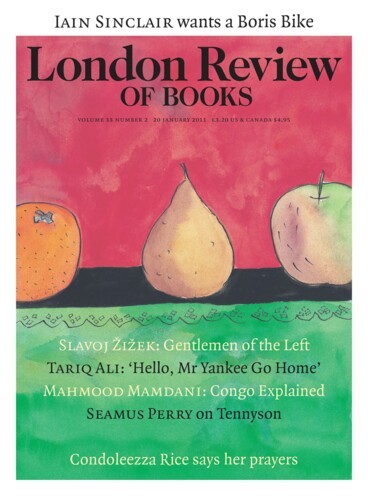
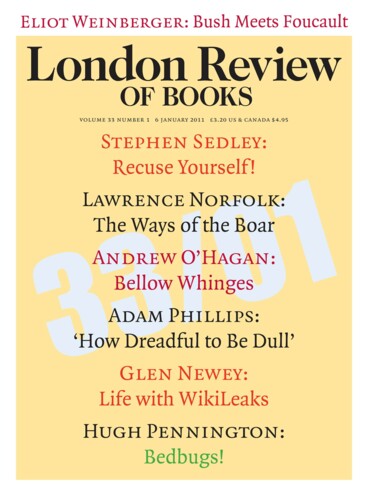
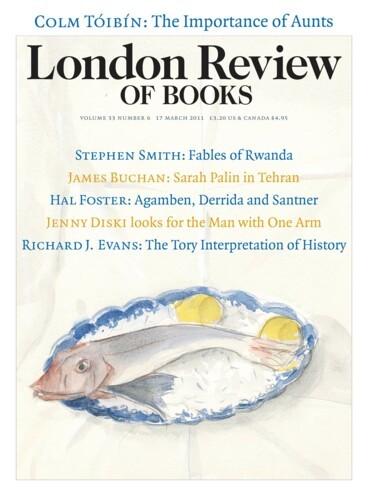
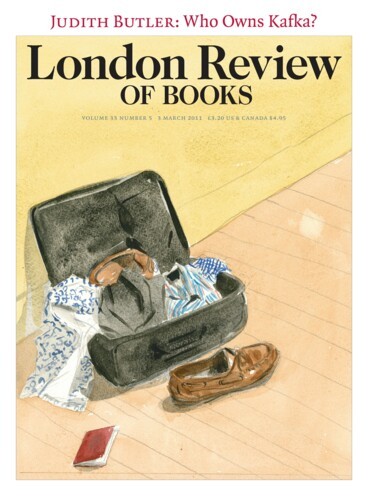
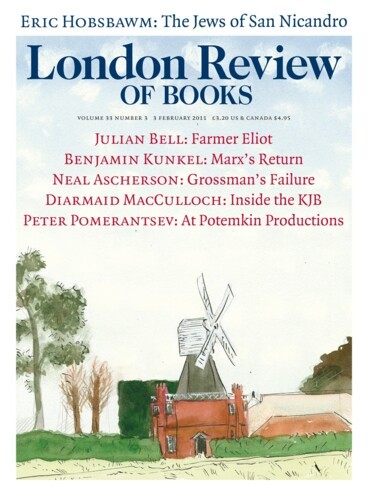
Peter Campbell, who was born in Wellington in New Zealand in 1937 and died in London in 2011, designed the LRB and wrote more than three hundred pieces for the paper, including, from 2000, a regular gallery piece. He also did the cover illustrations from 1993 until his death: his last, a fox in the street outside his house, was painted only a few weeks earlier. Many of these covers, as well as some of his other illustrations and book designs, can be seen in the collection Artwork and at petercampbell.org.uk.

Mary-Kay Wilmers, who first worked with him on the Listener in the late 1960s, when he designed the books for such BBC series as Kenneth Clark’s Civilisation and Jacob Bronowski’s The Ascent of Man, wrote about his capacious interests. When there wasn’t an exhibition he liked, he described what he saw around him: gasometers, plane trees, beaches (and untucked shirts), funfairs, the squares of Bloomsbury (where the LRB offices are), the timber-framed houses of Wellington. He was also interested in how things work, writing memorably about escalators. There were, as Wilmers wrote, ‘few aspects of the world that Peter didn’t wish to honour’.

At the National Gallery: Jan Gossaert

Peter Campbell, 17 March 2011

The Three Kings in Jan Gossaert’s Adoration of the Kings are lavishly dressed and richly supplied with gifts. The building in which they have discovered the Nativity is a handsome ruin. The arrangement of figures and walls is solemnly vertical. The painting is dated between 1510 and 1515 and is the finest in Jan Gossaert’s Renaissance at the National Gallery (until 30 May). A new...
At Tate Britain: ‘Watercolour’

Peter Campbell, 3 March 2011

I don’t remember when I was first irritated by that children’s rhyme, which is wrong twice over. Oil painting may well be hard but in some ways it’s easier than painting in watercolour, and watercolours are often more beautiful. However, the prejudice the rhyme encapsulates does arise from real differences. A typical oil painting is an object, a substantial piece of work...

Camille Pissarro, the great Impressionist painter, spent a year in England escaping from the Franco-Prussian War. His eldest son, Lucien, spent more than half his life here. Lucien was the gentlest, sweetest, least practical of men, it seems. His wife, Esther, the tough one, had two goals, the art historian John Rewald wrote: ‘to make friends happy while at the same time running his...

At Dulwich Picture Gallery: Norman Rockwell

Peter Campbell, 20 January 2011

If you grew up in the 1940s and 1950s anywhere in the English-speaking world where American magazines were more likely to be found than European ones, places where the culture was popular not high, then a pile of the Saturday Evening Post with Norman Rockwell’s covers was likely to have been a solace, and an entertainment. In my case it was New Zealand. My wife remembers sharpening her...

In his lifetime his reputation was high, but Sir Thomas Lawrence was scarcely buried – with great pomp in the crypt of St Paul’s – before the feeling spread that his work had more brilliance than substance. Victorians, who disliked the morals and manners of the leaders of Regency society, found them reflected in Lawrence’s frequently showy pictures of the men, their...

Read anywhere with the London Review of Books app, available now from the App Store for Apple devices, Google Play for Android devices and Amazon for your Kindle Fire.

Sign up to our newsletter

For highlights from the latest issue, our archive and the blog, as well as news, events and exclusive promotions.

Newsletter Preferences