Peter Campbell

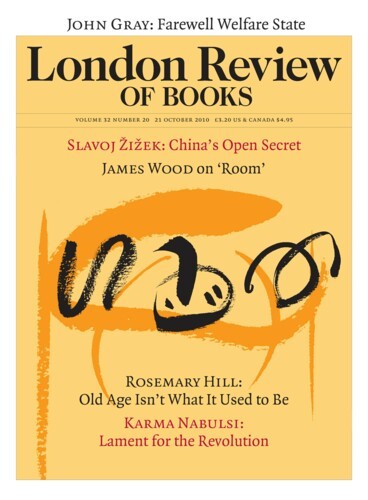
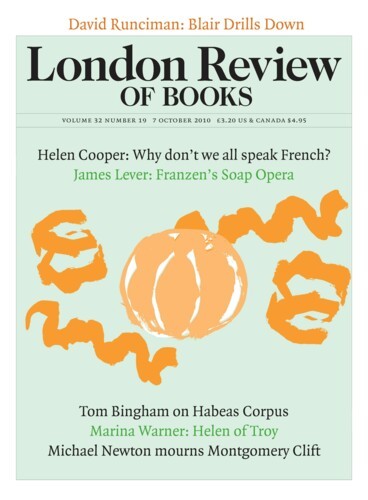
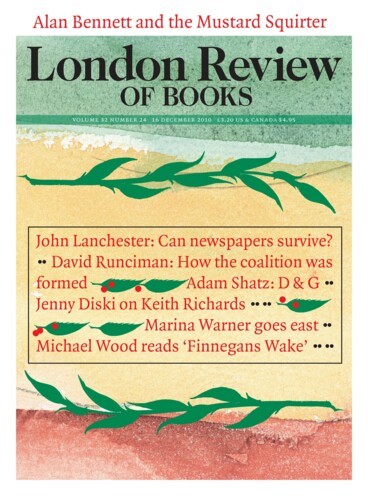
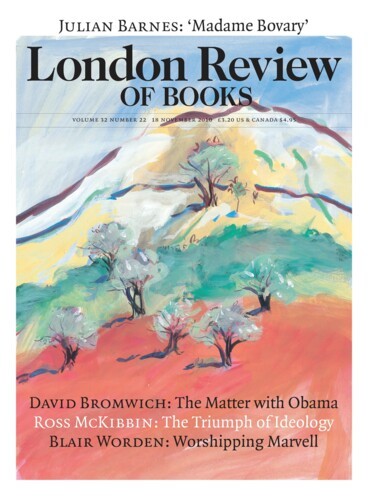
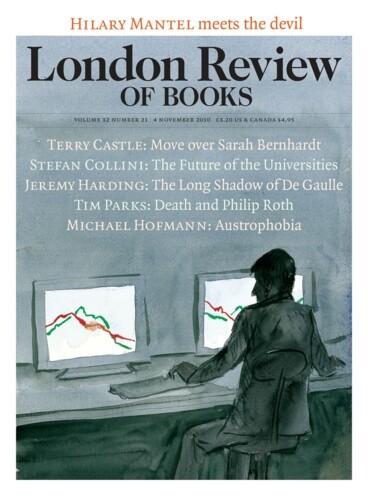
Peter Campbell, who was born in Wellington in New Zealand in 1937 and died in London in 2011, designed the LRB and wrote more than three hundred pieces for the paper, including, from 2000, a regular gallery piece. He also did the cover illustrations from 1993 until his death: his last, a fox in the street outside his house, was painted only a few weeks earlier. Many of these covers, as well as some of his other illustrations and book designs, can be seen in the collection Artwork and at petercampbell.org.uk.

Mary-Kay Wilmers, who first worked with him on the Listener in the late 1960s, when he designed the books for such BBC series as Kenneth Clark’s Civilisation and Jacob Bronowski’s The Ascent of Man, wrote about his capacious interests. When there wasn’t an exhibition he liked, he described what he saw around him: gasometers, plane trees, beaches (and untucked shirts), funfairs, the squares of Bloomsbury (where the LRB offices are), the timber-framed houses of Wellington. He was also interested in how things work, writing memorably about escalators. There were, as Wilmers wrote, ‘few aspects of the world that Peter didn’t wish to honour’.

At the Gagosian: James Turrell

Peter Campbell, 16 December 2010

When you shut your eyes you still see. If the light is strong you register a red haze as it passes through your eyelids, or the retinal after-images of bright objects. But even without residual inputs, even when there is nothing you can be said to have looked at, you still see spots and flashes and more organised phenomena like the fringe patterns that go with some headaches. That kind of...
It’s illegal to drive while you’re on your mobile phone, so why do galleries ask you to listen on headsets while you look at pictures? There is plenty of evidence – intuitive, anecdotal (scientific too, for all I know) – to show that concentrated listening and concentrated looking interfere with one another. Is it the money the headsets bring in? Or is it part of a...

At the V&A: The Ballets Russes

Peter Campbell, 4 November 2010

The range of materials in the exhibition Diaghilev and the Golden Age of the Ballets Russes, 1909-29 (at the V&A until 9 January) is not limited by beauty or intrinsic interest: if an item can help to explain how Diaghilev controlled and galvanised his family of collaborators, or let us imagine what near-century-old performances might have been like and why they transformed the art of...

At Tate Modern: Gauguin

Peter Campbell, 21 October 2010

Sweeney, in Eliot’s Sweeney Agonistes, says he’ll carry Doris off to a cannibal isle (she’s unimpressed). There will be:

Nothing to hear but the sound of the surf. Nothing at all but three things. DORIS: What things? SWEENEY: Birth, and copulation, and death. That’s all, that’s all, that’s all, that’s all. Birth and copulation and death. DORIS:...

At Tate Britain: Rachel Whiteread

Peter Campbell, 7 October 2010

Over the years the empty fourth plinth in Trafalgar Square became a focus for attitudes to monuments and monumentality. There was no agreement about which person, victory or event should be celebrated, and little confidence that any modern sculptor could manage the sorrow, patriotism, nobility, admiration, pride and so on that would once have seemed appropriate. There were those who lobbied...

Read anywhere with the London Review of Books app, available now from the App Store for Apple devices, Google Play for Android devices and Amazon for your Kindle Fire.

Sign up to our newsletter

For highlights from the latest issue, our archive and the blog, as well as news, events and exclusive promotions.

Newsletter Preferences