Michael Wood

Michael Wood is an emeritus professor at Princeton. He has written books on Yeats, Nabokov, Stendhal, Hitchcock and Empson, among other things.

Looking away

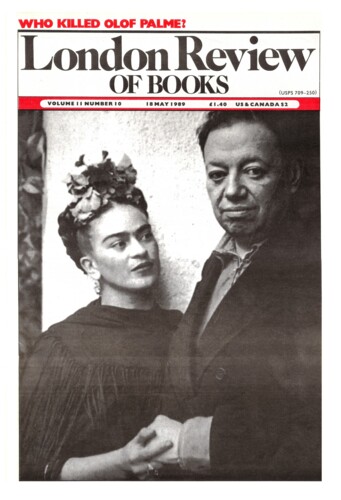
Michael Wood, 18 May 1989

‘The dead writers,’ Eliot said, ‘are that which we know.’ They are also, Peter Ackroyd might want to add, that which we don’t know we know or wish we knew better, agents of prodigious but incomplete hauntings. From The Last Testament of Oscar Wilde to Chatterton, Ackroyd has shown himself an adept in the speech of such ghosts. Indeed his gift for their speech is so great that it can be distracting: we forget to wonder if the ghosts have anything to say.

What time is it?

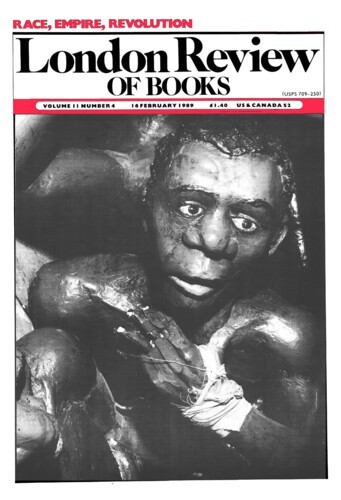
Michael Wood, 16 February 1989

‘If it’s December 1941 in Casablanca,’ Humphrey Bogart moodily asks in a famous movie, ‘what time is it in New York?’ The answer is not as obvious as it looks. Time, especially political time, has snags, hitches, runs; lags behind in some places, suddenly catches up. Reading translations, which have often travelled to us across all kinds of odd delays, we could do worse than adapt Bogart’s question to our texts. If it’s February 1989 in England, what time is it in Sweden, Germany, Italy?

The Horror of Money

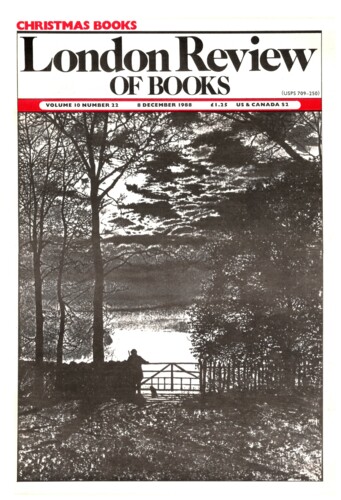
Michael Wood, 8 December 1988

Stendhal wrote compulsively from an early age. He scribbled copious advice to himself in a diary, coached his elder sister by correspondence, wrote travel books, autobiographies, a treatise on love, books on composers and painters. He wrote fast too, completed Le Rouge et le Noir while he was receiving the proofs of the work’s earlier chapters, and notoriously dashed off the whole of La Chartreuse de Parme in seven weeks. Yet this swift and prolific writer published only three novels in his lifetime, and was also a great master of the false start. He gave up enough novels to provide a book later assigned just that name: Romans Abandonnés. The equally abandoned Lucien Leuwen is some six hundred pages long, and one of the world’s greatest unfinished books. The serious competition, I suppose, would be Musil’s Man without Qualities.

The Meaninglessness of Meaning

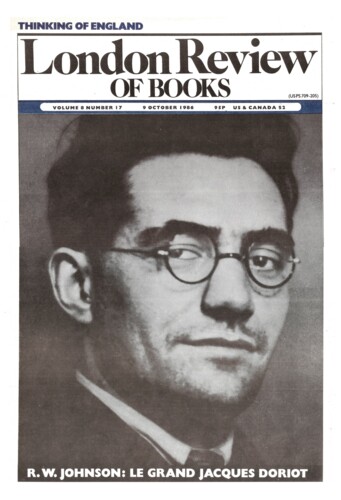
Michael Wood, 9 October 1986

A diary, Roland Barthes suggested, provokes in its writer not the tragic question, ‘Who am I?’ but the comic question: ‘Am I?’ This elegant and amused remark goes some way towards explaining why Barthes, who reflected much on his life and published a book called Roland Barthes par Roland Barthes, should not have kept a diary. The comic question can’t be confronted, it can only be circumvented, played with, smiled at. Of course, if you didn’t think it was funny, or if you were sure of the answer, you could keep a diary: but you wouldn’t be Barthes.

Fine Chances

Michael Wood, 5 June 1986

Henry James was a great haunter of drawing-rooms and dining-rooms, but it is not easy to picture him in a place called the Library of America, which is the name of the edition of which these volumes form a part. How does he look, posing for posterity alongside Poe, Jefferson, Melville, Mark Twain, Jack London, Harriet Beecher Stowe and others? Is he smiling at some of the company he is keeping; frowning momentarily at the presence of Whitman, who at first he thought was not a poet but a man merely ‘bullied by the accidents’ of experience? Does he make one of his oblique and courteous jokes, expressing surprise that America, in view of everything he thought it lacked, should have a library? ‘No sovereign,’ he said, wryly itemising his country’s social and cultural austerity, ‘no court, no personal loyalty, no aristocracy, no church, no clergy, no army, no diplomatic service, no country gentlemen, no palaces, no castles, nor manors, nor old country-houses, nor parsonages, nor thatched cottages nor ivied ruins; no cathedrals, nor abbeys, nor little Norman churches; no great Universities nor public schools – no Oxford, nor Eton, nor Harrow; no literature, no novels, no museums, no pictures, no political society, no sporting class – no Epsom nor Ascot!’ Of course James was speaking of America in the 1830s, the world the young Hawthorne looked out on, and he was exaggerating anyway. He knew America had changed, was changing as he wrote, and we can see that several of these apparent deficiencies have happily and not so happily been met. The interesting thing about the list is its slither from the civic to the picturesque, and its mocking little leap from Oxford to Ascot. The American lack is (or was) real enough: but we begin to wonder how we should feel about our own prissy possessions. James goes on to offer back-handed compliments in both directions. ‘The natural remark’ – for a European, he means – ‘in the almost lurid light of such an indictment, would be that if these things are left out, everything is left out. The American knows that a good deal remains; what it is that remains – that is his secret, his joke, as one may say.’’

Pirouette on a Sixpence: Untranslatables

Christopher Prendergast, 10 September 2015

O n​ the face of it a Dictionary of Untranslatables looks like a contradiction in terms, either self-imploding from the word go, or, if pursued, headed fast down a cul-de-sac in which it is...

Read more reviews

It took a very special kind of invention to get an awareness of the ‘erratic truth of death’s timing’ into a medium of mass entertainment.

Read more reviews

I told you so! oracles

James Davidson, 2 December 2004

I don’t believe in astrology, but I also know that not believing in astrology is a typically Taurean trait. When I first caught a bright young friend browsing in the astrology section of a...

Read more reviews

And That Rug! images of Shakespeare

Michael Dobson, 6 November 2003

Above the entrance to the saloon bar there is a picture of Shakespeare on the swinging sign. It is the same picture of Shakespeare that I remember from my schooldays, when I frowned over Timon of...

Read more reviews

Unspeakability

John Lanchester, 6 October 1994

Musing over Don Juan, Byron asked his banker and agent Douglas Kinnaird a rhetorical question: ‘Could any man have written it – who has not lived in the world? – and tooled in a...

Read more reviews

Read anywhere with the London Review of Books app, available now from the App Store for Apple devices, Google Play for Android devices and Amazon for your Kindle Fire.

Sign up to our newsletters

For highlights from the latest issue, our archive and the blog, as well as news, events and exclusive promotions.

Newsletter Preferences