Michael Wood

Michael Wood is an emeritus professor at Princeton. He has written books on Yeats, Nabokov, Stendhal, Hitchcock and Empson, among other things.

Theory with a Wife

Michael Wood, 3 October 1985

At the beginning of Robert Musil’s Man without Qualities a well-dressed couple arrives at the scene of an accident on a busy street in Vienna. The lady is uncomfortable, ‘had a disagreeable sensation in the pit of her stomach, which she felt entitled to take for compassion’. The man, after a pause, says: ‘These heavy lorries they use here have too long a braking-distance.’ The lady is much relieved. ‘Though she had doubtless heard the expression many times before, she did not know what a braking-distance was, nor had she any wish to know; it was sufficient for her that by this means the horrible happening could be fitted into some kind of pattern, so becoming a technical problem that no longer directly concerned her.’
The event that doesn’t occur

Michael Wood, 4 April 1985

Since his death in 1977, Nabokov has made three literary appearances: rather plodding affairs for such a gifted ghost, even allowing for their modest academic occasions and for the fact that the published texts (Lectures on Literature, Lectures on Russian Literature, Lectures on Don Quixote) represent scripts and drafts rather than the things themselves. Nabokov’s lectures, like his cramped and prickly prefaces, mainly serve to highlight the marvels of his fiction, where the pedestrian takes to the air, and his often domineering intelligence joins forces with his kindlier imagination. At first glance the present volume – containing four early and previously untranslated Russian plays and a couple of lectures on drama given at Stanford in 1941 – looks like just another dip into the dwindling family barrel. Dmitri Nabokov speaks in his introduction of ‘the elegant, appetising, carefully selected baggage that survives Father in Montreux’, and for a flickering instant I thought perhaps he was planning to publish that. The first glance, though, gets only part of the picture.’

Are women nicer than men?

Michael Wood, 21 February 1985

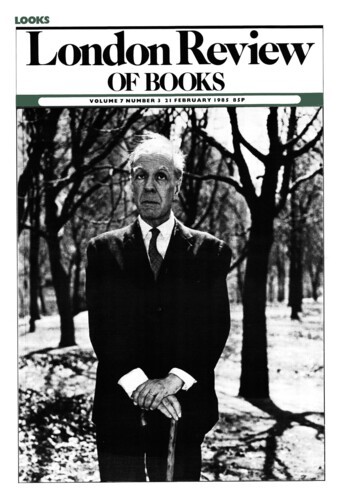
Places in fiction often have a curious dual nationality. They are entangled in historical events, marked on a solid social map. ‘It’s not exactly the moon I’m asking for,’ a girl thinks in The Dark Hole Days, ‘but surely all my dreams don’t end here: me in a duffle coat signing on the dole and walking in the debris of Belfast.’ Later she adds: ‘Belfast would fit into a corner of London. Not that it would fit in.’ On the other hand, places are used as pieces of an invention, elements of an intended meaning, and they come trailing all kinds of associations which may not have much to do with their material locations out there in the world. The ‘brilliant’, the ‘deep blue’ New England air and the irremediable Californian innocence that crop up so frequently in Superior Women really belong to literature or mythology rather than to the weather or any particular living Americans. Of course people and even the weather, as Wilde knew, do at times dutifully imitate literature, and that complicates the issue.

Stories of Black and White

Michael Wood, 4 October 1984

The freedom to juggle with language, Angela Carter suggests, is a promise and perhaps an instrument of other freedoms. Certainly her own cheerful jokes bespeak a lively independence of hallowed prejudices. ‘It’s very tiring, not being alienated from your environment.’ ‘It won’t be much fun after the Revolution, people say. (Yes, but it’s not all that much fun, now.)’ St Petersburg, in her new novel, is ‘a city built of hubris, imagination and desire’, and that, Carter says, is what cities, and lives, should be: crazy possibilities, even impossibilities, juggled into practice. But what if the first freedom is illusory, if all we have to juggle with is cliché, the language of others, a shabby idiom we can’t refresh and can’t abandon? What if the ‘shop-soiled … romance’ Carter finds so much energy in seems to us merely worn down, beaten thin, at best only the shadow of an old puzzle? This is the dilemma that confronts narrator and characters in Joan Didion’s Democracy, a novel whose title itself mimes the slippery problem. Democracy, in Didion’s work, is not a form of government but an item of rhetoric: what the world is to be made safe for; a conspiracy of empire rigged out as a heart-warming liberal dream. An organisation called the Alliance for Democratic Institutions is simply a means by which a once hopeful Presidential candidate in the novel seeks to keep his political flag flying.

Chances are

Michael Wood, 7 July 1983

‘What a chapter of chances,’ Tristram Shandy’s father says, ‘what a long chapter of chances do the events of this world lay open to us!’ The thought is echoed in the closing pages of Clive James’s Brilliant Creatures, whose author-hero is said to be a ‘chapter of accidents’, and in the title and precarious plot of Anthony Powell’s O, How the wheel becomes it! The wheel is Ophelia’s, and suggests the incessant circlings of fortune, but quickly, in Powell’s hands, comes to hint at roulette and the dodgy hazards of English literary life. Comedy loves chance, particularly when it’s the messy, galloping kind which adds insult to ignominy. As when Uncle Toby whacks Walter Shandy on the shin with his crutch while making an irrelevant remark. Or when, to borrow an instance from James, you discover you owe a wallop of back tax on the day your car has been vandalised and peed in. Or when, as in Powell, an old flame, or flicker, turns up out of the blue to hog the television show you were already feeling nervous about. There is no sense of comeuppance on these occasions, only a view of scuttled dignity, and life getting out of hand. What is enjoyable about the tightrope is not the feat of someone’s walking it or the threat that they might fall, but the possibility of a comic wobble, flailing arms and the spectre, but only the spectre, of disaster.

Pirouette on a Sixpence: Untranslatables

Christopher Prendergast, 10 September 2015

O n​ the face of it a Dictionary of Untranslatables looks like a contradiction in terms, either self-imploding from the word go, or, if pursued, headed fast down a cul-de-sac in which it is...

Read more reviews

It took a very special kind of invention to get an awareness of the ‘erratic truth of death’s timing’ into a medium of mass entertainment.

Read more reviews

I told you so! oracles

James Davidson, 2 December 2004

I don’t believe in astrology, but I also know that not believing in astrology is a typically Taurean trait. When I first caught a bright young friend browsing in the astrology section of a...

Read more reviews

And That Rug! images of Shakespeare

Michael Dobson, 6 November 2003

Above the entrance to the saloon bar there is a picture of Shakespeare on the swinging sign. It is the same picture of Shakespeare that I remember from my schooldays, when I frowned over Timon of...

Read more reviews

Unspeakability

John Lanchester, 6 October 1994

Musing over Don Juan, Byron asked his banker and agent Douglas Kinnaird a rhetorical question: ‘Could any man have written it – who has not lived in the world? – and tooled in a...

Read more reviews

Read anywhere with the London Review of Books app, available now from the App Store for Apple devices, Google Play for Android devices and Amazon for your Kindle Fire.

Sign up to our newsletters

For highlights from the latest issue, our archive and the blog, as well as news, events and exclusive promotions.

Newsletter Preferences