
Unreal City
Michael Wood, 7 October 1993
Baudelaire’s city is swarming with people and full of dreams, a place of daylight ghosts.
Michael Wood is an emeritus professor at Princeton. He has written books on Yeats, Nabokov, Stendhal, Hitchcock and Empson, among other things.
Baudelaire’s city is swarming with people and full of dreams, a place of daylight ghosts.

Current films are full of regrets and second chances, none more so than the recent work of Clint Eastwood. In the Line of Fire, which opened last month, has him playing an American Secret Service man haunted by his failure to protect John Kennedy on the day everyone remembers. Now another assassin, John Malkovich no less, is stalking another President: a risk for the incumbent but a chance of redemption for our hero. The regrets on the subject of violence are particularly murky. ‘Penance’ was the word Eastwood used in a Rolling Stone interview in relation to Unforgiven, his last film as star and director and one which brought him his first Oscar and a new respectability in the movie world. In conversation Eastwood made the fim sound more like a prayer then a Western. It was as if he was apologising on the screen for all his old movie misdeeds; and the film itself has at its core a long, illustrated sermon on the pain and horror of violent death. Penance here seems to mean moral confusion rather than anything like steady contrition. Unforgiven is a good movie because it doesn’t shirk the contradictions it raises, indeed it displays them with stately elegance; not a great movie because the contradictions, beneath the elegance, are a sprawling mess, a mirror of the muddle of our thoughts about violence.
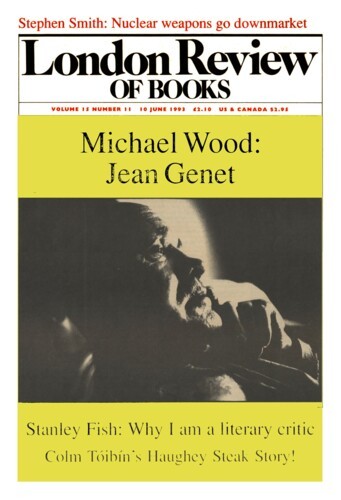
A thief is someone who steals, but what do you call someone who steals and gets caught all the time? Who gets caught lifting handkerchiefs from a Paris department store, for instance, and then a few days later, his sentence having been remitted, gets caught again, this time in the act of pinching stuff from parked cars? An incompetent thief, perhaps – which was what Cocteau called Genet, the delinquent in question: ‘You are a bad thief, you get caught. But you are a good writer.’ Genet said much the same thing about himself in a late interview. But then what happens when this incompetent thief writes, as Genet does in Our Lady of the Flowers, in the manner of a handbook on how to get away with it?’
The reviews and the hype hadn’t prepared me for Malcolm X at all. I expected it to be dull and worthy, a straight and long-winded retelling of a famous life. I found it lively, pretty dramatic, not all that much too long. It is a glossy parable of the sinner who came to virtue, found fame and power, was threatened and killed: the work, death and glorification of St Malcolm Martyr. I also found the film troubling because of its very glossiness, and troubling in ways I didn’t at first understand.

Everyone remembers what they were doing when John Kennedy was killed, but no one even asks what you were doing when Gerald Ford was President. The wonderfully comic, deviously historical premise of John Updike’s new novel is that someone asks. The someone is the plausible-sounding Northern New England Association of American Historians, and the person asked is one Alfred L. Clayton, a randy spiritual relative of J. Alfred Prufrock, and one of Updike’s basic, repeatable (and repeated) heroes: faithless, clever, well-intentioned, willing to apologise if only he can figure out what he’s done wrong.
Michael Wood talks to Malin Hay about the recent list from Sight and Sound of the ‘greatest films of all time’ (in which he voted), and what considerations could, or should, go into...
Michael Wood talks to Adam Shatz about critical theory, its origins, developments and various diversions, and where it stands today.
Michael Wood looks at how Fritz Lang uses sound in his first two sound films, M (1931) and The Testament of Dr Mabuse (1933).
Michael Wood reads his take on Joseph L. Mankiewicz’s Cleopatra.
O n the face of it a Dictionary of Untranslatables looks like a contradiction in terms, either self-imploding from the word go, or, if pursued, headed fast down a cul-de-sac in which it is...
It took a very special kind of invention to get an awareness of the ‘erratic truth of death’s timing’ into a medium of mass entertainment.
I don’t believe in astrology, but I also know that not believing in astrology is a typically Taurean trait. When I first caught a bright young friend browsing in the astrology section of a...
Above the entrance to the saloon bar there is a picture of Shakespeare on the swinging sign. It is the same picture of Shakespeare that I remember from my schooldays, when I frowned over Timon of...
Musing over Don Juan, Byron asked his banker and agent Douglas Kinnaird a rhetorical question: ‘Could any man have written it – who has not lived in the world? – and tooled in a...

Read anywhere with the London Review of Books app, available now from the App Store for Apple devices, Google Play for Android devices and Amazon for your Kindle Fire.
For highlights from the latest issue, our archive and the blog, as well as news, events and exclusive promotions.