Michael Wood

Michael Wood is an emeritus professor at Princeton. He has written books on Yeats, Nabokov, Stendhal, Hitchcock and Empson, among other things.

Loving Dracula

Michael Wood, 25 February 1993

Bram Stoker’s Dracula (as distinct from Bram Stoker’s Dracula) begins with a canny bit of Orientalism. The English solicitor Jonathan Harker is travelling to the Carpathians to meet his client Count Dracula. ‘The impression I had,’ Harker says of crossing the Danube at Budapest, ‘was that we were leaving the West and entering the East; the most Western of splendid bridges … took us among the traditions of Turkish rule.’ We know all about those traditions. This is the realm of the incalculable, bloodthirsty Other; the Other of our dreams, of course, the figure we compose out of everything we can’t or wont know about ourselves. But then Dracula is a dream, multiple, self-contradicting, hovering. He doesn’t show up in mirrors because he is himself a mirror, ready to reflect a whole hodgepodge of fears and desires. He drinks blood, preys on women; converts men to insect-eaters; he is the undead, a travesty of the resurrection; he is what waits at the end of Eastern journeys and he also comes West, buying up London, bringing boxes of earth from his native land; associated with bats and wolves and the night, he carries the imagery of rabies and syphilis into the age of Aids.
Regrets

Michael Wood, 17 December 1992

The pale child gives a faint wave of his hand. He is saying goodbye to his Jewish friend, about to be taken from school to die in Auschwitz, but there is also a whole history of helplessness in the gesture: not only the boy’s but that of his class and time and culture and place. The gesture occurs at the end of Louis Malle’s Au revoir les enfants, 1987 – the year of the story is 1944 – but it has echoes and relatives everywhere in French films since the war, and in French fiction of the same period. At the close of Malle’s (and Queneau’s) Zazie dans le métro (novel 1959, film 1960), the little girl who has breezed through all kinds of turbulence and yet missed her heart’s desire, a trip on the Metro, is asked by her mother what she has done during her brief stay in Paris. J’ ai vieilli, she says. Not: I have lived or learned or suffered or even necessarily, as Barbara Wright’s otherwise excellent translation has it, ‘I’ve aged’. Zazie may have aged but the idea is more sententious than anything else she says, and she is more likely to mean she has just grown older. Time has passed, as time does. There is nothing you can do about it, and nothing has been done. Of course the perky gaze of the actress Catherine Demongeot makes the remark seem cheerful enough in context, but the head-on framing of the face of a child, and Malle’s awkward cut to this face between the mother’s question and Zazie’s answer, give the moment a strongly emblematic feel, and bring us close to the shot in Au revoir les enfants. The line also appears in Malle’s Milou en Mai, 1989 – ‘a sort of quotation from myself’, as he says to Philip French in Malle on Malle.’’

Homage to the Provinces

Michael Wood, 28 May 1992

The funicular railway takes you to the top of the mountain with the strange name: a nonsense word, a child’s burble, Tibidabo. You see the city of Barcelona spread out beneath you; beyond it the Mediterranean. Très beau panorama, the Michelin guide says, as well it may, since the name is not the nonsense word it looks but the Devil’s Latin, part of the sentence in which he offered to Christ the kingdoms of the world and the glory of them: Haec omnia tibi dabo si cadens adoraveris me, ‘All these things will I give thee, if thou wilt fall down and worship me.’ I don’t know when the mountain received its name, but there is obviously a pretty complicated joke in the folk memory here. Is this the world Christ rejected? The Devil’s world? Or did Christ make a mistake? Perhaps the suggestion is that Christ didn’t take enough time to think, that a little Catalan pragmatism would have allowed him to reject the Devil but keep a piece of the worldly kingdom and glory.

There’s Daddy

Michael Wood, 13 February 1992

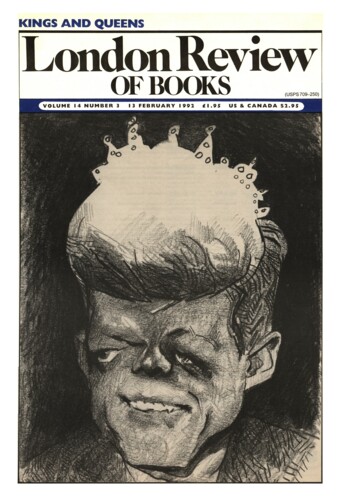
The Warren Commission reported that it found no ‘credible’ or ‘meaningful’ evidence of a conspiracy to assassinate President John Kennedy, and the words are of course a sore temptation to suspicious eyes. Do they mean, as they seem to mean, no real evidence at all? Or no evidence to speak of; no evidence you could act on; plenty of evidence but all of it shaky; plenty of evidence but none of it irresistible? What about the tone of that massive report, the words beneath the words? Patient scruple or cautious relief? I think it unlikely that the Commission was simply the great whitewash that many people see in it, but it did seem very happy to find all its trails leading only to Oswald, the lone killer who was himself conveniently killed two days later.

Watching a black man in the shower

Michael Wood, 12 September 1991

The heart of Young Soul Rebels, visually and dramatically, is a scene in an East London club, noisy, cheerful, full of glitter and bounce. Punk and soul music alternate on the disco deck; punk and soul styles are jumbled on the dance floor. Men and women, black and white, gays and straights, mix easily if loudly, having a good time. Two men are seen kissing, but only a newcomer, and our camera, linger over the event. The general effect is raucous and chaotic, but not strident or violent. The punks don’t really dance, they just jump heavily up and down. The soul brothers and sisters have all the rhythm and elegance that cliché awards them; but then one of the suggestions of this film is that clichés have to be worked with, that there is no way round them, and (at present) no place beyond. The time is the summer of 1977, the year of the Queen’s Jubilee, but the real celebration is here, every Saturday night: a festival of plurality.

Pirouette on a Sixpence: Untranslatables

Christopher Prendergast, 10 September 2015

O n​ the face of it a Dictionary of Untranslatables looks like a contradiction in terms, either self-imploding from the word go, or, if pursued, headed fast down a cul-de-sac in which it is...

Read more reviews

It took a very special kind of invention to get an awareness of the ‘erratic truth of death’s timing’ into a medium of mass entertainment.

Read more reviews

I told you so! oracles

James Davidson, 2 December 2004

I don’t believe in astrology, but I also know that not believing in astrology is a typically Taurean trait. When I first caught a bright young friend browsing in the astrology section of a...

Read more reviews

And That Rug! images of Shakespeare

Michael Dobson, 6 November 2003

Above the entrance to the saloon bar there is a picture of Shakespeare on the swinging sign. It is the same picture of Shakespeare that I remember from my schooldays, when I frowned over Timon of...

Read more reviews

Unspeakability

John Lanchester, 6 October 1994

Musing over Don Juan, Byron asked his banker and agent Douglas Kinnaird a rhetorical question: ‘Could any man have written it – who has not lived in the world? – and tooled in a...

Read more reviews

Read anywhere with the London Review of Books app, available now from the App Store for Apple devices, Google Play for Android devices and Amazon for your Kindle Fire.

Sign up to our newsletters

For highlights from the latest issue, our archive and the blog, as well as news, events and exclusive promotions.

Newsletter Preferences