Michael Wood

Michael Wood is an emeritus professor at Princeton. He has written books on Yeats, Nabokov, Stendhal, Hitchcock and Empson, among other things.

I am disorder

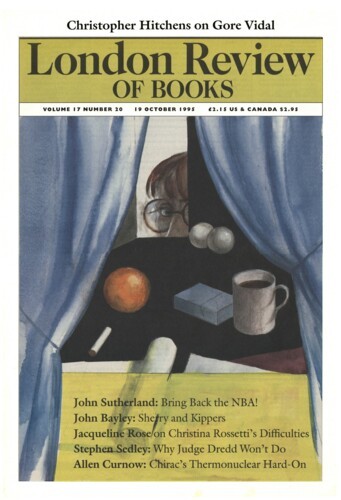
Michael Wood, 19 October 1995

Portnoy complained that his life was a Jewish joke, and Philip Roth himself once suggested that American reality beggared the imagination of even the most extravagant novelist. Who could have invented Eisenhower, he asked, and no sooner had he invented a caricature of Richard Nixon in Our Gang than Nixon turned out to be caricaturing himself in the same way, locker-room slang and all. ‘No a man’s character isn’t his fate,’ Roth writes in Operation Shylock: ‘a man’s fate is the joke that his life plays on his character’ – and a person in that novel is described as ‘a woman forged by the commonplace at its most cruelly ridiculous’. Life doesn’t imitate art. Life disgraces art; art, for all its slumming, has no idea how far life will go, how low it will sink.’

Shenanigans

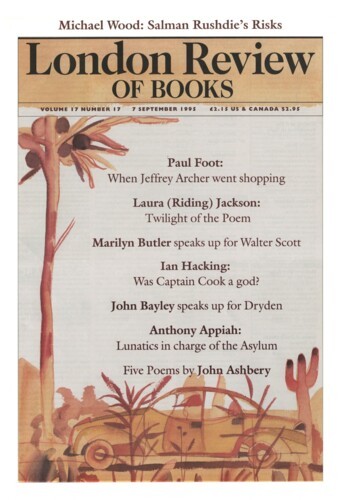
Michael Wood, 7 September 1995

The Moor’s last sigh is several things, both inside and outside Salman Rushdie’s sprawling new novel. It is the defeated farewell of the last Moorish ruler in Spain, the Sultan Boabdil leaving his beloved Granada in 1492, a year also known for other travels. It is Othello’s last gasp of jealousy and violence. It is, in the novel, the name of two paintings depicting Boabdil’s departure; and it is what the novel itself becomes, the long, breathless, terminal narration of the asthmatic Moraes Zogoiby, alias ‘Moor’. Old Moore’s Almanach flickers somewhere here (‘Old Moor will sigh no more’), as does Luis Buñuel’s dernier soupir (which appears as the Ultimo Suspiro petrol station). Ingrid Bergman and Humphrey Bogart were wrong, we learn, to think that a sigh is just a sigh: a sigh could be almost anything, and the name Zogoiby is a version of the Arabic elzogoybi, ‘the unlucky one’, the sobriquet traditionally attached to Boabdil.

Crazy Don

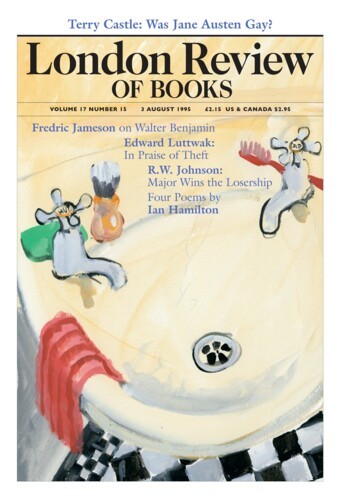
Michael Wood, 3 August 1995

Not only one of the (many) unread classics, Don Quixote is a book almost no one seems to have any intention of reading. People don’t feel bad about ignoring it, don’t need to pretend they’ve read it, don’t say they’ve always been meaning to take it to the beach. I hope I’m wrong about the novel’s actual readership, for the sake of several publishers and many readers who would immensely enjoy the book if they got to it, but I don’t think I’m wrong about the way things look.

My Kind of Psychopath

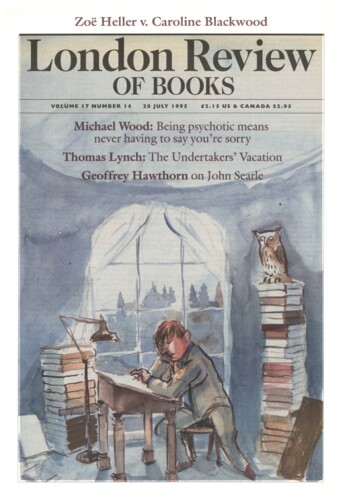
Michael Wood, 20 July 1995

When Orson Welles said the movies were the greatest train set in the world he probably wasn’t thinking about the toy crashes he could arrange. Quentin Tarantino obviously sees the movies as all kinds of fun, but his screenplays and films are full of accidents, scarcely imaginable without them. It’s not the bloodshed or the blowing away that’s so unusual – that’s just Peckinpah in the city, with a certain lingering on the leaking or blasted body. One of the meanings of pulp, as film and screenplay both remind us, is ‘a soft, moist, shapeless mass of matter’. What’s unusual is Tarantino’s characters’ crazy bad luck, often compounded by their engaging incompetence. In Pulp Fiction, directed by Tarantino himself and released in 1994, a fixed fight comes unfixed; a man on the run meets his chief enemy by chance as he crosses the street; the same man takes refuge in a pawnshop that happens to be run by a couple of hillbilly psychopaths; a couple tries to hold up a café that happens to contain a pair of killers having their breakfast; a would-be sophisticated woman fails to tell the difference between cocaine and heroin and nearly kills herself by finding out. When her companions are trying to bring her round, the stage direction reads: ‘From here on in, everything in this scene is frantic, like a documentary in an emergency ward, with the big difference here being nobody knows what the fuck they’re doing.’ Reservoir Dogs, directed by Tarantino and released in 1992, is all about a botched diamond heist, and how arch-criminals are chronically unable to spot the cop in their midst. True Romance, Tarantino’s first script, directed by Tony Scott and released in 1993, has a big drug deal that ends in a massacre because too many people show up at the party. There is a marvellous three-way stand-off here – drug-buyer’s bodyguards against cops against Mafia – which is repeated in Reservoir Dogs as gangster against gangster against gangster; and the gag about the hero being on the can while the climax of the movie takes place is carried over from True Romance to Pulp Fiction. After the Mafia men torture and kill an ex-cop in True Romance, they discover the information they were after tacked to the fridge. Even in Natural Born Killers, written by Tarantino and directed by Oliver Stone in 1994, which is by far the most brutal of these movies, the violence mainly suggests that everyone and everything is out of control, that no rules apply, and chaos is come again. What interests Tarantino, it seems, is not violence, but fiasco, the sense that life is a mess even in fiction. And then into this mess he introduces not order but style and a peculiar kind of innocence.’’

It Rhymes

Michael Wood, 6 April 1995

Pauline Kael used to write witheringly about musicals said to appeal to people who didn’t like musicals, and we might feel the same about poems for people who don’t like poems. ‘Here is a poem,’ the blurb for The Wild Party says, ‘that can make even readers who have no time for poetry stop dead in their tracks.’ It’s true that T.S. Eliot said, in ‘East Coker’, that ‘the poetry does not matter,’ but he can’t have been pushing for stuff like this:

Pirouette on a Sixpence: Untranslatables

Christopher Prendergast, 10 September 2015

O n​ the face of it a Dictionary of Untranslatables looks like a contradiction in terms, either self-imploding from the word go, or, if pursued, headed fast down a cul-de-sac in which it is...

Read more reviews

It took a very special kind of invention to get an awareness of the ‘erratic truth of death’s timing’ into a medium of mass entertainment.

Read more reviews

I told you so! oracles

James Davidson, 2 December 2004

I don’t believe in astrology, but I also know that not believing in astrology is a typically Taurean trait. When I first caught a bright young friend browsing in the astrology section of a...

Read more reviews

And That Rug! images of Shakespeare

Michael Dobson, 6 November 2003

Above the entrance to the saloon bar there is a picture of Shakespeare on the swinging sign. It is the same picture of Shakespeare that I remember from my schooldays, when I frowned over Timon of...

Read more reviews

Unspeakability

John Lanchester, 6 October 1994

Musing over Don Juan, Byron asked his banker and agent Douglas Kinnaird a rhetorical question: ‘Could any man have written it – who has not lived in the world? – and tooled in a...

Read more reviews

Read anywhere with the London Review of Books app, available now from the App Store for Apple devices, Google Play for Android devices and Amazon for your Kindle Fire.

Sign up to our newsletters

For highlights from the latest issue, our archive and the blog, as well as news, events and exclusive promotions.

Newsletter Preferences