Michael Wood

Michael Wood is an emeritus professor at Princeton. He has written books on Yeats, Nabokov, Stendhal, Hitchcock and Empson, among other things.

Like Apollinaire

Michael Wood, 4 April 1996

Perhaps all books are messages from other times and places, even the ones written yesterday and just down the road. But these three works by Kenzaburo Oë, who won the Nobel Prize for Literature in 1994, have an unusual flavour of missives cast into the sea long ago, only now arriving on our island beach. Nip the Buds, Shoot the Kids was published in Japan in 1958, and is now translated for the first time. A Personal Matter was published in Japan in 1964, and in an American translation, here reprinted, in 1969. Hiroshima Notes was published in Japan in 1965 and first translated, in this version, in 1981. So the youngest of the books is thirty years old, half Oë’s own age. The effect of reading them now is not to make us feel we have been there before, because we haven’t, even if we have been to Japan and read other Japanese novels. The effect, on me at least, was to make me try to remember these books’ English and American coevals, whatever it was we were reading in the wake of Sartre and Camus, and before the Sixties became the Sixties. William Golding, Iris Murdoch, Saul Bellow, Bernard Malamud, Thomas Pynchon, who else?
Going Wrong

Michael Wood, 7 March 1996

It’s always risky to think of films as signs of the times, when they are mainly signs of what someone thought would sell. It’s particularly risky when the films manifestly see themselves as signs of the times, heavy-breathing comments on the way we live now. These three new thrillers are all worth watching, but they are a little over-ripe, and they make you feel you might have got the wrong door, and gone to church instead of the movies.

Semi-Happy

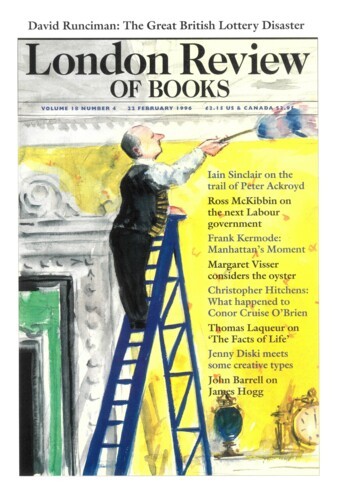
Michael Wood, 22 February 1996

Movies tend not to age gracefully. If they’re not still fresh, they look decrepit, or just dead. It’s hard to distinguish between the damage done to the old Frankenstein by Young Frankenstein, to say nothing of The Munsters, and the damage done by time and change on their own. Certainly when Dwight Frye, as Frankenstein’s crippled assistant Fritz, scuttles off down a hill, doubled over his very short walking-stick, it’s hard not to think of Marty Feldman and Gene Hackman and to murmur ‘Walk this way.’ The acting-style of the straight – that is, human – characters in Frankenstein as in other Thirties films seems to belong to some cobwebbed theatrical museum, all twitches and signals and period exclamations. The same goes for large chunks of movie humour in those days: if you were English, and just huffed and puffed like Bertie Wooster’s uncle, as Frederick Kerr does as Baron Frankenstein, you brought the house down, or at least the studio thought you did.’

In Love

Michael Wood, 25 January 1996

He suffered fools grimly, because he thought there were so many of them, but he was himself far from grim. His laugh was a cross between a splutter and a chuckle, as if the joke had been cooking inside him for some time, and now was too good to be retained any longer. No mistaking the deep amusement in this laugh; not a trace of rancour or disappointment. It’s true that he placed ‘sourness and spite … among the legitimate pleasures of pedantry’, and said he had made ‘a comfortable career’ out of the jeremiad; but then these formulations suggest a complicated performance rather than straightforward sourness or lamentation, and his professed worry that a series of his lectures seems ‘ingratiating’ in print strikes me as some sort of puritan mischief, rather as if Samson might have thought he was being too polite when he pulled the temple down. I often felt daunted by him, but I never met him without feeling better for the meeting – I am extending the notion of meeting to include casual encounters outside St David’s Station, Exeter and a wry postcard, long ago, from Stanford, as well as more substantial talks. He was Donald Davie, who was born in Barnsley in 1922 and died in Devon last autumn, a precise and passionate poet and critic, the Empson or the Eliot of his generation. Or rather, he would have been the Empson or Eliot of his generation, if his generation had not largely failed to need him, as it largely failed to need either poetry or criticism in anything other than easy doses.’

Top-Drawer in Geneva

Michael Wood, 30 November 1995

Proust said he didn’t understand how critics could divide literary works into good and bad patches, admiring the first half of a novel by Gautier but not the second, praising everything to do with Goriot in Père Goriot, damning everything to do with Rastignac. He was thinking of Emile Faguet, but we might think of F.R. Leavis performing the same sort of operation on Daniel Deronda. ‘A book is still for me a living whole,’ Proust said, ‘with which I strike up an acquaintance from the very first line, that I listen to with deference, that I allow to be in the right all the time I am with it, without choosing and without arguing.’ Proust’s principle is admirable, but he hadn’t read Albert Cohen, parts of whose Belle du Seigneur are so mawkishly terrible you wonder why the publishers haven’t folded from embarrassment, while other parts are brilliantly, minutely observed, mercilessly funny, a parade of social and moral dissections that make Waugh and Montherlant look like teddy-bears.

Pirouette on a Sixpence: Untranslatables

Christopher Prendergast, 10 September 2015

O n​ the face of it a Dictionary of Untranslatables looks like a contradiction in terms, either self-imploding from the word go, or, if pursued, headed fast down a cul-de-sac in which it is...

Read more reviews

It took a very special kind of invention to get an awareness of the ‘erratic truth of death’s timing’ into a medium of mass entertainment.

Read more reviews

I told you so! oracles

James Davidson, 2 December 2004

I don’t believe in astrology, but I also know that not believing in astrology is a typically Taurean trait. When I first caught a bright young friend browsing in the astrology section of a...

Read more reviews

And That Rug! images of Shakespeare

Michael Dobson, 6 November 2003

Above the entrance to the saloon bar there is a picture of Shakespeare on the swinging sign. It is the same picture of Shakespeare that I remember from my schooldays, when I frowned over Timon of...

Read more reviews

Unspeakability

John Lanchester, 6 October 1994

Musing over Don Juan, Byron asked his banker and agent Douglas Kinnaird a rhetorical question: ‘Could any man have written it – who has not lived in the world? – and tooled in a...

Read more reviews

Read anywhere with the London Review of Books app, available now from the App Store for Apple devices, Google Play for Android devices and Amazon for your Kindle Fire.

Sign up to our newsletters

For highlights from the latest issue, our archive and the blog, as well as news, events and exclusive promotions.

Newsletter Preferences