Michael Wood

Michael Wood is an emeritus professor at Princeton. He has written books on Yeats, Nabokov, Stendhal, Hitchcock and Empson, among other things.

Family Values

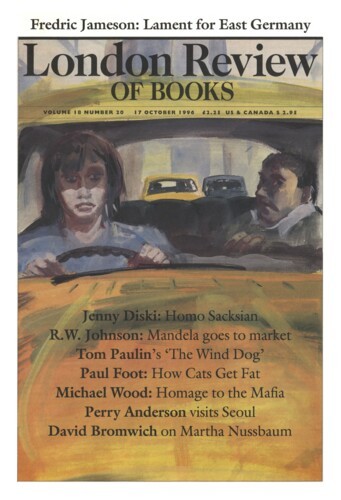
Michael Wood, 17 October 1996

‘We were the last romantics,’ Yeats said, but he spoke too soon. We might feel the same about the situation proposed by the title of Mario Puzo’s new novel, now sitting comfortably at number four in the New York Times bestseller list. Don Domenico Clericuzio, the ageing mobster grandee in this book, is said to have led his family to ‘the very heights of power’, using only the instruments of ‘a Borgialike cruelty and a Machiavellian subtleness, plus solid American business know-how’. He has also probably watched the Godfather movies several hundred times. How could we ever tire of such a figure, what would stop his replication? The idea of the last Don is like the idea of the last cliché.

Misinformed about Paradise

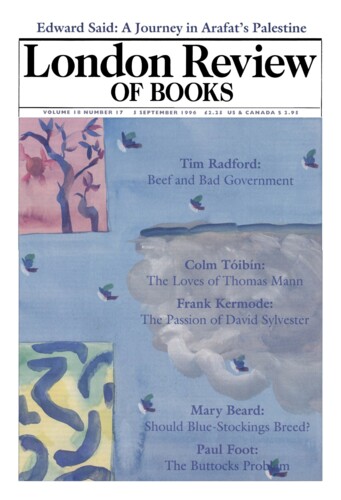
Michael Wood, 5 September 1996

In the old times, long before the birth of the Irish Free State, a young woman called Brigid McLaughlin went down from Derry to work in southern Donegal. Her job was to look after two children, a girl and a boy, aged nine and seven, orphans. ‘The children were beautiful,’ we are told, ‘especially the girl. She was dark, the boy was fair. They spoke Irish only.’ Fortunately, Brigid spoke Irish, too. She had a year’s contract, ‘but she was not, for all of that year, to leave the children out of her charge and was never to take them away from the house itself.’ The children were charming and well-mannered, and every day they visited their parents’ grave behind the house, and sat there for a long time. On a bad day in autumn, rain pouring down, Brigid forbade them to do this, and had her first quarrel with her charges. Not only that. In the morning they had exchanged their hair colour, the boy was now dark, the girl was fair. And yet they insisted that they had always been that way, that nothing was different. When Brigid took them to the priest, they promptly switched back again to their original dispensation. Later the children exchanged voices, even sexes, and Brigid discovered that they could not be seen in a mirror. ‘She knew now that she was being challenged by evil, and the children were being stolen from her by whatever was in that grave out the back.’ Finally, the grave won out, and the children were gone for good. Brigid returned to Derry ‘completely strange in the head’, and gave up talking. Once a year, on the anniversary of the children’s disappearance, she would sing an Irish song the children sang just before they left. No one in Derry understood the words.

We have all kinds of images of the modern poet, little mythologies made out of snatches of the life and work and reputation. The figure is hieratic and austere, like Maillarmé and Valéry, inward and intricate like Eliot and Pessoa, serenely eccentric like Marianne Moore, public and overflowing like Neruda and Pound.

The Life of the Mind

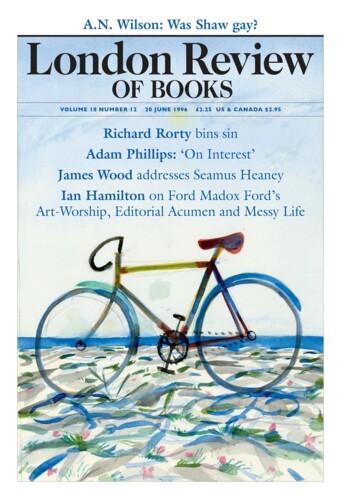
Michael Wood, 20 June 1996

The screen shows a flat, empty road from a very low angle, a torn tyre lying on it like a piece of junk sculpture. Then the towers of a city in the distance; then a set of ramshackle houses; a pasture and a farmhouse; the white screen of a drive-in; a field full of oil pumps. A drawling voice, all wide vowels and unclosed consonants, starts to philosophise: ‘The world is full of complainers, and the fact is, nothing comes with a guarantee … Something can always go wrong … What I know about is Texas, and down here you’re on your own.’ These are the opening moments of Blood Simple, Ethan and Joel Coen’s first movie, released in 1983, and they look like an agenda, an announcement of work to come. They look that way only now, though, when we have seen the later films; learned that the appearance of raw and gritty realism in that first movie was deceptive. We were never in America, only ‘America’, a place full of stories about itself, none the less mythological because historical reality every now and then manages to catch up with it, or incorporate a piece of its gory or flamboyant action. The ‘down here’ in the voice-over now sounds like a giveaway, since it implies an awareness of other places, even an anxiety about them, about the way Texas may look from a different region. Of course there’s boasting in the claim too, a pride in the fact that chainsaw massacres, for instance, don’t happen just anywhere.

A Sort of Nobody

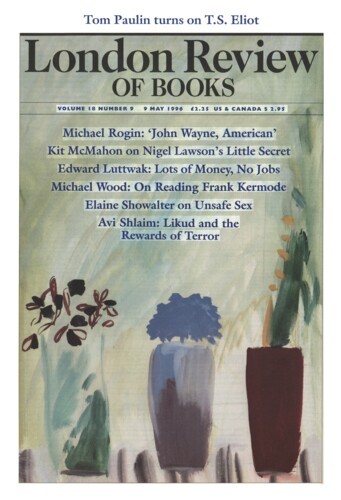
Michael Wood, 9 May 1996

Criticism for Frank Kermode is the articulation of assumptions, a sort of phenomenology of interpretative need. Its job, as he says in The Sense of an Ending (1967), is ‘making sense of the ways we try to make sense of our lives’. It involves close reading, discriminations of value, a practised affection for old and new texts, but its chief quarry is the turn of a culture’s mind, one of those trains of thought which Conrad thought could not be false – because even when they look horribly false they are embedded in arguments or entailments we need to believe are true. ‘I thought I could see a new way of looking at certain assumptions,’ Kermode says in Romantic Image (1957). He could; he did; and he has kept doing it. The world, he says at the end of The Genesis of Secrecy (1979), ‘is our beloved codex’:’

Pirouette on a Sixpence: Untranslatables

Christopher Prendergast, 10 September 2015

O n​ the face of it a Dictionary of Untranslatables looks like a contradiction in terms, either self-imploding from the word go, or, if pursued, headed fast down a cul-de-sac in which it is...

Read more reviews

It took a very special kind of invention to get an awareness of the ‘erratic truth of death’s timing’ into a medium of mass entertainment.

Read more reviews

I told you so! oracles

James Davidson, 2 December 2004

I don’t believe in astrology, but I also know that not believing in astrology is a typically Taurean trait. When I first caught a bright young friend browsing in the astrology section of a...

Read more reviews

And That Rug! images of Shakespeare

Michael Dobson, 6 November 2003

Above the entrance to the saloon bar there is a picture of Shakespeare on the swinging sign. It is the same picture of Shakespeare that I remember from my schooldays, when I frowned over Timon of...

Read more reviews

Unspeakability

John Lanchester, 6 October 1994

Musing over Don Juan, Byron asked his banker and agent Douglas Kinnaird a rhetorical question: ‘Could any man have written it – who has not lived in the world? – and tooled in a...

Read more reviews

Read anywhere with the London Review of Books app, available now from the App Store for Apple devices, Google Play for Android devices and Amazon for your Kindle Fire.

Sign up to our newsletters

For highlights from the latest issue, our archive and the blog, as well as news, events and exclusive promotions.

Newsletter Preferences