Michael Wood

Michael Wood is an emeritus professor at Princeton. He has written books on Yeats, Nabokov, Stendhal, Hitchcock and Empson, among other things.

There is something slightly wrong with the apparently impeccable Philadelphia Story. The film works so well for everyone – director, actors, audiences – that the flaw must be very slight, and perhaps even an advantage, a wrinkle that enhances the smoothness of the rest. But it’s there and it’s this. The heroine is bright, rich, funny, classy, but a little censorious...
“To put it far more crudely than the novel ever does: if you can drown in fame as easily as in the sea, if fame is a form of drowning, then what’s the difference between success and failure? This is a question, not a rhetorical way of suggesting there is no difference.”

Things I Said No To: Italo Calvino

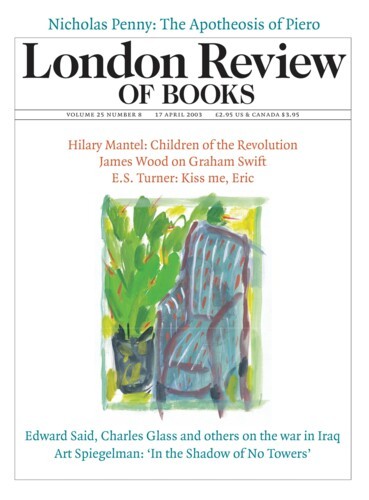
Michael Wood, 17 April 2003

A certain monotony characterises saints’ lives, at least when viewed from the outside, and the same goes for writers. The chosen career flattens out the visible differences. If it wasn’t for the lion who traditionally accompanies St Jerome, Italo Calvino suggests in The Castle of Crossed Destinies (1973), you could hardly tell him from St Augustine. Both saints are often pictured...

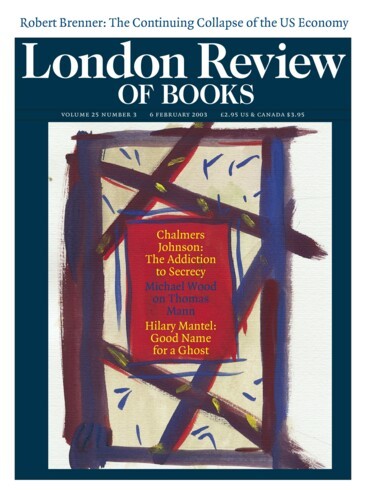
Impossible Wishes: Thomas Mann

Michael Wood, 6 February 2003

It’s worth pausing over the thought of Mann as a Joyce in disguise, a Joyce masquerading as a Galsworthy, say. What would happen to a literary form like the novel if it was invisibly hollowed out rather than brilliantly exploded? Could there be a Modernism that looked like its opposite?

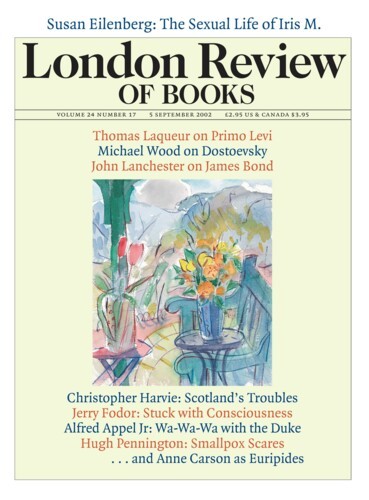
Tricky Minds: Dostoevsky

Michael Wood, 5 September 2002

‘The mind is a scoundrel,’ Dostoevsky wrote in his notes for The Brothers Karamazov, ‘but stupidity is straight and honest.’ This wasn’t what he himself thought, or rather, it was only one of the things he thought. In the novel the line is given to Ivan Karamazov, who explains to his younger brother Alyosha that he began their conversation about religion...

Pirouette on a Sixpence: Untranslatables

Christopher Prendergast, 10 September 2015

O n​ the face of it a Dictionary of Untranslatables looks like a contradiction in terms, either self-imploding from the word go, or, if pursued, headed fast down a cul-de-sac in which it is...

Read more reviews

It took a very special kind of invention to get an awareness of the ‘erratic truth of death’s timing’ into a medium of mass entertainment.

Read more reviews

I told you so! oracles

James Davidson, 2 December 2004

I don’t believe in astrology, but I also know that not believing in astrology is a typically Taurean trait. When I first caught a bright young friend browsing in the astrology section of a...

Read more reviews

And That Rug! images of Shakespeare

Michael Dobson, 6 November 2003

Above the entrance to the saloon bar there is a picture of Shakespeare on the swinging sign. It is the same picture of Shakespeare that I remember from my schooldays, when I frowned over Timon of...

Read more reviews

Unspeakability

John Lanchester, 6 October 1994

Musing over Don Juan, Byron asked his banker and agent Douglas Kinnaird a rhetorical question: ‘Could any man have written it – who has not lived in the world? – and tooled in a...

Read more reviews

Read anywhere with the London Review of Books app, available now from the App Store for Apple devices, Google Play for Android devices and Amazon for your Kindle Fire.

Sign up to our newsletters

For highlights from the latest issue, our archive and the blog, as well as news, events and exclusive promotions.

Newsletter Preferences