Michael Hofmann

Michael Hofmann is a poet and translator from German of books by Thomas Bernhard, Jenny Erpenbeck, Günter Grass, Franz Kafka, Joseph Roth and Patrick Süskind, among many others. He teaches at the University of Florida. He has contributed dozens of poems to the LRB since 1980 and more than sixty pieces, on subjects including Stefan Zweig, Bohumil HrabalHalldór Laxness, Caspar David Friedrich and boarding schools.

His Own Prophet: Read Robert Lowell!

Michael Hofmann, 11 September 2003

“The personal poet, the failed chameleon, the reviser, the marshaller of detail, the logomancer, that for me is Lowell, that’s where my own sense of him has settled after so much time. The religious poet, the formal poet, the monumental or confessional or public poet, all these for me are rather fortuitous, almost extraneous showings, that I feel little anxiety in excluding. Nor do I see him as the poet of water and the seaboard . . . rather he is the poet of organic life, growth and decay, and particularly of wood and lumber and mulch, of red and green and brown leaves.”
Imbalance: The Charm of Hugo Williams

Michael Hofmann, 22 May 2003

It is a curious thing that of the three judges offering superlatives on the jacket of Hugo Williams’s Collected Poems – Edna Longley, Douglas Dunn and Peter Porter – none is English. And yet Williams, born in Windsor during World War Two, the son of the English actor Hugh Williams, schooled by Life and Eton, a youthful toiler for Alan Ross’s London Magazine, an...

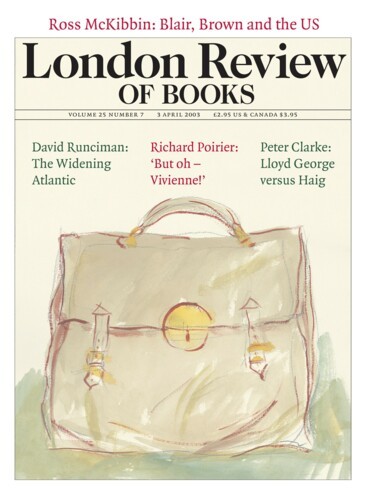
Poem: ‘Broken Nights’

Michael Hofmann, 3 April 2003

Then morning comes, saying: ‘This was a night.’ Robert Lowell

Broken knights. – No, not like that. Well, no matter. Something agreeably Tennysonian (is there Any other kind?) About ‘broken knights’. Sir Bors and Sir Bedivere. In my one-piece pyjamas – My it doesn’t matter suit, With necessarily non-matching – Matchless, makeless, makeles –...

None for forty years, then two in 14 months. Not London buses, but English translations – in this instance, of books by the Swedish novelist Hjalmar Söderberg (1869-1941). The Serious Game would appear to be a translation of a novel that was first published in Swedish in 1912 and has not previously appeared in English; Doctor Glas is a reissue of a 1963 version of the 1905...

Slowly/Swiftly: James Schuyler

Michael Hofmann, 7 February 2002

Not first sight, often enough, but a second look – it is a mysterious thing with poetry that it finds its own moment. The poets that have meant most to me – Lowell, Bishop, Schuyler – all, as it were, were rudely kept waiting by me. I had their books, or I already knew some poems of theirs, but there was no spark of transference. Then it happened, and our tepid prehistory...

Go for it, losers: Werner Herzog’s Visions

David Trotter, 30 November 2023

Documentary has customarily been regarded as a genre duty-bound to deal in facts. But the only duty Herzog has ever felt as a filmmaker is, as he puts it, to ‘follow a grand vision’.

Read more reviews

Kafka wrote that, were it not for the final act, Michael Kohlhaas would be ‘a thing of perfection’, which is a diplomatic way of saying that Kleist absolutely butchers it. In fact, one of...

Read more reviews

What a carry-on: W.S. Graham

Seamus Perry, 18 July 2019

Many poets end up having a hard life but W.S. Graham went out of his way to have one. His dedication to poetry, about which he seems never to have had a second thought, was remorseless, and his instinct,...

Read more reviews

Remarque apparently knew that The Promised Land would be his last novel, and meant it to be one of his finest, perhaps his masterwork.

Read more reviews

Jakob Wassermann, who published nearly a book a year for the last thirty years of his life but died broke and exhausted, soon to be forgotten, on 1 January 1934 at the age of sixty, was well...

Read more reviews

Opposite: Peter Stamm

Benjamin Lytal, 30 August 2012

‘Literature should be naked,’ Peter Stamm writes. Words should never obscure the story, ‘its warmth, its form, its vitality’. It’s form that critics in Germany and...

Read more reviews

The cow, the shoe, then you: Hans Fallada

Philip Oltermann, 8 March 2012

On Tuesday, 17 October 1911, 18-year-old Rudolf Ditzen, the future Hans Fallada, got up before dawn to meet his schoolfriend Hanns Dietrich von Necker at a tourist spot outside Rudolstadt in...

Read more reviews

Extreme Understanding: Irmgard Keun

Jenny Diski, 10 April 2008

As any adult can tell you – or any adult not given over entirely to mawkish and convenient notions of innocence – children are born spies. Every parent (previously an independent...

Read more reviews

Tooloose-Lowrytrek: Malcolm Lowry

Elizabeth Lowry, 1 November 2007

The two central facts about Malcolm Lowry are that he wrote and that he drank. He drank while writing – or possibly he wrote while drinking. When he died in June 1957 after downing a lethal...

Read more reviews

A Leap from the Bridge: Wolfgang Koeppen

Alexander Scrimgeour, 12 December 2002

Between 1951 and 1954, Wolfgang Koeppen published three scathing, disillusioned novels ridiculing the notion of a new start and a clean slate for West Germany. At the time, perhaps as many as 80...

Read more reviews

To Live like a Bird

Mark Rudman, 1 June 2000

Michael Hofmann’s poetry is a lament for a lost world. Some years ago, in an article on Frank O’Hara, he talked about New York no longer being the thrilling place it had been in the...

Read more reviews

Empire of Signs: Joseph Roth

James Wood, 4 March 1999

With Joseph Roth, you begin – and end – with the prose. The great delight of this Austrian novelist, who wrote in the Twenties and Thirties, lies in his strange, nimble, curling...

Read more reviews

Chilly

Penelope Fitzgerald, 9 February 1995

At the age of 48, after thirty years of lecturing on German literature and writing radio plays, Gert Hofmann began to produce disconcerting novels. Michael Hofmann, his son, the poet, confronted...

Read more reviews

Never for me

Michael Wood, 2 December 1993

‘I was not myself. I was just anyone.’ The person who says ‘I’ in Michael Hofmann’s earlier poems is uncertain, diffident, angry; he seems both gnarled and youthful,...

Read more reviews

Self-Hatred

Gabriele Annan, 5 November 1992

This German novel has waited nearly forty years for its English translator. Michael Hofmann fell in love the moment the Good Fairy told him about it, and set out to liberate it from the thorn...

Read more reviews

No more pretty face

Philip Horne, 8 March 1990

Wim Wender’s very pleasurable Paris, Texas (1984) is both an American movie and a European film. Its creative pedigree is mixed – all through the credits: the German Wenders as...

Read more reviews

Foreigners

John Lanchester, 5 January 1989

Attentive readers of the Guardian’s news pages will already know about Arabesques. A 1986 report from Jerusalem told readers of a first novel by a 36-year-old writer which was making a big...

Read more reviews

French Air

John Sutherland, 12 November 1987

In his autobiographical papers, Surely you’re joking, Mr Feynman?, the Nobel Prize-winning physicist, Richard Feynman, describes being piqued by an article in Science about how well...

Read more reviews

Tales of Hofmann

Blake Morrison, 20 November 1986

The acrimony in Michael Hofmann’s book is that of a son towards his father. Like a family photograph album, the sequence ‘My Father’s House’ records the son’s growth...

Read more reviews

We shall not be moved

John Bayley, 2 February 1984

There remains a most decided difference – indeed it grows wider every year – between what Philip Larkin calls ‘being a writer’, or ‘being a poet’, and managing...

Read more reviews

Read anywhere with the London Review of Books app, available now from the App Store for Apple devices, Google Play for Android devices and Amazon for your Kindle Fire.

Sign up to our newsletter

For highlights from the latest issue, our archive and the blog, as well as news, events and exclusive promotions.

Newsletter Preferences