John Sutherland

John Sutherland’s Life of Stephen Spender was published in May 2004. Formerly of University College London, he teaches at Caltech in Pasadena.

Carré on spying

John Sutherland, 3 April 1986

John le Carré has patiently established himself over the last twenty-five years as the discriminating reader’s favourite thriller writer. The BBC’s adaptations of the George Smiley trilogy in 1979 and 1982 made him almost overnight a popular author on the Ian Fleming scale, and it can have done no harm that the TV version of Tinker, Tailor, Soldier, Spy coincided with the Blunt scandal. Now, as a rite of academic canonisation, three critical monographs have been published which respectfully analyse his fiction.
Edgar and Emma

John Sutherland, 20 February 1986

I take the following details from Current Biography, July 1976. Edgar L. Doctorow was born in New York City on 6 January 1931 to David R. and Rose Doctorow, whom he has described as ‘old-fashioned social democrats’. His grandparents on both sides were Jewish immigrants from Russia. Doctorow grew up on Eastburn Avenue, in the Bronx. His mother was a pianist and his father had a store in the old Hippodrome building that sold musical instruments, radios and records. According to Doctorow, there was never any money, and his father would have to be considered a ‘failed man’. Nevertheless, he retains pleasant memories of his childhood.

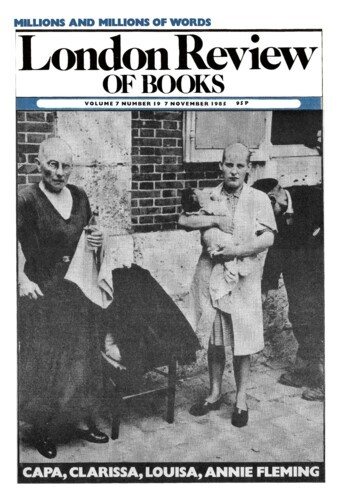
Carrying on with a foreign woman

John Sutherland, 7 November 1985

Kurt Vonnegut’s new novel finds him on old ground. All his hallmarks are prominently here: the cute narrative manner belying an apocalyptic message (the end of the world is once again nigh); the little ‘so it goes’ tics of style (here an asterisk placed before the names of characters about to die); comic-scientific periphrasis (marriage is ‘biologically significant copulation’). It’s as if, having labelled himself a boring old fart, as he did in the prologue to Breakfast of Champions, Vonnegut had now decided to play the part for all it’s worth. Fortunately, the old fart’s bag of tricks still amuses. But I think I would have liked this novel more had it been the first of the author’s that I’d read.

No 1 Writer

John Sutherland, 5 September 1985

Genre fiction is as competitive as prizefighting. The current champion of thriller writers in America is Elmore ‘Dutch’ Leonard. With the imminent release of the film Stick (a much-hyped but somewhat limp adaptation directed by and starring Burt Reynolds) he should make number one here, too. Leonard’s eminence ties in with the emergence of Miami as the new crime fashion centre of the United States. Styles have changed. Chicago was speakeasies and gangs; Las Vegas high-rolling casinos; New York, the five Mafia families. Miami crime has no roots in long-standing urban deprivation, minority ethnic solidarity, or the anomalies of state gambling laws. It was created by a series of rapid influxes of people, capital and contraband all cooked in the Sun Belt’s year-round summer. First came the monied retirees, who triggered off the real-estate boom (this is the background to John D. MacDonald’s underrated Condominium). Secondly, the mind-boggling sums of money generated by middle-class America’s insatiable appetite for prohibited cocaine. Thirdly, the invasion by criminal classes educated in villainy outside the US – in Cuba, Haiti and Colombia. Fidel Castro’s exporting his entire population of moral incorrigibles from Mariel in 1980 topped off the anti-social mixture nicely.’

Must they twinkle?

John Sutherland, 1 August 1985

The volumes of the British Literary Magazines series (three out of four of which have now been published) are primarily works of ready reference. Alphabetically arranged within historical period, entries supply brief profiles of around four hundred ‘representative’ journals, together with some bare-bones factual data. The coverage is wider (but less full) than the 48 titles covered by the Wellesley Index to Victorian Periodicals; less wide (but fuller) than the Waterloo Directory of Victorian Periodicals which heroically aims (one day) to bring all the age’s thirty thousand journals under bibliographic control. Although its range extends from Augustan to Modern, the BLM project shares with these other catalogues a central interest in the 19th century, and marks another forward leap in charting what Michael Wolff twenty years ago called the ‘golden stream’ of Victorian periodical writing.

Like it or not, ‘Orwell’ is a brand: ordinariness, common decency, speaking plain truths to power, a haggard, prophetic gaze.

Read more reviews

Kids Gone Rotten: ‘Treasure Island’

Matthew Bevis, 25 October 2012

John Singer Sargent’s ‘Robert Louis Stevenson and His Wife’ (1885). The first return to Treasure Island was made by Robert Louis Stevenson himself. Fourteen years after...

Read more reviews

Stephen Spender was a visitor to the city of Hamburg both before the war and after, when he played a part in the work of occupation and recovery. He was well on his way to being the noted...

Read more reviews

When Stephen Spender’s son Matthew was ten years old, he caught his hand in a car door. ‘The event,’ John Sutherland writes, ‘recalled other tragedies in the boy’s...

Read more reviews

Look here, Mr Goodwood

John Bayley, 19 September 1996

A learned, indeed an erudite little book; but also one that is so absorbing, so readable, so quietly and deftly humorous, that it shows up all the dull pretentiousness of nine-tenths of the stuff...

Read more reviews

Burying Scott

Marilyn Butler, 7 September 1995

John Sutherland’s pithy, cynical Life of Scott is very much a biography of our time: irreverent, streetwise, set foursquare in a ‘real world’ in which careers achieve money and...

Read more reviews

The Great Mary

Dinah Birch, 13 September 1990

‘No Arnold can write a novel; if they could, I should have done it.’ That was Matthew Arnold’s reaction to his niece’s first significant attempt at fiction, Miss...

Read more reviews

An Infinity of Novels

Philip Horne, 14 September 1989

Anthony Trollope once proposed to write ‘a history of English prose fiction’, but ‘broke down in the task, because I could not endure the labour in addition to the other labours...

Read more reviews

Read anywhere with the London Review of Books app, available now from the App Store for Apple devices, Google Play for Android devices and Amazon for your Kindle Fire.

Sign up to our newsletters

For highlights from the latest issue, our archive and the blog, as well as news, events and exclusive promotions.

Newsletter Preferences