John Lanchester

John Lanchester is the author of six novels – The Debt to Pleasure, Mr Phillips, Fragrant Harbour, Capital, The Wall and Look What You Made Me Do – and a collection of ghost stories, Reality, and Other Stories. He has also written a memoir, Family Romance, and two books about the financial system, Whoops!, and How to Speak Money.

His first piece for the LRB, on Martin Amis, appeared in 1987, when he was a junior member of staff at the paper. He has since written well over a hundred pieces on subjects including agoraphobia, Don De Lillo, Anthony Powell, Ian Rankin, Ian Fleming, Rupert Murdoch, Google, Wal-Mart, Alastair Campbell’s diaries, Cityphilia and Cityphobia, the failure of the banking system in 2008, Marx, getting hooked on Game of Thrones, the PPI scandal, the robotified future, bitcoin, Facebook, Agatha Christie, Maigret, Universal Basic Income, the shipping industry, cheating in sport, Covid, statistics and the uselessness of modern finance.

Ng

John Lanchester, 9 May 1991

There’s a story that when Kazuo Ishiguro was studying creative writing at the University of East Anglia his tutor took him to one side. Ishiguro was at the time writing stories like the one contained in Firebird 2 – a punchy little McEwanesque conte in which the narrator’s mother dies from eating a poisoned fish. The tutor, who had worked in advertising, explained to Ishiguro the concept of the Unique Selling Point, or USP: the USP being the quality about a product which the advertiser wishes to stress in order to establish the identity of the brand. Thus, the USP of Fairy Liquid used to be that it was gentle on the washer-up’s hands, but is now – sign of the times? – the fact that it’s better value for money than its competitors. ‘Kazuo,’ the tutor allegedly said, ‘your USP is that you are Japanese.’
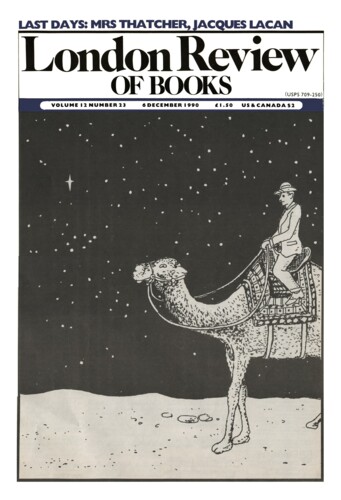
Born of the age we live in

John Lanchester, 6 December 1990

Rupert Murdoch bought the Sun in April 1969. The newspaper was an avatar of the Daily Herald, a Labour paper – the biggest-selling daily in Britain during the Thirties – that had fallen on hard times. In 1961 the International Publishing Corporation had bought the loss-making Herald as part of a deal involving the acquisition of several lucrative magazine titles. Hugh Cudlipp, chairman of IPC, had given the unions a guarantee to keep the paper going for seven years, and to keep it supporting the Labour movement; at the same time, the paper was not allowed to compete with the existing IPC title, the Daily Mirror. With these albatrosses tied around its neck, it’s not surprising that the paper’s circulation declined, notwithstanding its 1964 relaunch as the Sun, complete with the new Wilson-era slogan: ‘Born of the age we live in!’ When IPC finally decided to sell the Sun the circulation had fallen from 1.5m to 650,000 copies. After the print unions refused to discuss Robert Maxwell’s offer for the paper, Murdoch stepped in. ‘I am constantly amazed at the ease with which I entered British newspapers,’ he later said.’

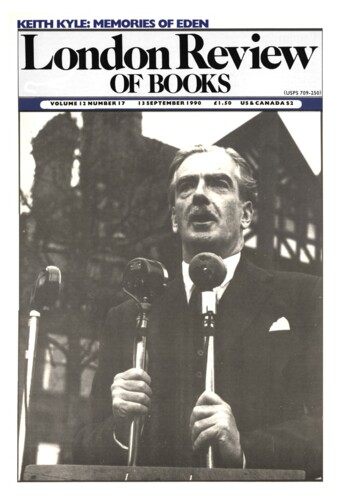
How criminals think

John Lanchester, 13 September 1990

In his now-famous article ‘The Cultural Logic of Late Capitalism’, the Marxist critic Fredric Jameson gives one of the defining characteristics of Post-Modernism as being ‘the effacement of the older (essentially high-modernist) frontier between high culture and the so-called mass or commercial culture’. This effacement of frontiers, which has often taken parodic form (the soup cans of Andy Warhol, the deliberate kitsch of architects like Philip Venturi, author of the feisty manifesto Learning from Las Vegas) is now itself parodied in Gilbert Adair’s funny and accomplished second novel. The narrator of Love and Death on Long Island is the Hampstead-inhabiting author of four novels more popular in France than in this country, as well as of ‘a history of angels’. As the novel opens his work is starting to recover from two decades of neglect, and he is awaiting the publication of his second non-fiction book, a discussion of Post-Modernism called The Gentrification of the Void.

Diary: Bad Trips in Cumbria

John Lanchester, 30 August 1990

I am agoraphobic – though when I hear case-histories of some of my fellow agoraphobics, who have to slay mental dragons and scale psychological Matterhorns before they can even begin to think about going out of the house, I feel pretty lucky. There are people who haven’t been outdoors for twenty or thirty years. In my own case, I have extended periods of complete equilibrium before what behaviourists would call a ‘bad learning experience’ intervenes, and seems somehow to teach me about the possibility of the phobia all over again.’

Diary: Watching the World Cup

John Lanchester, 12 July 1990

After seeing his first ever English Football League match, a West German football journalist turned to me and dazedly asked: ‘Is this what you have to watch every week?’ He was referring to several things he couldn’t believe about the game – its maniacal tempo and hectic physicality, as well as its tactical simple-mindedness – but mostly he was referring to what he saw as an evident deficiency of skill, and hence interest. This aghast reaction was duplicated all over Europe after England’s 1-1 draw with the Republic of Ireland in Sardinia, during the first round of the World Cup. It was one of the most sterile games anyone had ever seen, at times almost hallucinogenic in its dullness, and for a lot of people it summed up the tactical and technical bankruptcy that has overtaken football in this country.’

Hong Pong: John Lanchester

Thomas Jones, 25 July 2002

First, let me declare a disinterest. John Lanchester and I are both involved, in different ways, with the London Review of Books, but otherwise have nothing to do with one another. Now...

Read more reviews

On the Run: John Lanchester

Adam Phillips, 2 March 2000

The name is ordinary, so the book announces itself as a book about no one special; though, of course, when men without qualities become the subjects of novels a certain gravity (if not grace) is...

Read more reviews

Read anywhere with the London Review of Books app, available now from the App Store for Apple devices, Google Play for Android devices and Amazon for your Kindle Fire.

Sign up to our newsletters

For highlights from the latest issue, our archive and the blog, as well as news, events and exclusive promotions.

Newsletter Preferences