John Lanchester

John Lanchester is the author of six novels – The Debt to Pleasure, Mr Phillips, Fragrant Harbour, Capital, The Wall and Look What You Made Me Do – and a collection of ghost stories, Reality, and Other Stories. He has also written a memoir, Family Romance, and two books about the financial system, Whoops!, and How to Speak Money.

His first piece for the LRB, on Martin Amis, appeared in 1987, when he was a junior member of staff at the paper. He has since written well over a hundred pieces on subjects including agoraphobia, Don De Lillo, Anthony Powell, Ian Rankin, Ian Fleming, Rupert Murdoch, Google, Wal-Mart, Alastair Campbell’s diaries, Cityphilia and Cityphobia, the failure of the banking system in 2008, Marx, getting hooked on Game of Thrones, the PPI scandal, the robotified future, bitcoin, Facebook, Agatha Christie, Maigret, Universal Basic Income, the shipping industry, cheating in sport, Covid, statistics and the uselessness of modern finance.

Self-Effacers

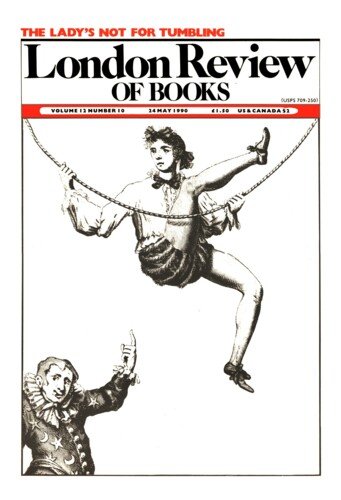
John Lanchester, 24 May 1990

It’s sometimes easy to forget that good writing is not necessarily brilliant on the surface. There are talented novelists who eschew local flourishes in favour of a tonal evenness which they believe better serves the purposes of structure, characterisation and plot. Their prose seeks to be transparent rather than dazzling. If one could plot writers on a continuum which measured the extent to which a prose style forces its brilliance on our attention, the four novelists here under review would be clustered towards the self-effacing side of the spectrum, with colleagues such as Burgess, Nabokov and Amis fils huddling together for warmth at the far end.

Cheers

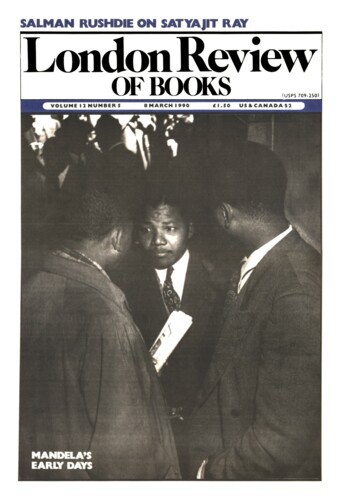
John Lanchester, 8 March 1990

Though the incidence of alcoholism among American writers has been extraordinarily high, fictional depictions of the condition by American novelists are surprisingly rare. One of the most vivid comes from John Updike’s Bech is back, the second of his books to deal with the American writer’s life through the alter ego of unprolific Jewish novelist Henry Bech, here attending a party:

Strong Meat

John Lanchester, 11 January 1990

Harry Fonstein, one of the four main characters in The Bellarosa Connection, is a now-prosperous American-Jewish businessman who was saved from a Fascist prison and smuggled to America by Mafia types acting at the behest of Billy Rose, the famous Jewish showbiz figure (‘Damon Runyon’s pal’) whom he had never met. This is Harry:

Sour Plums

John Lanchester, 26 October 1989

In 1964, Time published a profile of John Cheever which, in a sub-heading, described him as ‘The Monogamist’. Subsequent events have proved that not to have been the fact-checkers’ finest hour. In 1984, two years after his death, Susan Cheever published Home before Dark, a memoir which portrayed her father, whose public image was that of an impeccably upper-middle-class monogamist suburban WASP, as a promiscuously bisexual alcoholic. One memorable scene had John Updike, a friend and rival – Norman Mailer called Cheever and him ‘the Old Pretender and the Young Pretender of the New Yorker’ – ringing the doorbell and being answered by Cheever, bombed out of his mind and stark naked. Home before Dark struck some people as devotedly filial, sensitive and moving etc, and struck others as an upmarket Mommy Dearest. But Cheever’s children hadn’t finished with him, and now The Letters of John Cheever, edited by the writer’s son Benjamin, means that he has become the victim of a familial double whammy.’

State of the Art

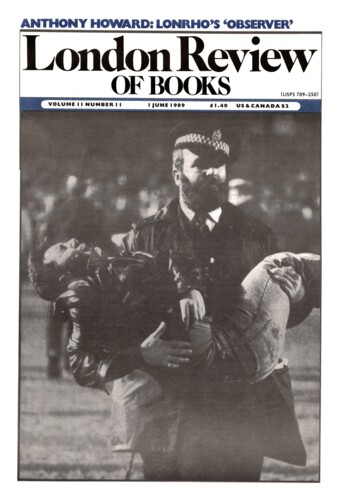
John Lanchester, 1 June 1989

The broad distinction among English football teams is between hearties and aesthetes. The aesthetes have, fortunately, tended to carry off the main footballing prizes – certainly they look set to do so this year, in the persons of Liverpool Football Club – but the hearties dominate numerically, and set the tone of most of the matches to be seen anywhere in the country on a Saturday afternoon. Hearties subscribe to two tenets, both of which have their origins in a characteristic national turning-away and turning-inwards. The first hearty tenet is called work-rate. Since the early Fifties it has been clear that England was not as good at football as it once thought it was: the traumatic 1950 World Cup defeat at the hands of the USA made this apparent, and it was emphatically rubbed in by the two cataclysmic losses to the Hungarians, 6-3 at Wembley in 1953 and 7-1 in Budapest in 1954.

Hong Pong: John Lanchester

Thomas Jones, 25 July 2002

First, let me declare a disinterest. John Lanchester and I are both involved, in different ways, with the London Review of Books, but otherwise have nothing to do with one another. Now...

Read more reviews

On the Run: John Lanchester

Adam Phillips, 2 March 2000

The name is ordinary, so the book announces itself as a book about no one special; though, of course, when men without qualities become the subjects of novels a certain gravity (if not grace) is...

Read more reviews

Read anywhere with the London Review of Books app, available now from the App Store for Apple devices, Google Play for Android devices and Amazon for your Kindle Fire.

Sign up to our newsletters

For highlights from the latest issue, our archive and the blog, as well as news, events and exclusive promotions.

Newsletter Preferences