John Lanchester

John Lanchester is the author of six novels – The Debt to Pleasure, Mr Phillips, Fragrant Harbour, Capital, The Wall and Look What You Made Me Do – and a collection of ghost stories, Reality, and Other Stories. He has also written a memoir, Family Romance, and two books about the financial system, Whoops!, and How to Speak Money.

His first piece for the LRB, on Martin Amis, appeared in 1987, when he was a junior member of staff at the paper. He has since written well over a hundred pieces on subjects including agoraphobia, Don De Lillo, Anthony Powell, Ian Rankin, Ian Fleming, Rupert Murdoch, Google, Wal-Mart, Alastair Campbell’s diaries, Cityphilia and Cityphobia, the failure of the banking system in 2008, Marx, getting hooked on Game of Thrones, the PPI scandal, the robotified future, bitcoin, Facebook, Agatha Christie, Maigret, Universal Basic Income, the shipping industry, cheating in sport, Covid, statistics and the uselessness of modern finance.

Bond in Torment: James Bond

John Lanchester, 5 September 2002

It would be an exaggeration, but not all that much of an exaggeration, to say that the Bond novels are at heart a series of lavish beatings strung together with thriller elements . . . The tenderest, most yearning word in Fleming’s lexicon is ‘cruel’.
Diary: A Month on the Sofa

John Lanchester, 11 July 2002

Both Ronaldo and Ronaldinho have been playing in attack for Brazil. In Futebol Alex Bellos points out that Ronaldo was once himself known as Ronaldinho, because there was already another Ronaldo in the side, as well as a Ronaldão. When the current Ronaldinho came along, this could have meant that Brazil were fielding Ronaldão, Ronaldo, Ronaldinho, and Ronaldinhozinho: big Ronald, normal-sized Ronald, little Ronald, and even littler Ronald. Instead the former Ronaldo dropped out, the new Ronaldo became Ronaldinho Gaúcho (after his place of origin), and the former Ronaldinho was promoted to Ronaldo, a title he still holds. All this is gripping. But what I want to know is, why are so many Brazilians called Ronald? Surely it can’t be anything to do with Ronnie Biggs? Or did he fit so easily into Brazil because it was already a country of many Ronalds?

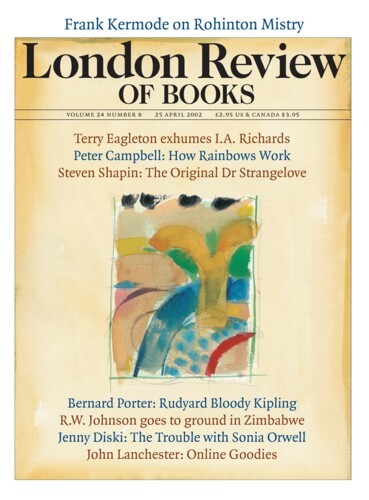
Diary: Online Goodies

John Lanchester, 25 April 2002

At the Grammy awards the other week, an unusual note was struck by Michael Greene, a record industry bigwig. The only real point of interest at most award ceremonies is the frocks (and sometimes, admittedly, the hair), so it was a break with tradition when Greene and his tuxedo launched into the subject of Internet piracy. ‘No question the most insidious virus in our midst is the...

Lumpy, Semi-Dorky, Slouchy, Smarmy

John Lanchester, 23 August 2001

In January 1957 the New York Police Department arrested a man called George Metesky, whose activities over the previous 16 and a bit years had earned him the sobriquet ‘the Mad Bomber’. The Bomber had planted more than thirty explosive devices, favouring public places such as cinemas, train stations, libraries and phone booths. He hadn’t killed anyone but his bombs were...

Be interesting! Martin Amis

John Lanchester, 6 July 2000

In the middle of the current memoir boom it is easy to forget that the novelist’s memoir is a distinct and recent genre. There are, it goes without saying, any number of first-rate writers whose main claim on our attention is their autobiographical work; there are great writers whose letters and/or diaries add up to masterpieces of self-portraiture (Byron, Woolf, Flaubert); there are, and this, too, is a contemporary phenomenon, writers who turn to fiction after an explicitly autobiographical first book. But none of those cases is quite the same as that of the novelist of established reputation and readership who at some mid or late point in his career (the pronoun is not quite gender-neutral, since for some reason it is usually a man) sits down to tell the story of his life. Nabokov’s Speak, Memory is in this and other respects an important book, and it also establishes the defining problem of the genre, which is how to give the memoir an artistically gratifying shape while remaining true to the messiness and quotidianness of lived life. It’s a problem which, to my mind, the great man outrageously flunked, settling for a spurious and cod-mystical belief in pattern, as if life were as pretty in its shapes and echoes and motifs as a work of fiction – his fiction. The much-acclaimed result, while full of astounding things, is also hysterical and, in some important sense, feels false.’

Hong Pong: John Lanchester

Thomas Jones, 25 July 2002

First, let me declare a disinterest. John Lanchester and I are both involved, in different ways, with the London Review of Books, but otherwise have nothing to do with one another. Now...

Read more reviews

On the Run: John Lanchester

Adam Phillips, 2 March 2000

The name is ordinary, so the book announces itself as a book about no one special; though, of course, when men without qualities become the subjects of novels a certain gravity (if not grace) is...

Read more reviews

Read anywhere with the London Review of Books app, available now from the App Store for Apple devices, Google Play for Android devices and Amazon for your Kindle Fire.

Sign up to our newsletters

For highlights from the latest issue, our archive and the blog, as well as news, events and exclusive promotions.

Newsletter Preferences