John Lanchester

John Lanchester is the author of six novels – The Debt to Pleasure, Mr Phillips, Fragrant Harbour, Capital, The Wall and Look What You Made Me Do – and a collection of ghost stories, Reality, and Other Stories. He has also written a memoir, Family Romance, and two books about the financial system, Whoops!, and How to Speak Money.

His first piece for the LRB, on Martin Amis, appeared in 1987, when he was a junior member of staff at the paper. He has since written well over a hundred pieces on subjects including agoraphobia, Don De Lillo, Anthony Powell, Ian Rankin, Ian Fleming, Rupert Murdoch, Google, Wal-Mart, Alastair Campbell’s diaries, Cityphilia and Cityphobia, the failure of the banking system in 2008, Marx, getting hooked on Game of Thrones, the PPI scandal, the robotified future, bitcoin, Facebook, Agatha Christie, Maigret, Universal Basic Income, the shipping industry, cheating in sport, Covid, statistics and the uselessness of modern finance.

Rebusworld: The Rise and Rise of Ian Rankin

John Lanchester, 27 April 2000

According to the OED, a ‘rebus’ is ‘an enigmatic representation of a name, word or phrase by figures, pictures, arrangement of letters etc, which suggest the syllables of which it is made up’. In 1987, Ian Rankin’s novel Knots & Crosses introduced us to a tough Edinburgh Detective Sergeant called John Rebus. A series of local girls had been kidnapped and strangled. Rebus – 41-year-old drinker, ex-soldier, failed husband, absentee father, Christian, annual rereader of Crime and Punishment – begins receiving a series of cryptic notes. The first few messages say There are clues everywhere. Then a message is delivered to Rebus’s home: For those who read between the times. It becomes clear that the killer has some personal connection to the detective. An Eng. Lit. professor at Edinburgh University calls Rebus to say that, as the author of Reader Exercises and Directed Exegetic Response, he has noticed that the names of the victims appear to make up a word: take the first letters of their Christian names and surnames and they spell out the word Samantha. That’s a rebus; it’s also the name of Rebus’s daughter. He dashes off to find her but she has already been abducted by the killer, an army buddy of Rebus’s who cracked during SAS training and has held a grudge against him ever since. Rebus gets there just in time to save his daughter, though not without being shot – the first of the many woundings, beatings and physical mishaps which befall him in Rankin’s books.’‘

See you in court, pal: The Microsoft Trial

John Lanchester, 30 September 1999

There are people who use computers. That, in the context of LRB readers and contributors, is most of us. Above them on the informational equivalent of the Great Chain of Being are the people who know about computers: the people who can tell us how to stick an unbent paperclip into the hole above a wonky disc drive to make the floppy pop out etc. All of these people are now on the Internet. Above them are the bona fide geeks, who are either people who have things professionally to do with computers, or who are far-gone in hobby-dom. These people can write code (which is geekspeak for ‘write computer programs’), mark up HTML to create web pages, and know not only what’s going on, but also what’s about to go on. Above them are the übergeeks, the illuminati of the digital revolution: the kind of people, to use one example from Po Bronson’s entertaining Silicon Valley collage The Nudist on the Late Shift, who reprogram their BMW’s chips to make the car 40 per cent more powerful, the kind of people who, in computer terms, can routinely achieve the impossible.‘

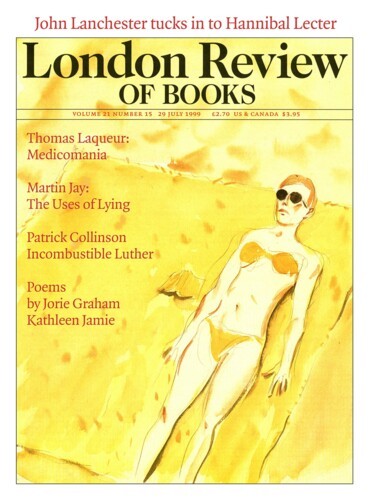
The first time we – that’s we the reading public – met Dr Hannibal Lecter, he was lying on his cot in his cell at the Chesapeake State Hospital for the Criminally Insane with a copy of Alexandre Dumas’s Grand dictionnaire de cuisine open on his chest. Lecter was incarcerated for having murdered nine people ‘that we know about’, and having crippled two others, one of whom (of whom more later) was permanently attached to a respirator in Baltimore. Dr Lecter was being visited by Will Graham, a Special Investigator attached to the FBI, in pursuit of a man who had murdered two families. When Graham arrives at Lecter’s cell, the good doctor wakes up: ‘Dr Lecter’s eyes are maroon and they reflect the light redly in tiny points.’ Brrrrr. Is it chilly in here, or is it me?’‘

D&O

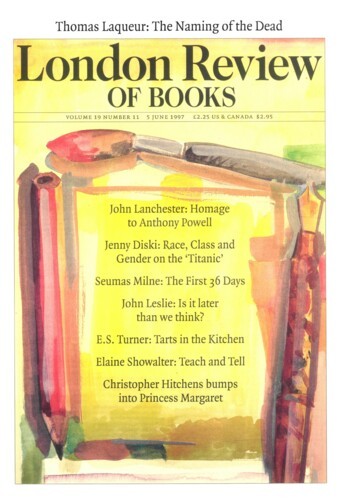
John Lanchester, 5 June 1997

Most good novelists make life seem more interesting than it is. The very fact that their work offers a continuous aesthetic or psychic frisson is a kind of falsehood, a betrayal of reality; and one of the hardest things for any writer to capture is the feeling that nothing much is happening. If I had to praise only one aspect of Anthony Powell’s work, it would be his ability to capture this dailiness and ordinariness, and to combine it with a range of incidents and characters as broad as that tackled by any English-language novelist this century. There is a stereotype of Powell as a snob and novelist of society, and it’s true that he has written about Eton in the Teens, Oxford in the Twenties, and all that; but his oeuvre also encompasses pub life, literary life, the British film industry in the Thirties, war in Northern Ireland and London, campus uprisings in the Sixties and hippy cults in the Seventies, not to mention such subjects as abortion, adultery, alcoholism, voyeurism, necrophilia, black magic, and the awfulness of MPs. There is a lot of the world in Powell’s work, and a lot of history too. To give just one example, The Military Philosophers, the ninth novel in A Dance to the Music of Time, contains a description of the Whitehall response to news of the Katyn massacre (‘One would really have thought that someone at the top of the Polish set-up would have grasped that this is not the time to make trouble’) that is both a grimly valuable piece of documentary realism and also a subtle account of the fact that realpolitik is often no more than brutal fantasy. And throughout all this, that sense of dailiness and ordinariness – which hereinafter I’ll refer to as D&O – remains intact.’

Diary: On Fatties

John Lanchester, 20 March 1997

Nel mezzo del cammin di nostra vita – more specifically, on the evening of my 35th birthday, last week – I saw Tom Cruise. He was sitting at the next table in a restaurant, accompanied by his equally small and perfectly formed wife Nicole Kidman and eight buddies. I suppose the world’s two most famous Scientologists, apart of course from John Travolta and the late L. Ron himself, were in town for the premières of their respective new movies. Or perhaps this was just another symptom of the reinvention of London as the hippest, most happening, furthest-molecule-forward-on-the-cutting-edge city since Periclean Athens. (Actually, the alacrity with which the locals have fallen on Newsweek’s emetic paean to ‘Cool Britannia’ and Vanity Fair’s ditto to ‘Swinging London’ is a medium-sized symptom of decline in itself – but I digress.) Cruise was giving the dinner, it turned out, and he did a certain amount of pantomime with the wine, swirling and sniffing and sipping, before nodding with great formality and permitting it to be poured; after which everyone else swirled and sniffed and sipped and nodded with great formality, too. It wasn’t hard to work out who was the Alpha Male.’

Hong Pong: John Lanchester

Thomas Jones, 25 July 2002

First, let me declare a disinterest. John Lanchester and I are both involved, in different ways, with the London Review of Books, but otherwise have nothing to do with one another. Now...

Read more reviews

On the Run: John Lanchester

Adam Phillips, 2 March 2000

The name is ordinary, so the book announces itself as a book about no one special; though, of course, when men without qualities become the subjects of novels a certain gravity (if not grace) is...

Read more reviews

Read anywhere with the London Review of Books app, available now from the App Store for Apple devices, Google Play for Android devices and Amazon for your Kindle Fire.

Sign up to our newsletters

For highlights from the latest issue, our archive and the blog, as well as news, events and exclusive promotions.

Newsletter Preferences