John Lanchester

John Lanchester is the author of six novels – The Debt to Pleasure, Mr Phillips, Fragrant Harbour, Capital, The Wall and Look What You Made Me Do – and a collection of ghost stories, Reality, and Other Stories. He has also written a memoir, Family Romance, and two books about the financial system, Whoops!, and How to Speak Money.

His first piece for the LRB, on Martin Amis, appeared in 1987, when he was a junior member of staff at the paper. He has since written well over a hundred pieces on subjects including agoraphobia, Don De Lillo, Anthony Powell, Ian Rankin, Ian Fleming, Rupert Murdoch, Google, Wal-Mart, Alastair Campbell’s diaries, Cityphilia and Cityphobia, the failure of the banking system in 2008, Marx, getting hooked on Game of Thrones, the PPI scandal, the robotified future, bitcoin, Facebook, Agatha Christie, Maigret, Universal Basic Income, the shipping industry, cheating in sport, Covid, statistics and the uselessness of modern finance.

“In a few weeks from now, Labour will have been in office for eight years, and we will be in the middle of an election campaign which seems certain to win it at least four more. The party’s record in government evokes a range of responses on the left – from mild gloom to clinical depression, from irritation to rage, from apathy to horror – but one of the most consistent things it provokes is disorientation. This is a Labour government? This is what we were looking forward to for those 18 years of Tory rule? War, tuition fees, house arrest, wholesale subservience to American foreign policy, talk of services being ‘swamped’ by refugees, the deliberately manipulative use of fear, the introduction of ID cards, the suspension of habeas corpus – and these are the good guys. What happened?”
“At the moment, the discussion about poverty and inequality and class is so addled that there isn’t even a basic measure of, or consensus about, what poverty is. Poverty is not having money; inequality is having less money than other people. In Britain, to be poor is generally defined as meaning that you live on 60 per cent of the median income. But that isn’t a measure of poverty at all, since an entire society could be living on a dollar a day each, yet under this definition would have nobody who qualified as poor. This measure for poverty is in fact a measure of inequality, and the means of dealing with inequality are not just different from those required to deal with poverty but are in some respects their complete opposite.”

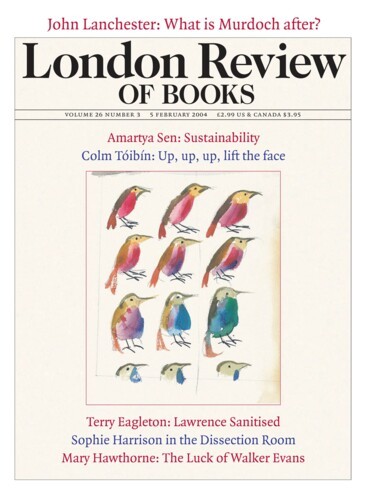
Bravo l’artiste: What is Murdoch after?

John Lanchester, 5 February 2004

“Chenoweth has found, looking at the accounts, that [News Corp’s] profits, declared in Australian dollars, were A$364,364,000 in 1987, A$464,464,000 in 1988, A$496,496,000 in 1989 and A$282,282,000 in 1990. The odds that such figures were a happy coincidence are 1,000,000,000,000 to one. That little grace note in the sums is accountant-speak for ‘Fuck you.’”

Diary: Unbelievable Blair

John Lanchester, 10 July 2003

“Blair’s political personality has always been predicated on the proposition ‘I am good.’ His dewy-eyed, slightly fumbling sincerity – his brilliantly articulate impersonation of earnest inarticulacy – has all along been tied to his self-projection as a Good Man. He is careful about not touting his religion in public, but he doesn’t need to, since the conviction of his own goodness is imprinted in everything he says and does. It is one of the things he has in common with the party he leads, and one of the reasons people are wrong when they say that Blair is a natural Tory.”

Short Cuts: Football and Currie

John Lanchester, 17 October 2002

It is possible to love football without loving the culture of the English Premiership. The waves of cash that have rolled into the game since the deal with Sky in 1991 may not have fundamentally altered the character of the sport – a quarter of a century ago, Tom Stoppard was making a character in his play Professional Foul complain about the ‘yob ethics’ of the game –...

Hong Pong: John Lanchester

Thomas Jones, 25 July 2002

First, let me declare a disinterest. John Lanchester and I are both involved, in different ways, with the London Review of Books, but otherwise have nothing to do with one another. Now...

Read more reviews

On the Run: John Lanchester

Adam Phillips, 2 March 2000

The name is ordinary, so the book announces itself as a book about no one special; though, of course, when men without qualities become the subjects of novels a certain gravity (if not grace) is...

Read more reviews

Read anywhere with the London Review of Books app, available now from the App Store for Apple devices, Google Play for Android devices and Amazon for your Kindle Fire.

Sign up to our newsletters

For highlights from the latest issue, our archive and the blog, as well as news, events and exclusive promotions.

Newsletter Preferences