James Meek

James Meek is a contributing editor at the LRB. His new novel, Your Life without Me, has just been published.

Short Cuts: Deepfakery

James Meek, 5 December 2019

Electionseason in the Trapped-Together Kingdom, and people are talking about politicians and parties, sort of. The talk isn’t always talk, as such. To put it another way, when was the last time someone told you a joke? When was the last time you saw a fresh quip inked on the door of a toilet? No, I can’t remember either. But when was the last time you clicked on a link to a...

The Dreamings of Dominic Cummings

James Meek, 24 October 2019

Iwent​ travelling in Remainia. My aim was to write about St Albans in Hertfordshire, a city just north of London where voters and the local MP are out of sync on the wedge issue of the day. In 2016 the people of St Albans voted heavily to remain in the EU – among cities, St Albans was behind only Edinburgh, Cambridge, Oxford, Brighton and Glasgow in the rankings of pro-EU vote...

The Two Jacobs: The Faragist Future

James Meek, 1 August 2019

I used to share the feeling that there was something contradictory about Rees-Mogg’s elderly Edwardian schoolboy act in Parliament and his cosmopolitan quest for value in the stock markets of the world. Burrowing deep into the facts in search of a gotcha! moment is a vital journalistic endeavour, and may it continue for ever. But having read through years of Rees-Mogg’s voluminous parliamentary speeches and looked at the activities of Somerset Capital Management, I find that the paradigm ‘He says he’s one thing, but actually he’s another’ misses the bigger point, which is that there is no contradiction. Rees-Mogg is out in plain sight. The Rees-Mogg of SCM and the Rees-Mogg of Parliament are facets of a single worldview that shows the actual nature of Faragist Britain.

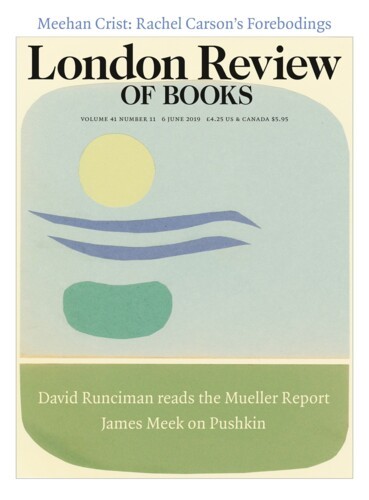
Pushkin lies entombed in the vast mausoleum of his reputation. According to Oleg Turnov, who compiles an annual list, new works of Russian Pushkinography are published at the rate of several hundred a year, rising to an average of three a day in 1999, the bicentenary of his birth, and range from multi-volume academic studies and serious biographies to lurid works like Aleksandr Zinukhov’s Who Killed Aleksander Pushkin? And when you finally get to Pushkin, you’re liable to be told that if you don’t speak Russian you can’t get to him anyway.

The internet hasn’t so much changed people’s relationship to news as altered their self-awareness in the act of reading it. Before, we were isolated recipients of the news; now, we are self-consciously members of groups reacting to news in shared ways. Marvellously, this facilitates solidarity for the truly oppressed, for campaigners, for those with minority interests. But it also means that the paranoid, the suspicious, the xenophobic and the conspiracy-minded know they’re not alone. They’re conscious of themselves as a collective, as an audience, weeping, cheering, heckling and screaming from the safety of the darkness over the stalls, occasionally pulling on a mask to jump onto the stage and pull down the trousers of the performers or to start a false panic that the theatre is on fire.

Planes, Trains and SUVs: James Meek

Jonathan Raban, 7 February 2008

James Meek’s last, bestselling novel, The People’s Act of Love, published in 2005 to great critical acclaim, was set in 1919, in ‘that part of Siberia lying between Omsk and...

Read more reviews

Dynamite for Cologne: James Meek

Michael Wood, 21 July 2005

James Meek’s early fiction is alert, acrid and funny, and only slightly too insistent on its own quirkiness – as if it were hoping reviewers would call it surreal (they did) and...

Read more reviews

Read anywhere with the London Review of Books app, available now from the App Store for Apple devices, Google Play for Android devices and Amazon for your Kindle Fire.

Sign up to our newsletter

For highlights from the latest issue, our archive and the blog, as well as news, events and exclusive promotions.

Newsletter Preferences