D.A.N. Jones

D.A.N. Jones was a literary journalist who wrote more than sixty pieces for the LRB. Mary-Kay Wilmers wrote after his death in 2002 that Jones ‘presented himself as a plain man . . . but he was also more interesting and cagier than that’.

Fighting Men

D.A.N. Jones, 2 February 1984

Vernon Scannell is not the first British poet to have been keen on boxing and, apparently, quite good at it: we may think of Lord Byron and Robert Graves. But few others, surely, have written and worried so concernedly about the ethics of this sport, its moral justification. Ring of Truth, his first novel since The Big Time in 1965, returns hungrily to Scannell’s old problem. Can deliberate wounding be good sport? Scannell tells of dangerous, exciting weeks in the life of Dave Ruddock, a boxer from Leeds, acknowledged as Middleweight Champion of the World. ‘He had not lost a fight since he was 13 … Schoolboy Champion of Great Britain, Junior ABA and Senior ABA Champion, a Lonsdale Belt, the European title and then the pot of gold, the Championship of the World – 11 years without dropping a decision.’ Dave Ruddock is feeling pretty good. We read on the dust-cover that Scannell himself has been a National Schoolboy and Senior Amateur Boxing Champion: he has also done a little professional boxing (under the name of ‘Johnny Bain’) and travelled with a fairground boxing-booth. While writing about Dave Ruddock, he must have been thinking: ‘I too could have been a contender!’–
Sour Notes

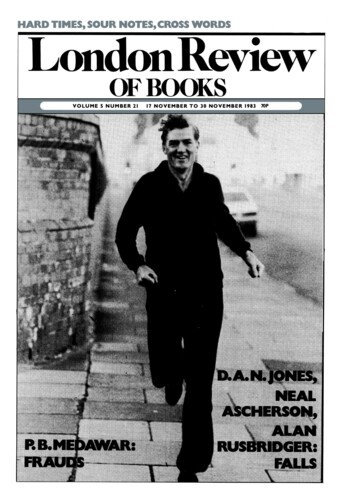
D.A.N. Jones, 17 November 1983

Sir Peter Hall is a man of Notes. He is a director of plays who has become Director of the National Theatre. The skills of play directors are not those of performers (like his predecessor at the National, Lord Olivier). Play directors pride themselves on their ability to give what they call Notes. This sort of Note (scarcely recognised by dictionaries) is not the sort manual workers make, in notebooks or on notepaper: it is mouth work. Sometimes it is like the tuning note given to a band by piano or woodwind; sometimes like a note of disapproval or approbation uttered by a schoolmaster to his class, or a professor to his seminar. So now, in Sir Peter’s diary, we find the National Director descending upon the actors rehearsing Horvath’s play, Tales from the Vienna Woods, under the direction of Maximilian Schell:

Saint Jane

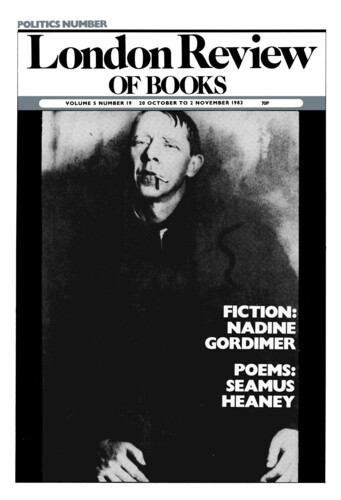
D.A.N. Jones, 20 October 1983

Peter Prince’s admirable novel, The Good Father, is about a group of professional-class people in the London Borough of Lambeth, trying to see themselves as liberal and left-wing. They were students together in the late 1960s and are struggling to maintain in the 1980s the package of liberal values (or ‘received ideas’) which they shared so confidently in their youth. The trouble with such package deals is that when one item loses its authority the believer may throw out the whole lot, bag and baggage, baby and bathwater: he may rush to the opposite extreme, seeking out illiberal values to embrace with a fervour that embarrasses old conservatives. Bill Hooper, the hero of The Good Father, was once an excessively keen feminist: now, in his thirties, separated from his wife and denied custody of their four-year-old son, he becomes a fighter for men’s rights – and rather a dirty fighter, unchivalrous, ungentlemanly.–

Gentlemen Travellers

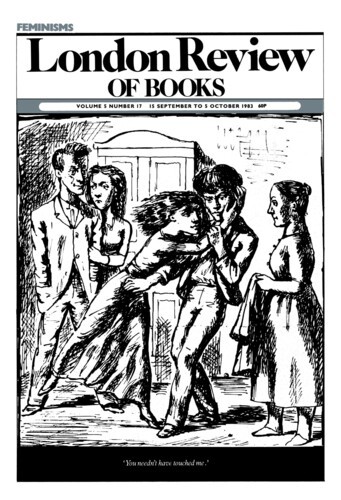
D.A.N. Jones, 15 September 1983

The cool, courteous Alexander Kinglake and the hot, contentious George Borrow are two of the best-liked and most influential travel-writers of the 19th century. They were contemporaries for much of their long lives (Borrow died in 1881, aged 78, Kinglake in 1891, aged 82) but play very different roles in the 20th-century imagination.

Veni, vidi, video

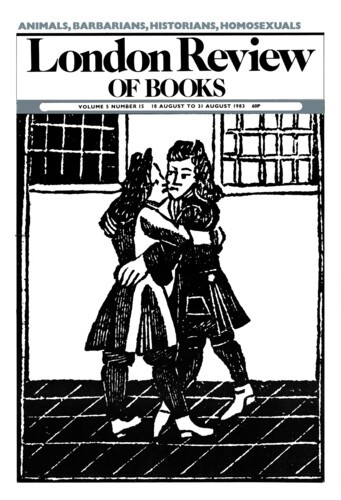
D.A.N. Jones, 18 August 1983

It would be easy to overpraise Dangerous Pursuits. This is a comedy of surveillance, dealing with in-store video monitors, hardware and software, amateur and professional police espionage, counter-terrorism, peeping toms and voyeurs. Everyone is bugged. Nicholas Salaman has plotted his book so deftly, with almost plausible pranks and conspiracies, surprises and reversals, sexual depravities and savage cruelties, that it sometimes resembles a first-rate spy thriller. But, despite the melancholy conclusion, Dangerous Pursuits is truly comic, dipping easily into absurdity when events become too nauseous to be taken seriously. There are passages that read like a parody of such long, morbid, humourless para-political thrillers of espionage as Monimbo (copyright Mossgrave Partnership) or Charles McCarry’s The Last Supper – so ambitiously titled but with all the human interest of a computer or a ventriloquist’s dummy. Charles McCarry must not be confused with Edgar Bergen’s famous doll, Charlie McCarthy, since he is never intentionally funny: but his narrative and dialogue benefit by being read aloud, in a quacking, inhuman voice, without movement of the lips.–

Read anywhere with the London Review of Books app, available now from the App Store for Apple devices, Google Play for Android devices and Amazon for your Kindle Fire.

Sign up to our newsletter

For highlights from the latest issue, our archive and the blog, as well as news, events and exclusive promotions.

Newsletter Preferences