D.A.N. Jones

D.A.N. Jones was a literary journalist who wrote more than sixty pieces for the LRB. Mary-Kay Wilmers wrote after his death in 2002 that Jones ‘presented himself as a plain man . . . but he was also more interesting and cagier than that’.

Passage to Africa

D.A.N. Jones, 7 July 1983

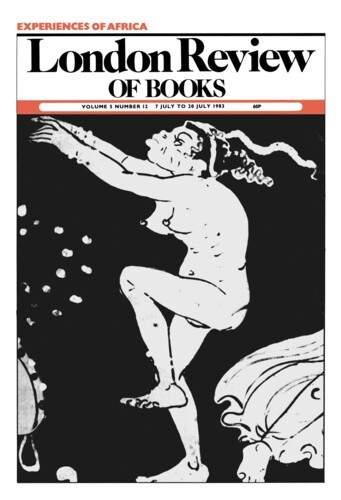
When I took up work in Nigeria, the day after their Independence ceremony of 1960, I had with me two old British books to introduce me to the country – or, at least, to my seniors’ appreciation of it. They were as different, almost, as Cocteau and Baden-Powell. One was picturesque and picaresque, Africa dances: A Book about West African Negroes, published by Geoffrey Gorer in 1935 when he was 30, after a rather Waugh-like tour of French and British territories: he had been guided by Féral Benga, a ballet dancer from Senegal whom he had met in Paris. The striking pictures included a smoky painting of handsome Benga by his friend, Pavel Tchelitchew, who had introduced him to Gorer. Before his passage to Africa, young Gorer had already published The Revolutionary Ideas of the Marquis de Sade and his mood was still dandy-left, rive-gauche, smoothly dissident and shocking. Africa dances is now reissued as a paperback, in regrettably abbreviated form, with no pictures. We may trace in it the shifts and jumps of Gorer’s developing political consciousness, dancing uneasily between the back and the front half of the New Statesman. He was inclined to see (and love) his ‘negroes’ as sculptures, objets d’art, patterns of dance, to be described to British readers in an amoral aesthetic way: but there were spasms of humane indignation at the French mode of government and, as a concomitant, a growing respect for the British system, despite its comically stodgy ‘This England’ aspects.–
Story: ‘Popping’

D.A.N. Jones, 2 June 1983

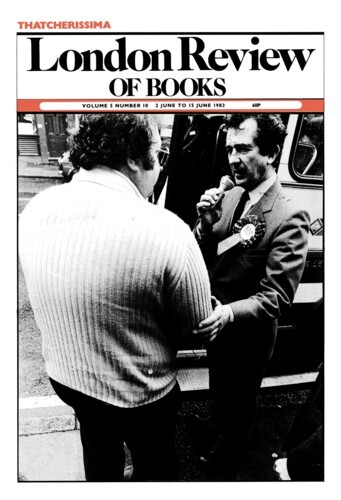
It was my 53rd birthday and so I strolled, as was my custom, out of my Quanco office into Hyde Park to look at the statue which had been set up on the day of my birth. Curiously enough, the maintenance of that statue had become part of my ever-increasing Quanco duties – only the cleaning and repair, of course, despite Quanco’s ever-decreasing funds: the task of changing the advertisements and the labels on the statue belongs to the Commercials. I like watching the Commercials perform this weekly rite: it brings a touch of colour and razzmatazz to our fusty little park.–

Boss of the Plains

D.A.N. Jones, 19 May 1983

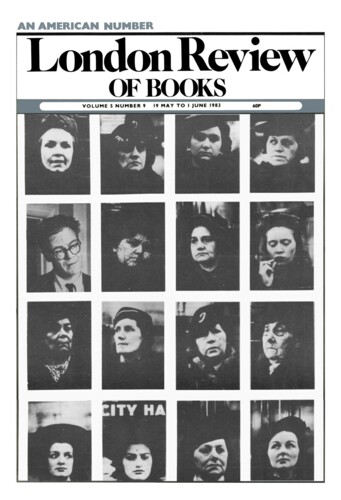
Paul Fussell’s 34 essays were written in different moods and time-zones for different British and American journals, between 1967 and 1982. Some are boyishly truculent, politically partisan, denouncing wrong-headed fellow Americans (so that the British reviewer whistles between his teeth, thinking: ‘They can’t be as bad as all that’). Others are what he calls ‘ironical’, with complaints against Americans who misunderstand his tone: he seems to expect British readers to do better. Still other essays – about warfare and his own military experiences – are so confessional and impassioned that the British reviewer feels he needs to be very tactful.–

Saturday Night in Darlington

D.A.N. Jones, 1 April 1983

Darlington is not like Bermondsey: it has not been ruined yet. In Bermondsey you could see the local community industry, the dockland, turned into a building-site – with the traditional community leaders and politicians quarrelling fiercely over the future of this land: older and younger members or ex-members of the Labour Movement were at each others’ throats in an extreme local version, a microcosm, of the national split. You could see the blocks of council flats – many of which have housed the families of young dockworkers quite happily – boarded up, scorned and despised: for the young men and women have moved away. You could see older small houses, once workmen’s cottages, now extremely desirable for young professional people. In came a bright young professional man as candidate for the Social Democratic Party, cutting between the quarrelling ‘socialist’ factions, and boosted by the London media-men (conveniently near at hand and poised to foment and exploit the Labour quarrel). This candidate scooped the pool, assisted by the votes and abstentions of elderly Bermondsey people bewildered by the ruin and general beastliness, not sure why good old Bob Mellish was being so rude to nice young Peter Tatchell. The vicious graffiti about Tatchell were gleefully reported: not so the more libellous graffiti about Mellish.–

Beltz’s Beaux

D.A.N. Jones, 3 March 1983

Aliza Shevrin has served her apprenticeship as one of the dutiful translators of Isaac Bashevis Singer, along with Ruth Schachner Finkel, Rosanna Gerber, Dorothea Straus et al. She seems no less expert with the Yiddish of an older master, Sholom Aleichem, best-known to English readers as the chronicler of the Jewish poor in the shtetl of the 1880s, the low-life, high-thinking world of Fiddler on the Roof. The world of Marienbad, in 1911, is more classy and farcical: plenty of high life and low thinking. The Bohemian holiday town is thronged with merry Jewish ladies from Warsaw, reluctantly let off the leash by their merchant husbands, slaving away in Nalewki Street. Marienbad is felt to be as dangerous to marital fidelity as Bath and Scarborough were for Restoration playwrights.

Read anywhere with the London Review of Books app, available now from the App Store for Apple devices, Google Play for Android devices and Amazon for your Kindle Fire.

Sign up to our newsletter

For highlights from the latest issue, our archive and the blog, as well as news, events and exclusive promotions.

Newsletter Preferences