Colin Burrow

Colin Burrow is a fellow of All Souls College, Oxford. His books include Shakespeare and Classical Antiquity and Imitating Authors: Plato to Futurity, as well as editions of Ben Jonson, Shakespeare and the metaphysical poets. His first contribution to the LRB, in 1999, was on British and Irish poetry of the Civil War; he has since written more than seventy pieces for the paper, on subjects from Catullus and Virgil to Hilary Mantel and Ursula Le Guin. He presented ‘On Satire’, an LRB Close Readings podcast series, with Clare Bucknell.

His Dark Example: ‘The Book of Dust’

Colin Burrow, 4 January 2018

My children​ are now 21 and beyond the age of being reasoned with or read to. This has its advantages: reasoning has never come naturally to me. But I profoundly miss reading to them as they slumped against me in symmetrical warmth (they are non-identical twins). There were some books, it’s true, over which I fell asleep. Reading The Hobbit aloud enabled me to acquire the skill of...
On Michael Longley: Michael Longley

Colin Burrow, 19 October 2017

There are​ few contemporary poets as likeable as Michael Longley. That’s not because his poems are simply amiable, but because he looks at things hard and clearly and invites his readers to share his acts of seeing. In his new book, Angel Hill (Cape, £10), even a cataract operation is an opportunity to celebrate sharpness of vision: ‘My eyeball’s frozen. I lie/At the...

Ohs and Ahs, Zeros and Ones: Lyric Poems

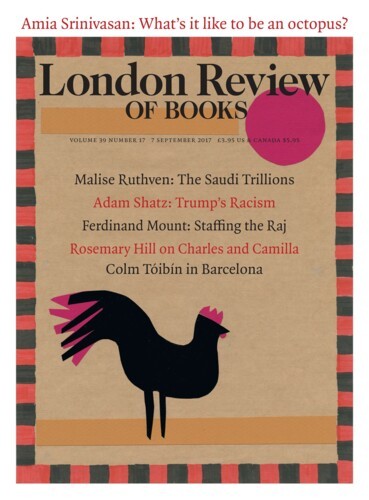
Colin Burrow, 7 September 2017

C hopping up literary activity into manageable portions of relatively similar material is, like butchery, a job that requires both skill and a measure of brutality. Of all the limbs into which literature has been subdivided by its anatomists, ‘lyric’ is perhaps the most like Grendel’s arm after Beowulf tears it off and hangs it up in Hrothgar’s hall: huge, a bit of a...

On Les Murray: Les Murray

Colin Burrow, 27 July 2017

Bunyah is​ a valley about 300 km north of Sydney in which the Australian poet Les Murray grew up, and to which he returned in 1985 as ‘my refuge and my homeplace’. Over-educated readers might imagine from its title that On Bunyah (Carcanet, £14.99) is a set of philosophical meditations which belongs on the shelves next to, say, John Stuart Mill’s On Liberty. But...

On Philip Terry

Colin Burrow, 13 July 2017

If the world​ of experimental poetry makes you think of pseudy dudes in black 501s and Doc Martens, then I would prescribe a small daily dose of Philip Terry, for whom being experimental chiefly means being thoughtfully rebellious and funny. In his translation of Dante’s Inferno (2014), Terry is guided through the hell that is the University of Essex (where he is professor of creative...

Don’t break that fiddle: Eclectic Imitators

Tobias Gregory, 19 November 2020

The boundary between the broader and narrower senses has never been firm, and the history of literary imitation has always been bound up with the histories of philosophy, rhetoric and education. Plato,...

Read more reviews

I must needs acknowledge, that the Greeke and Latine tongues, are great ornaments in a Gentleman, but they are purchased at over-high rate. Montaigne, Essays I  grew up​ in postwar...

Read more reviews

Mr Who He? Shakespeare’s Poems

Stephen Orgel, 8 August 2002

In his own time, Shakespeare was much better known to the reading public as a poet than as a playwright. Venus and Adonis went through ten editions before his death in 1616, and another six...

Read more reviews

Read anywhere with the London Review of Books app, available now from the App Store for Apple devices, Google Play for Android devices and Amazon for your Kindle Fire.

Sign up to our newsletters

For highlights from the latest issue, our archive and the blog, as well as news, events and exclusive promotions.

Newsletter Preferences