Andrew O’Hagan

Andrew O’Hagan is the LRB’s editor at large. He is the author of seven novels – Our Fathers, Personality, Be Near Me, The Life and Opinions of Maf the Dog, The Illuminations, Mayflies and Caledonian Road – and four books of non-fiction: The Missing, The Atlantic Ocean: Essays on Britain and America, The Secret Life: Three True Stories (which contains his LRB pieces on Julian Assange, creating a fake identity online and the search for Satoshi Nakamoto) and On Friendship.

His first piece for the LRB, a Diary about James Bulger’s murder and the cruelty of children to other children, appeared in 1993, when he was working as an editor at the paper (in 2010 he wrote about Jon Venables’s rearrest). He has written more than a hundred and fifty pieces for the LRB since then, on subjects including begging, the sinking of his grandfather’s ship, the murder of the Irish solicitor Rosemary Nelson, Marilyn Monroe and Arthur Miller, the end of British farming, Jonathan Franzen, hating football, Scotland’s sense of grievance, the Democratic and Republican National Conventions of 2004 and the Republican one of 2024, poetry anthologies, the 7/7 bombing outside the LRB’s old offices, the aftermath of Hurricane Katrina, what happens to our rubbish, a driving holiday with Seamus Heaney and the LRB’s first editor, Karl Miller, Jimmy Savile and the BBC, Norman Mailer, the Daily Mail, the Grenfell disaster, Robert Louis Stevenson in Bournemouth and in Edinburgh, old Soho, the New Romantics and Prince Harry.

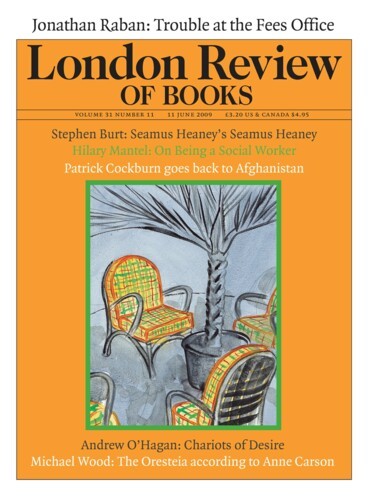
A Car of One’s Own: Chariots of Desire

Andrew O’Hagan, 11 June 2009

Those who spend most of their lives being alert to the demands of others – and that’s most employees, most husbands, wives, parents, most believers – will know the rhythmic, sedative pull of the motorways as the road performs its magic, pulling you back by degrees to some forgotten individualism that the joys and vexations of community always threatened to turn into an upholstered void. Virginia Woolf was almost right: all one really needs is a car of one’s own, the funds to keep it on the road and the will to encounter oneself within. Though most of those men aren’t listening to Virginia Woolf – they’re listening to Dylan’s Highway 61 Revisited.
From The Blog
16 May 2009

It turns out the Cold War did not end with either a bang or a whimper in Europe, but with a series of feeble melodies that come invested with the strongest doses of motherland prejudice and rivalry. Those who doubt it have not been paying attention to the Eurovision Song Contest, now in its 54th year, a competition whose chief virtue is to demonstrate the standard failure of political philosophy to rival sequins and bad music as an indicator of the moral outlook of nations. Forget Machiavelli, Edmund Burke, Voltaire, Marx, Lenin or Ortega y Gasset. The world-dominating perspectives of Italy, Ireland, France, Germany, Russia and Spain – to name but six of this year's 42 participating countries – are to be represented by assorted ragamuffins with plentiful false eyelashes and voices as dainty as a fortnight of shelling in Dubrovnik. Every year it gets madder, but 2009, which is being hosted by Russia, must surely be the biggest, campest carnival yet, with nations threatening by the half-hour to storm off or to scratch out the eyes of their neighbours, all in the name of peace, understanding and postwar unification.

Short Cuts: Susan Boyle

Andrew O’Hagan, 14 May 2009

Was there a time when people didn’t know what other people were thinking? I can vouch for the fact that there was: it lasted, roughly speaking, from the dawn of man until the launch of YouTube. In the 1970s, if you wanted to know what other people were thinking you might read a novel, but to do that you would have to make a journey to a bookshop or a library or borrow it from another...

Short Cuts: the Oscars

Andrew O’Hagan, 26 February 2009

It’s not easy to believe, but people used to think the Oscars didn’t matter. Now the hoopla takes up half a year, much longer if you take into account that many actors, writers and directors begin mugging for Oscars the moment they agree to a project. In previous times a respectable number of the nominees didn’t turn up at all, but now they would sooner be wheeled in...

Artovsky Millensky: The Misfit

Andrew O’Hagan, 1 January 2009

Even as late as the 1950s, at the height of his fame as a playwright, Arthur Miller would periodically leave his nice house to hang around the dockyards. He had worked for two years in the 1930s at a car parts warehouse, where he first encountered anti-semitism and suspicion. Reading Russian novels on his way into work, he found, when he considered it later, that the workers ‘feared his...

About a third of the way through his first book, The Missing, Andrew O’Hagan pauses over a perception he thinks his readers may find ‘a bit surprising’. It’s an intricate...

Read more reviews

Read anywhere with the London Review of Books app, available now from the App Store for Apple devices, Google Play for Android devices and Amazon for your Kindle Fire.

Sign up to our newsletters

For highlights from the latest issue, our archive and the blog, as well as news, events and exclusive promotions.

Newsletter Preferences