Adam Shatz

Adam Shatz is the LRB’s US editor. He is the author of Writers and Missionaries: Essays on the Radical Imagination, which includes many pieces from the paper, and The Rebel’s Clinic: The Revolutionary Lives of Frantz Fanon. He has written for the LRB on subjects including the war in Gaza, Fanon, France’s war in Algeria, mass incarceration in America and Deleuze and Guattari. His LRB podcast series, Human Conditions, considers revolutionary thought in the 20th century through conversations with Judith Butler, Pankaj Mishra and Brent Hayes Edwards. Sign up here.

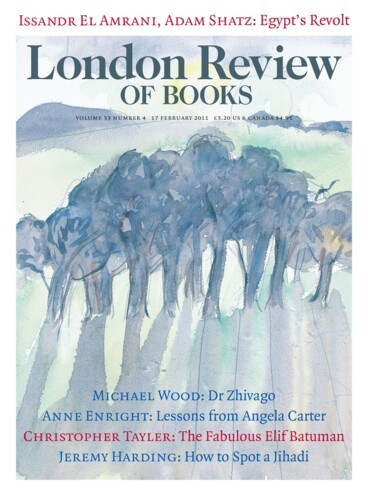
After Egypt

Adam Shatz, 17 February 2011

After the battle for Tahrir Square, the conceptual grid that Western officials have used to divide up the Islamic world into secular and religious forces, Western-friendly moderates and anti-Western extremists, good Muslims and bad Muslims, has never looked more inadequate, or more irrelevant. If the revolution in Egypt succeeds, it will have swept away not only a corrupt and autocratic regime, but the vocabulary, and the patterns of thought, that have underpinned Western policy in the greater Middle East for more than a half century.

After Mubarak

Adam Shatz, 17 February 2011

The Mubarak regime – or some post-Mubarak continuation of it – may survive this challenge, but the illusions that have held it in place have crumbled. The protests in Tahrir Square are a message not only to Mubarak and the military regime that has ruled Egypt since the Free Officers coup of 1952; they are a message to all the region’s autocrats, particularly those supported by the West, and to Washington and Tel Aviv, which, after spending years lamenting the lack of democracy in the Muslim world, have responded with a mixture of trepidation, fear and hostility to the emergence of a pro-democracy movement in the Arab world’s largest country.

From The Blog
11 February 2011

The demonstrations that have rocked Egypt for the last 18 days have turned into a nation-wide street party, and it is impossible not to be moved by the scenes of Egyptians celebrating their victory. The dictator who ruled Egypt for the last 30 years has been forced from office by non-violent, civil disobedience on a scale not seen since the 1979 revolution in Iran. And the principal agent of change – until today, when Mubarak stood down and the army took over – has been the Arab citizen, a striking change in a region where the romanticised figure of 'resistance' has been the soldier, the guerilla and, at times, the suicide bomber. At the White House press conference today, Obama and his press officer Robert Gibbs insisted that Egypt's revolution was really just about Egypt, but they knew better: Washington's policy during the crisis had been driven by fear of regional instability, and by the fears whispered into the administration's ears by Israel and the Saudis, and shifted only when Mubarak became a clear liability to American interests.The success of the Egyptian revolutionary model will be studied closely, and its lessons applied. The realisation of the Egyptian dream is the nightmare of Arab despots, and of Binyamin Netanyahu. But the revolution in Egypt is not over: in fact, it has only begun.

From The Blog
26 January 2011

Mahmoud, my driver in Cairo when I reported from Egypt last year, didn't talk much about politics, and – an understandable precaution – kept his views to himself unless he was asked a direct question. But when he dropped me off at the airport, he launched into a sharp attack on the Mubarak regime. 'The Egyptians are a very patient people by nature, but their patience is running out,' he said. 'They could explode.'

Desire Was Everywhere

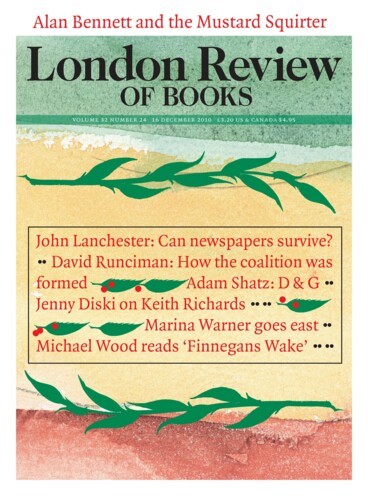
Adam Shatz, 16 December 2010

The ‘philosophy of desire’ was born in 1969, Serge Gainsbourg’s annéeérotique, when the radical psychoanalyst Félix Guattari met the philosopher Gilles Deleuze. Today, it’s hard to imagine them not knowing each other, and easy to forget how unlikely their partnership was. François Dosse begins his biography of the two men with their first...

Fanon’s world has a logic. His pages are full of identities, contradictions, Aufhebungen – master and slave, being and nothingness. Any biography, however, has to decide in the end which of the various...

Read more reviews

Read anywhere with the London Review of Books app, available now from the App Store for Apple devices, Google Play for Android devices and Amazon for your Kindle Fire.

Sign up to our newsletter

For highlights from the latest issue, our archive and the blog, as well as news, events and exclusive promotions.

Newsletter Preferences