
Adam Shatz

Adam Shatz is the LRB’s US editor. He is the author of Writers and Missionaries: Essays on the Radical Imagination, which includes many pieces from the paper, and The Rebel’s Clinic: The Revolutionary Lives of Frantz Fanon. He has written for the LRB on subjects including the war in Gaza, Fanon, France’s war in Algeria, mass incarceration in America and Deleuze and Guattari. His LRB podcast series, Human Conditions, considers revolutionary thought in the 20th century through conversations with Judith Butler, Pankaj Mishra and Brent Hayes Edwards. Sign up here.

From The Blog
3 November 2010

Last Sunday afternoon I was eating a pear – an overripe and dangerously juicy pear – on High Holborn, on my way to the gym. When the pear slipped from my hand onto the pavement I bent down to pick it up ('The streets are for people, not for trash,' my mother always said), only to be caught in the act by two old ladies who hadn't seen me eating it. One of them looked aghast as I fumbled with the pear, which by now had collected a fair amount of dirt. Transformed by her gaze into a bum, I became so self-conscious that the pear fell out of my hand again. Determined to bin it somewhere like a responsible citizen, I waited till they'd passed, and made one last, successful attempt to pick it up. Relief! Just then, she turned round to satisfy her curiosity and stared at the man furtively clasping a soiled, half-eaten pear. I was almost tempted to offer her a bite.

From The Blog
18 October 2010

The Lebanese braced themselves – some in excitement, others in dread – when Mahmoud Ahmadinejad’s visit was announced. Since the early 1980s, when the Iranian Revolutionary Guard helped to set up Hizbullah, Lebanon has been ‘the lung through which Iran breathes’ in the Arab world, as the late Grand Ayatollah Mohammad Hussein Fadlallah, an early mentor to Hizbullah, famously put it. That lung has developed into a mini-regional power – the only Arab army to have forced Israel to withdraw from Arab land, as Hizbullah often brags – and a major player in Lebanon’s highly sectarian, highly volatile political system, adored by its Shia followers and resented by many Sunnis and Christians.

From The Blog
15 October 2010

I understand why some people, including friends of mine, are confused; even I'm confused sometimes. (In some ways life must have been simpler when everyone was called John or Mary.) We have the same name, apart from that silent 'c', and we both like jazz. Not just jazz: the same kind of jazz. Adam Schatz is an avant-garde jazz promoter and concert organiser in New York. I used to cover that scene as a DJ at Columbia University and as a freelancer for the New York Times. Every so often I get emails praising my latest event; they make me wish I’d been there. Whether he also has an interest in Middle Eastern politics, or cooking, I'm too afraid to find out. Though I suppose I could: he's asked to be my friend on Facebook.

Short Cuts: Israel and Iran

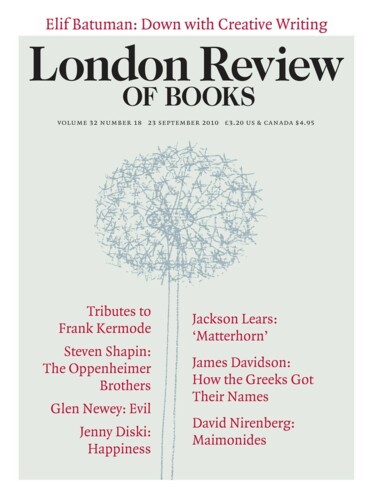
Adam Shatz, 23 September 2010

Israel is likely to launch a strike against uranium-enrichment sites in Iran within a year. Or so Jeffrey Goldberg reports in the current issue of the Atlantic Monthly. If the Iranians continue to defy the International Atomic Energy Agency and Obama refuses to pursue a more muscular punishment, he warns, an Israeli attack is a ‘near certainty’. Tony Blair, we must assume, would...

From The Blog
30 August 2010

Sam Tanenhaus, reviewing Jonathan Franzen's Freedom in the New York Times Book Review, writes: Liberals, no less than conservatives — and for that matter revolutionaries and reactionaries; in other words, all of us — believe some modes of existence are superior to others. But only the liberal, committed to a vision of harmonious communal pluralism, is unsettled by this truth. This is why a Ramsey Hill pioneer like Patty Berglund [one of Franzen's characters] will suffer torments of indecision when thinking how best to “respond when a poor person of color accused you of destroying her neighborhood.” If Tanenhaus weren't the editor of the Book Review, you'd wonder how this got past the editor.

Fanon’s world has a logic. His pages are full of identities, contradictions, Aufhebungen – master and slave, being and nothingness. Any biography, however, has to decide in the end which of the various...

Read more reviews

Read anywhere with the London Review of Books app, available now from the App Store for Apple devices, Google Play for Android devices and Amazon for your Kindle Fire.

Sign up to our newsletter

For highlights from the latest issue, our archive and the blog, as well as news, events and exclusive promotions.

Newsletter Preferences