Stephen Sedley

Stephen Sedley is a former judge of the High Court and the Court of Appeal, and visiting professor at Oxford.

Free speech for Rupert Murdoch

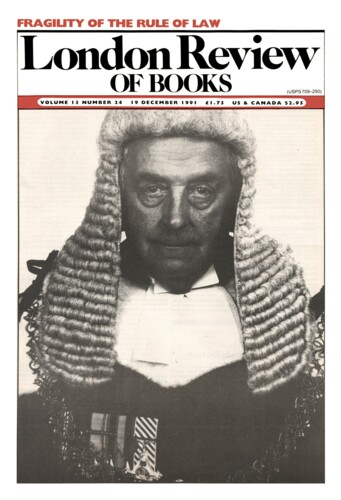
Stephen Sedley, 19 December 1991

It has taken 12 years of Thatcherism to disrupt the extraordinary complacency of the British about then civil liberties and their constitution. Our constitutional arrangements have never been much more than a matter of convention, and what passes for constitutional law has generally been a Panglossian description of the way things are. Our liberties are largely the product of a carry-over into the statism of the 19th and 20th centuries of procedures (notably jury trial) and rights (notably the integrity of person and property) created in an earlier period by a judiciary concerned to consolidate the transfer of power from monarch to entrepreneur. While these prized liberties were being imported and built on by newer nations, they were being continuously eroded in the land of their birth. While British workers led the way in founding unions, British judges led the way in outlawing them, until Parliament intervened. While British radicals and freethinkers spoke their minds, British judges devised new ways of silencing them. The Britain which in 1899 led the way in substituting reformation for punishment as the aim of imprisonment has since led the way in over-long sentences served in foul and overcrowded gaols. The foundation in 1934 of the NCCL was a barometric indication of the state of civil rights and the rule of law when Margaret Roberts was still a child.


Diary: On the Guildford Four

Stephen Sedley, 9 November 1989

At almost exactly the same time as the Police were fitting up the Guildford Four, Richard Nixon was discovering that a shredder was a far more important piece of equipment than a photocopier. Late-night shredding parties have since become a feature both of US Administrations and of certain industrial enterprises as the step of judicial investigation approaches. True, not even the shredder was able to keep the CIA’s records from the Ayatollah’s reconstruction brigade, though no doubt embassy equipment has now been upgraded to include incinerators. But the preservation by the Surrey Police of a series of drafts of the ‘voluntary’ confessions attributed to the Guildford Four beggars belief. Somehow the bureaucratic mentality which forbids ever throwing away a piece of paper seems to have triumphed not only over sedulous corruption but even over simple self-preservation.

Breaking the Law

Stephen Sedley, 18 May 1989

Connoisseurs of fine ironies will be slapping their thighs at the sight of the Bar and the Government with their teeth sunk in each other’s legs, the former egged on by the judiciary, the latter by Dennis Skinner. It’s a fair guess that three-quarters of the Bar are loyal Tory voters. Yet how many of them, and indeed of their colleagues in the centre and on the left, had understood that Thatcherism is not just a tougher brand of Conservatism? What patrician Tories despise as the mentality of the Grantham grocer (as their parents despised Hitler for his vulgarity rather than his politics) is in truth a gut ideology which has no time and no room for any power élite that claims its status as a matter of right. Privilege, inequality, selfishness, exclusivity: these are of course important values, but they are to be earned in a cut-throat marketplace, not gerrymandered in the collegiate seclusion of the Inns of Court.

Keeping mum

Stephen Sedley, 2 March 1989

‘There is among the many departments of our well-ordered state a department which would be known if we were Chinese as “The Board of Things to be Known and Not to be Known”.’ Hilaire Belloc, writing in 1925 a satire on England as he imagined it would be in 1953, accurately linked the mandarin élitism of the Civil Service with its determination to control the supply of public information. What is new in the present decade is the assumption of power by a government which shares this determination but which also has definite and disturbing ends in view. Nevertheless the formal processes of public dialogue are still in place, and White Papers and published Bills form a traditional part of them.

Letter

Missing Person

5 May 1988

I don’t think I have previously seen a reviewer admit to a mistaken criticism, accept that the facts are the opposite of what he has alleged and then apply to them an enhanced version of his original slight (Letters, 2 June). George Steiner’s interesting failure to notice Orwell among the writers listed by Margot Heinemann as having fought in Spain makes his references to party discipline...

At Sunday mass in my North London parish there was recently imposed a ‘New People’s Mass’. It came suddenly and without warning. One week, we were all enjoying versions of the...

Read more reviews

In a narrow pass

Derek Hirst, 19 November 1992

Stephen Sedley and Lawrence Kaplan seek to map a new course for the post-socialist Left, and to turn attention away from that beguiling but now exploded theme, egalitarianism. The long fixation...

Read more reviews

Read anywhere with the London Review of Books app, available now from the App Store for Apple devices, Google Play for Android devices and Amazon for your Kindle Fire.

Sign up to our newsletters

For highlights from the latest issue, our archive and the blog, as well as news, events and exclusive promotions.

Newsletter Preferences