R.W. Johnson

R.W. Johnson was a fellow in politics at Magdalen College, Oxford for many years before returning to South Africa, where he was brought up, in 1995. His books include The Long March of the French Left, How Long Will South Africa Survive? and Look Back in Laughter: Oxford’s Postwar Golden Age. He died in July 2026 at the age of 82.

Who’ll man the fax?

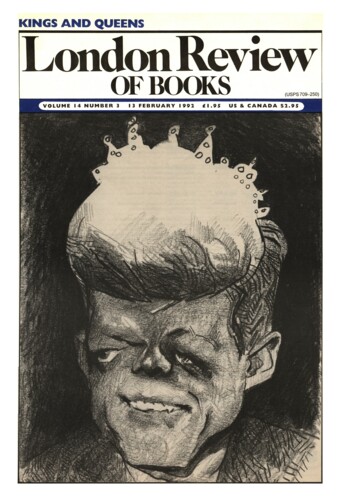
R.W. Johnson, 13 February 1992

One of the great lessons of the Nineties is that democracy can be a doomsday machine: some states – Yugoslavia, East Germany, the Soviet Union – are unable to survive its coming. This may be the year in which we see whether South Africa is one of those that can. With the launching of Codesa – the Convention for a Democratic South Africa, whose first plenary session was held on 20-21 December – the march towards a democratic, non-racial South Africa has entered its climactic phase. Nineteen of the country’s political groups attended, but ominously, the absentees included the extreme Africanist Left – the PAC (Pan-Africanist Congress) and AZAPO (Azanian People’s Organisation) – and, perhaps more significantly, Treurnicht’s Conservative Party and such far-right groups as Terreblanche’s AWB. ‘More significantly’, because the white Right may now command 40 or 50 per cent of the white electorate and because these whites are often armed to the teeth. Currently, at least, the PAC and AZAPO lack that sort of political and military firepower. On the other hand, some of those who did attend, such as the generally unelected Bantustan oligarchs and the various Asian groups, represent comparatively little. Nonetheless, the summoning of Codesa – its working parties are in session now and will report to another plenary meeting in March – represented a great day in South African history. The road ahead is studded, no doubt, with symbolic walkouts, furious ultimata and all the other necessary histrionics of a meeting, called after centuries of oppression and exclusion, to re-found a great and divided country. But no one, after all, is going to die of histrionics: the real dangers lie elsewhere.’
What Buthelezi wants

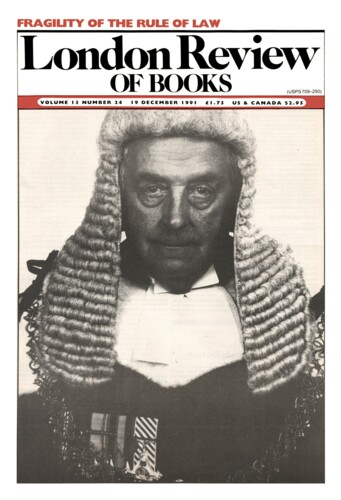
R.W. Johnson, 19 December 1991

As multi-party negotiations on a new constitution for South Africa get under way at last, there is a widespread impression that what is really in prospect is a two-party deal between the Government and the ANC. Of the many groups this leaves out of account, Chief Buthelezi’s Inkatha movement is the most significant. In preparation for this new phase, Inkatha has transformed itself from a ‘national cultural movement’ into the Inkatha Freedom Party.

Letter

Not even a member

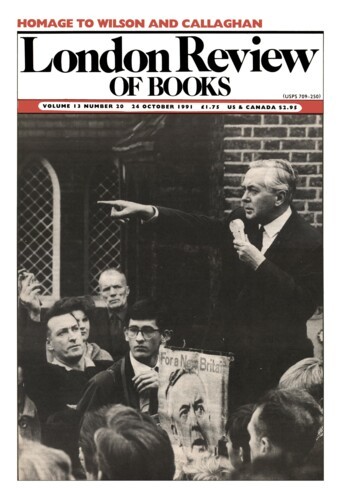
24 October 1991

I am sorry to have upset Gillian Slovo (Letters, 5 December). In fact, she criticises me for things I didn’t say. I did not say she was a member of the SACP, let alone ‘a leading cadre’, and I certainly never argued that ‘what a woman’s father and grandfather do must obviously determine who she is.’ The point I did make – that the SACP is in part bound together...

Hearing mention of an old friend who is a long-time stalwart of the South African Communist Party, I enquired how he was. ‘Oh, the same as the rest of them,’ our mutual acquaintance replied. ‘You know – clinging onto his collapsing world view as best he can.’ The man in question holds a powerful position within the ANC and is spoken of by some as a possible future cabinet minister: in that sense his world is hardly collapsing. But his case exemplifies the strange paradox of the SACP, a paradox which has become all the sharper in the wake of recent events in the USSR.’

Aids in South Africa

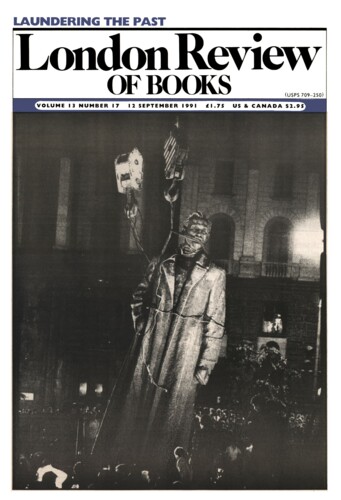
R.W. Johnson, 12 September 1991

An Aids epidemic is coming to South Africa. The countries with the highest Aids incidence in the world are grouped in East-Central Africa – Burundi, Tanzania, Uganda and Malawi are probably the greatest sufferers of all – and gradually the virus has been making its way southwards. It has indeed been possible to work out South Africa’s ‘HIV prevalence lag time’: nine years behind Burundi, eight behind Tanzania, Uganda and Malawi, seven behind Zaire, Zambia and Rawanda, five behind Kenya and Angola – and so on. South Africa has been protected not only by its position on the continent’s southern tip, but by its social and economic isolation: trade sanctions and the inhibitions on tourism have been an ill wind blowing some good. However, 60 per cent of the world’s Aids victims are to be found in Africa – and there is no prospect of South Africa avoiding the scourge.’

Bristling Ermine: R.W. Johnson

Jeremy Harding, 4 May 2017

R .W. Johnson​ is a long-standing contributor to the LRB. His first appearance was on the letters page in 1981, where he took ‘mild issue’ with a review of his most celebrated book,

Read more reviews

Anyone in South Africa, white or black, rich or poor, who reads R.W. Johnson’s new book could be forgiven for rushing to the airport. It’s a familiar tale of African hopelessness,...

Read more reviews

Making things happen

Ross McKibbin, 26 July 1990

This Johnson is an energetic essayist. His energy is not simply physical, though he has plenty of that: it is mental too. He seems to write quickly – how else the productivity? – but...

Read more reviews

The scandal that never was

Paul Foot, 24 July 1986

Profound embarrassment has greeted the publication of R.W. Johnson’s book on the shooting-down of a Korean airliner over Russian airspace. Even its serialisation in the Sunday Telegraph...

Read more reviews

Downhill

David Marquand, 19 September 1985

As late as 1951, the British economy was the strongest in Western Europe. Only the wartime neutrals, Sweden and Switzerland, surpassed us in income per head. In his magisterial new history of the...

Read more reviews

Althusser’s Fate

Douglas Johnson, 16 April 1981

‘Is it easy to be a Marxist?’ Louis Althusser put this question to a crowded audience at the University of Picardy in 1975. Is it possible to be an Althusserian? The question has to...

Read more reviews

Read anywhere with the London Review of Books app, available now from the App Store for Apple devices, Google Play for Android devices and Amazon for your Kindle Fire.

Sign up to our newsletters

For highlights from the latest issue, our archive and the blog, as well as news, events and exclusive promotions.

Newsletter Preferences