R.W. Johnson

R.W. Johnson was a fellow in politics at Magdalen College, Oxford for many years before returning to South Africa, where he was brought up, in 1995. His books include The Long March of the French Left, How Long Will South Africa Survive? and Look Back in Laughter: Oxford’s Postwar Golden Age. He died in July 2026 at the age of 82.

Lions, Princes, Bosses

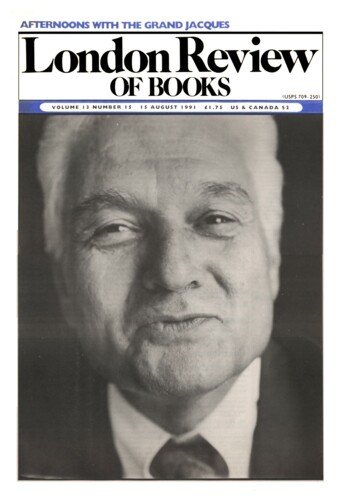
R.W. Johnson, 15 August 1991

A year ago you could probably have got odds of 100-1 against the proposition that the man chosen to open the ANC’s first national conference back in South Africa would be Jacob Zuma, the frequently feared chief of intelligence of the ANC’s guerrilla arm, Umkhonto we Sizwe (MK). But supreme among Mr Zuma’s qualities is the fact that he is one of the rare Zulus in the ANC’s leadership, a status which quickly earned him promotion to head of the ANC’s Southern Natal region, which includes Durban. From this position he earned a reputation as a charming and moderate diplomat in the tricky negotiations with Buthelezi’s Inkatha movement. Welcoming delegates to the ANC’s Durban conference, Mr Zuma caused minor gasps by talking of how Shaka Zulu, virtually Inkatha’s patron saint, had had ‘his own ideas of how to build a nation’ (essentially, conquest, mass murder and forced assimilation). He also reminded delegates that ‘everyone has wished this conference well; no one who has spoken of it has spoken against it’ – a scarcely veiled reference to Buthelezi and a hint that it would be as well to avoid furious denunciations of the chief in his own backyard.
President de Klerk’s further instalment of reform leaves no doubt that South Africa is moving away from the era of apartheid at some speed. His speech follows hard on a truce agreement between the ANC and Inkatha – the first step towards ending a conflict which has cost some five thousand lives in Natal and on the Reef since 1985. Whether the truce will hold and whether it will stem the creeping ethnicisation of black politics remains to be seen. But Mandela’s public embrace of Buthelezi has inaugurated a new and intense phase of politicking within and between the two organisations. With Inkatha now poised to play a major role alongside the ANC in the negotiations for a new constitution, it will in any case be harder for conventional radical opinion to maintain its simple demonisation of Inkatha and its leader.’

Further Left

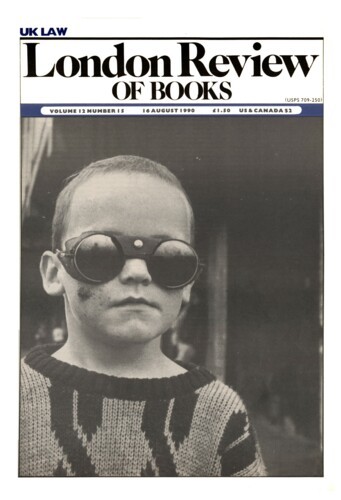
R.W. Johnson, 16 August 1990

Many years ago it was the habit of the PPE tutors in Magdalen College, Oxford to hold a discussion group for their undergraduates. At one such meeting we were somewhat disconcerted to find we had been gatecrashed by an extremely loud and talkative outsider of Marxist bent who laid down the law about everything, referred to the dons as ‘comrade’ – he did not know my name, so I was ‘the red-headed comrade’ – and rather capsized the whole evening. Not long after, the discussion group was disbanded. The gatecrasher’s name, we learnt, was Christopher Hitchens, and he apparently did this sort of thing rather often, being famous for a sort of pyrotechnic brashness. Looking back, one realises that these were entirely apposite qualities for the successful journalist, which is very much what Hitchens has become.’

At an enormous ‘peace’ rally in Durban at the end of February Nelson Mandela called upon the warring Inkatha and UDF factions to ‘throw your arms into the sea’, an appeal which met with considerable applause. Perhaps the loudest ovation of all, however, came when Mandela announced, at the meeting’s end, that he had ‘a wonderful present’ to offer the crowd – ‘the mother of the nation’. This was not, as it might once have been, an introduction to Winnie Mandela – who sat silently by – but to a frail old lady of 86, the widow of the former ANC leader and Nobel Peace Prize-winner, Chief Albert Luthuli. It was a master card to play, not merely because of the continuing public ambivalence towards Winnie, but because Chief Albert Luthuli still occupies a special place in the hearts of the predominantly Zulu crowd, irrespective of whether they were ANC or Inkatha supporters. Luthuli had been a dignified, almost saintly man, who died in restriction, his movement banned.’

Letter
I’m sorry to have offended Robin Blackburn by my article on Raymond Williams (Letters, 8 March). Robin is wrong to talk of my ‘animus’ against Williams. I had and have none. As I said in my review, he was clearly a nice, gentle and generous man, and I have no doubt that his political writings, defective though I think them, stemmed from noble instincts, that his heart was, as they...

Bristling Ermine: R.W. Johnson

Jeremy Harding, 4 May 2017

R .W. Johnson​ is a long-standing contributor to the LRB. His first appearance was on the letters page in 1981, where he took ‘mild issue’ with a review of his most celebrated book,

Read more reviews

Anyone in South Africa, white or black, rich or poor, who reads R.W. Johnson’s new book could be forgiven for rushing to the airport. It’s a familiar tale of African hopelessness,...

Read more reviews

Making things happen

Ross McKibbin, 26 July 1990

This Johnson is an energetic essayist. His energy is not simply physical, though he has plenty of that: it is mental too. He seems to write quickly – how else the productivity? – but...

Read more reviews

The scandal that never was

Paul Foot, 24 July 1986

Profound embarrassment has greeted the publication of R.W. Johnson’s book on the shooting-down of a Korean airliner over Russian airspace. Even its serialisation in the Sunday Telegraph...

Read more reviews

Downhill

David Marquand, 19 September 1985

As late as 1951, the British economy was the strongest in Western Europe. Only the wartime neutrals, Sweden and Switzerland, surpassed us in income per head. In his magisterial new history of the...

Read more reviews

Althusser’s Fate

Douglas Johnson, 16 April 1981

‘Is it easy to be a Marxist?’ Louis Althusser put this question to a crowded audience at the University of Picardy in 1975. Is it possible to be an Althusserian? The question has to...

Read more reviews

Read anywhere with the London Review of Books app, available now from the App Store for Apple devices, Google Play for Android devices and Amazon for your Kindle Fire.

Sign up to our newsletters

For highlights from the latest issue, our archive and the blog, as well as news, events and exclusive promotions.

Newsletter Preferences